5:33
They said to him, ‘Why do the disciples of John fast often and offer prayers, and likewise the disciples of the Pharisees, but yours eat and drink?’
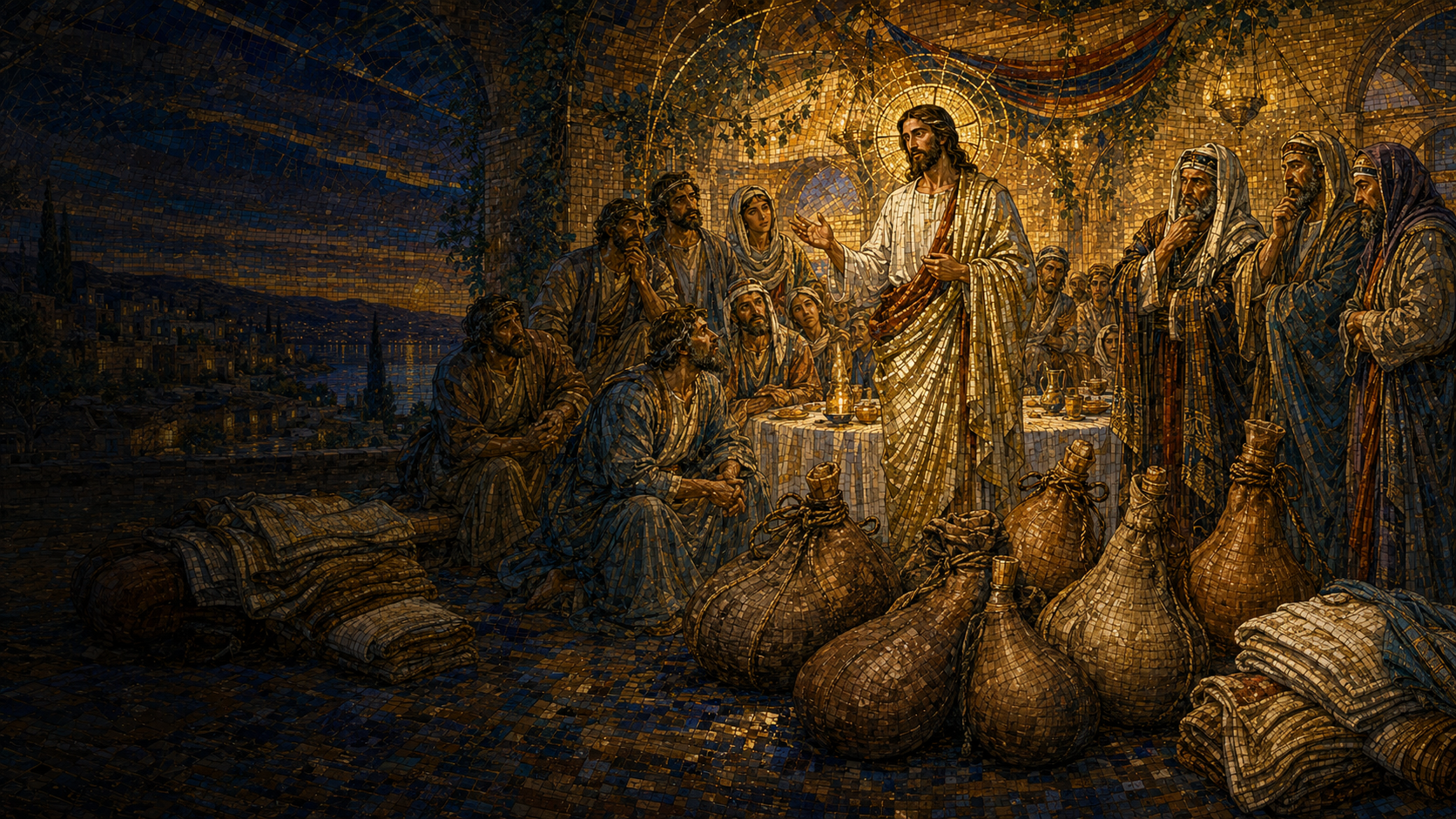
Luke 5:33–39
Today’s interpretive key
Jesus reveals himself as the Bridegroom whose presence makes discipleship a feast, yet whose departure will give fasting its proper hour. His new wine does not decorate an unchanged life: grace renews the person who receives it, while patiently overcoming our attachment to familiar ways.
The question sounds disciplined: others fast, so why do Jesus' disciples eat and drink? Yet Christ answers by revealing that faithful practice must be understood through his presence. He is the Bridegroom, and the disciples are living within the joy of a wedding feast. The Fathers do not dismiss fasting. Cyril of Alexandria honors it as a means of restraining the passions, and Augustine distinguishes the fast of sorrow from the deeper abstinence by which spiritual delight loosens the grip of temporal pleasures. But no practice can be judged rightly while ignoring who Christ is and what hour his saving work has reached. The Bridegroom will be taken away, and then grief, prayer, and fasting will have their appointed place. Jesus extends the lesson through cloth and wine. The Gospel is not a patch attached to an unreformed life, nor can the fervor of faith, hope, and charity simply be contained within habits hardened against grace. Augustine sees the disciples themselves being prepared as new wineskins through prayer, hope, and the gift of the Holy Spirit. Bede sees outward good works in the garment and inward spiritual life in the wine. Renewal therefore reaches both conduct and desire. The final saying recognizes how strongly the familiar taste holds us: the old feels better simply because it is known. Christ neither flatters that resistance nor forces novelty as fashion. He calls for a heart made supple enough to receive the living gift without losing either the wine or the vessel.
Douay-AI, modernized from the public-domain Douay-Rheims Bible. View source ↗
They said to him, ‘Why do the disciples of John fast often and offer prayers, and likewise the disciples of the Pharisees, but yours eat and drink?’
He said to them, ‘Can you make the children of the bridegroom fast while the bridegroom is with them?’
Cyril describes the Saviour's appearing as a great spiritual festival: human nature, formerly barren, is joined to Christ as a bride and made fruitful. Those called into his new evangelical way are therefore children of the Bridegroom. Chrysostom draws the practical conclusion that an hour of gladness should not be confused with an hour of mourning. Augustine adds that fasting can arise either from tribulation over sin or from joyful freedom as spiritual goods become sweeter than bodily ones. Jesus' answer orders both forms around himself. Discipline is not abolished, but the Bridegroom's presence determines what response is fitting now.
But the days will come when the bridegroom shall be taken away from them; then they shall fast in those days.
Augustine hears Christ foretelling the desolation his disciples will suffer when the Bridegroom is taken from them. Their sorrow will seek expression in fasting and lamentation until consolation is restored through the Holy Spirit. Cyril likewise treats the coming fast as an appointed response after the spiritual feast of Christ's visible presence. Ambrose guards the saying from becoming merely chronological: Christ promises to remain with his Church, so separation also occurs whenever sin draws a person away from him. Fasting then becomes more than deprivation of food. It is embodied longing, repentance, and a deliberate return toward communion with the Bridegroom.
He also spoke a parable to them: ‘No one puts a piece from a new garment upon an old garment; otherwise, he both tears the new, and the piece taken from the new does not agree with the old.’
Augustine connects the new cloth with the teaching of a spiritually renewed life. Its discipline is comprehensive: it loosens attachment not only to pleasant food but to every temporal delight that rules the heart. If one fragment is imposed upon people still devoted to their former habits, the teaching seems torn from its whole and cannot agree with the life beneath it. Ambrose similarly warns against mixing the actions of the old person with those of the new. Christ is not offering a religious patch that leaves the underlying garment untouched. Grace forms a coherent way of life whose outward practices belong together.
No one puts new wine into old wineskins; otherwise, the new wine will burst the wineskins, and it will be spilled, and the wineskins will be lost.
Gregory of Nyssa begins with the natural energy of newly drawn wine, whose warmth drives an active process within it. He sees this as an image of the new covenant: its teaching carries an excellence that old, unbelieving vessels cannot contain. The obstacle is not a defect in the wine but a soul unreceptive to divine wisdom, so the grace offered fails to bear fruit there. Augustine applies the image first to the apostles, who could not yet bear the full force of spiritual precepts. Christ prepares vessels as well as giving wine; renewal must accompany the gift if both are to endure.
But new wine must be put into new wineskins, and both are preserved.
Augustine says the apostles became new wineskins after the Lord's ascension, when desire for Christ's consolation renewed them through prayer and hope and they received the Holy Spirit. The command therefore concerns preparation, not novelty for its own sake. Bede identifies the wine with the inward fervor of faith, hope, and charity, while the garment represents good works visible outwardly. Grace renews the inner capacity from which faithful action flows. The final phrase matters: both wine and wineskins are preserved. God's gift does not erase the person who receives it; it heals and strengthens that person to hold a life previously beyond natural capacity.
No one who has drunk old wine immediately desires new, for he says, ‘The old is better.’
Bede reads the old wine as the familiar life and inherited traditions to which Christ's hearers had become attached. Because their taste was already formed, they rejected the precepts of new grace and could not perceive the sweetness of spiritual teaching. Jesus' word recognizes that conversion meets real resistance: what is customary often feels better simply because it is known. Yet familiarity is not the measure of truth. The saying calls for patience without complacency. The heart must be renewed enough to taste what grace gives, rather than judging the Gospel solely by preferences established before the Bridegroom was welcomed.
Jesus does not answer a question about fasting with a convenient exemption. He gives the practice its center. When the Bridegroom is present, the fitting response is joy; when he is taken away, fasting becomes a truthful expression of longing. Christian discipline is therefore neither performance nor self-improvement. It is a response to communion with Christ and to the ache of whatever separates us from him. Ask what your habits are actually serving. A practice can look rigorous while avoiding love, and a celebration can look free while refusing sacrifice. Both feast and fast become holy when they draw their meaning from the Lord. The images of cloth and wine press the question further. Grace cannot remain a small religious patch on an otherwise guarded life. Christ brings a newness that reaches the whole garment and requires a vessel made ready to receive it. This renewal is not contempt for creation, history, or patient formation. Jesus even acknowledges the force of acquired taste: those accustomed to the old do not immediately desire the new. Conversion often includes this resistance. Familiar patterns feel safe even when they cannot hold the life God gives. Bring that reluctance honestly into prayer. Let fasting loosen attachments, hope stretch the heart, and charity make it supple. Do not ask the Gospel merely to preserve every settled preference. Ask the Holy Spirit to renew the vessel so that the wine is not spilled and the person receiving it is preserved.
Read the source Catena Aurea ↗
Cyril says the questioners move from criticizing Christ's table fellowship to challenging his disciples' lack of fasting. Their comparison assumes that visible austerity proves fidelity to the law. Cyril does not belittle fasting: holy people use bodily discipline to restrain disordered passions. Yet Christ does not need fasting to conquer passions, because as God he is wholly free from them. His disciples, meanwhile, are being strengthened by sharing his grace. Their conduct must therefore be read from the presence and action of Christ, not measured by an external comparison that ignores who stands among them.