6:1
And it happened on the second-first sabbath that, as he went through the grainfields, his disciples plucked the ears of grain and ate them, rubbing them in their hands.
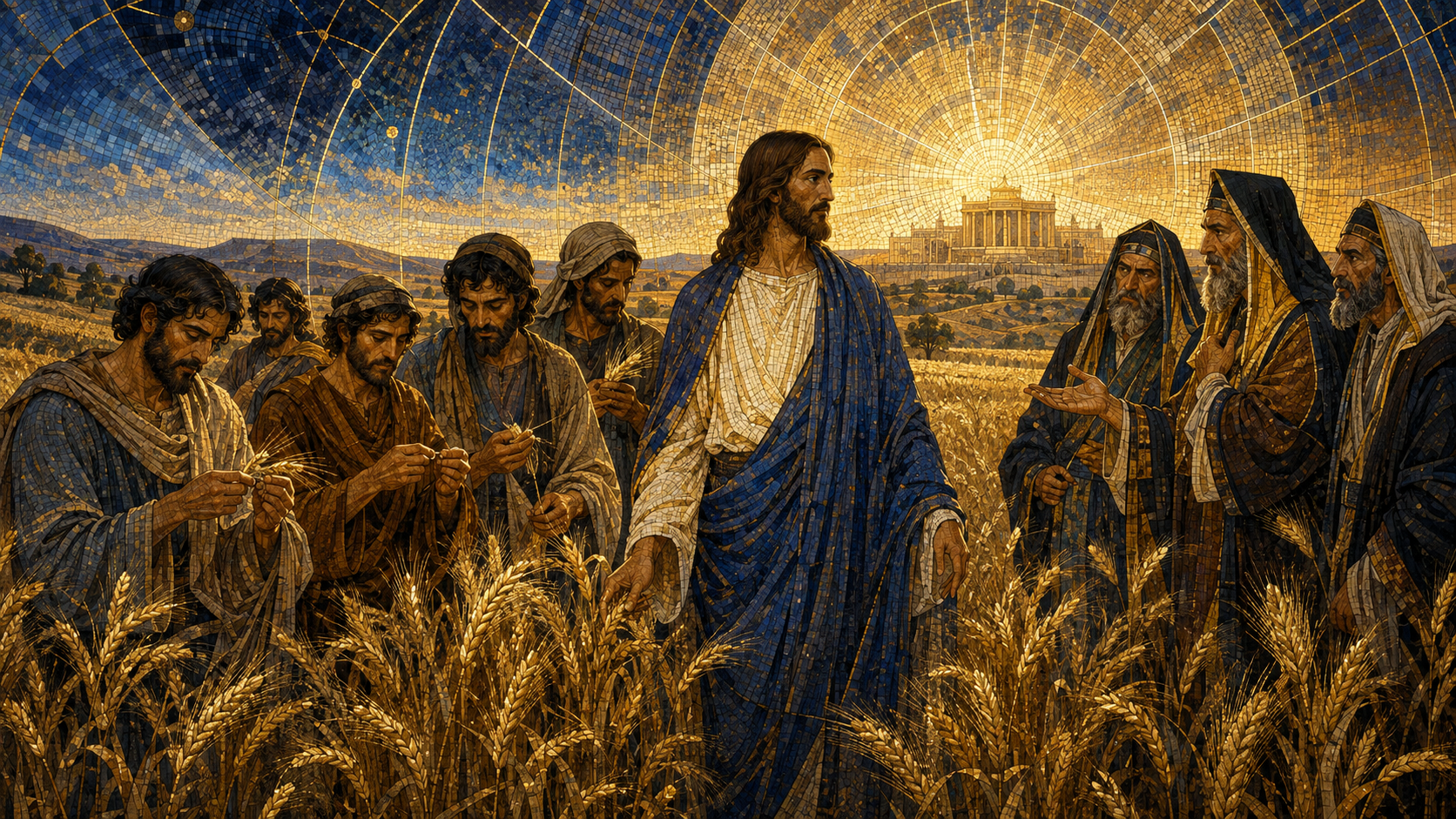
Luke 6:1–5
Today’s interpretive key
Jesus reveals the sabbath as God's gift rather than a weapon against the hungry. By recalling David and the sacred bread, he exposes a judgment that knows the rule but misses its purpose; by declaring himself Lord of the sabbath, he identifies the divine authority from which holy rest receives its meaning.
A small act of hunger becomes a test of how Scripture is read. The disciples take no prepared feast from the grainfield. They pluck a few ears, rub away the husks, and eat as they walk. Yet some Pharisees see only a forbidden action. The Fathers gathered in the Catena Aurea attend closely to this contrast. Bede sees the disciples' simple food as evidence of a disciplined life: crowded by the multitude and without opportunity to eat, they satisfy necessity with what the field provides. Cyril of Alexandria points out the accusers' inconsistency, since even on the sabbath they themselves break and eat bread at table. Jesus then recalls David, hungry and pursued, receiving the bread of proposition reserved by law for priests. The appeal does not make holiness unimportant. It shows that the law must be judged according to the righteousness and mercy God placed within it, not applied with partiality against Christ's disciples. Ambrose sees in David's action a figure of the sacred bread coming to nourish God's people and of the Church offering herself as a spiritual sacrifice. Theophylact finally reaches the center: Christ can speak with authority about the sabbath because he is its legislator. His words are more than a defense of his companions. The Son of Man stands within human need and at the same time above the command as its Lord. Sabbath observance finds its truth in him: rest from sin, reception of God's gifts, and mercy toward the person whom the law was given to serve.
Douay-AI, modernized from the public-domain Douay-Rheims Bible. View source ↗
And it happened on the second-first sabbath that, as he went through the grainfields, his disciples plucked the ears of grain and ate them, rubbing them in their hands.
Some of the Pharisees said to them, ‘Why do you do what is not lawful on the sabbath days?’
Cyril says the Pharisees and scribes find fault because they do not understand the Scriptures they claim to defend. He challenges their inconsistency with an ordinary question: when a table is set before them on the sabbath, do they not also break bread? The disciples' small act is treated as unlawful while comparable actions in the accusers' own lives pass unnoticed. Cyril's point is not that the sabbath lacks authority, but that interpretation must be truthful and impartial. Zeal for the command becomes corrupt when it is used selectively to condemn Christ's companions.
Jesus answered them: ‘Have you not read even this, what David did when he was hungry, he and those who were with him:
Cyril recalls Moses' command to judge righteously and without respect of persons. The accusers praise David as saint and prophet, yet they condemn Jesus' disciples without allowing hunger or the scriptural precedent to shape their judgment. Christ's question therefore uncovers more than incomplete recollection. They know David's honor but fail to apply the same measure when those standing near Jesus are accused. Scripture is not rightly read when familiar saints receive generous interpretation and present neighbors receive only suspicion. The Lord calls them from partiality to a judgment consistent with the law itself.
how he entered the house of God, took and ate the bread of proposition, and gave it to those who were with him, which is not lawful for anyone to eat except the priests?’
Ambrose reads David's escape with his companions as a figure pointing toward Christ and the apostles. The bread reserved for priests comes into the hands of the hungry, foreshadowing sacred nourishment given to God's people and the Church's calling to offer herself as a spiritual sacrifice. His conclusion is careful: because the sabbath was made for humanity, genuine need does not simply shatter the command. When hunger requires relief after long deprivation, the law is fulfilled according to its purpose. Holiness and mercy are not rivals when both are received within God's saving design.
And he said to them, ‘The Son of Man is Lord also of the sabbath.’
Theophylact hears Christ declare that he is Lord of the sabbath because he is the one who established it. As legislator, he possesses authority over the command and can reveal its true application. His title, Son of Man, does not reduce that authority: the Son of God wondrously condescended to become human and to bear this name for humanity's sake. Chrysostom adds that the sabbath was made for the human person, not the person for the sabbath. The command therefore remains subject to its divine Lord and ordered toward the good he intends for those who receive it.
The Pharisees' question is not wrong because obedience is trivial. It is wrong because their judgment isolates an action from hunger, mercy, Scripture, and the identity of Jesus. A rule meant to order life toward God becomes, in their hands, a charge against people taking the simplest food. Christ answers by bringing the whole law back into view. David's hunger did not make sacred things profane; within God's providence, the consecrated bread sustained him and his companions. The episode asks whether our own judgments reflect the lawgiver's purpose or merely our ability to identify an infraction. Holy rest is not indifference to commandments, and mercy is not permission to reshape truth at will. Both meet in Christ. He is the Son of Man who shares human weariness and need, and he is the Lord who possesses authority over the sabbath. Let him examine the way you use religious knowledge. Does it make you more attentive to the hungry, more honest about your own inconsistencies, and more capable of righteous judgment? Or does it provide distance from those whose circumstances you have not bothered to understand? The disciples' handfuls of grain reveal that strict appearances can conceal a failure of charity. Bring necessity, work, worship, and rest beneath Christ's lordship. Ask him to free you from anxious fault-finding and from the opposite temptation to empty obedience of meaning. In him, the command becomes what God intended: a gift that turns us from servile works, teaches trust, and makes room for worship and mercy.
Read the source Catena Aurea ↗
Bede explains that the disciples had no opportunity to eat because the crowds continually pressed around Jesus. When hunger overtook them, they did not seek a prepared meal or rich food; they plucked grain and rubbed it in their hands. For Bede, this simplicity reveals a disciplined manner of life rather than disregard for holiness. Their action is governed by necessity and restraint. The scene therefore asks the reader to notice the human reality before issuing judgment: men serving beside Christ relieve genuine hunger with the modest provision available along their path.