5:1
And it came to pass that, as the multitudes pressed around him to hear the word of God, he stood by the lake of Genesareth.
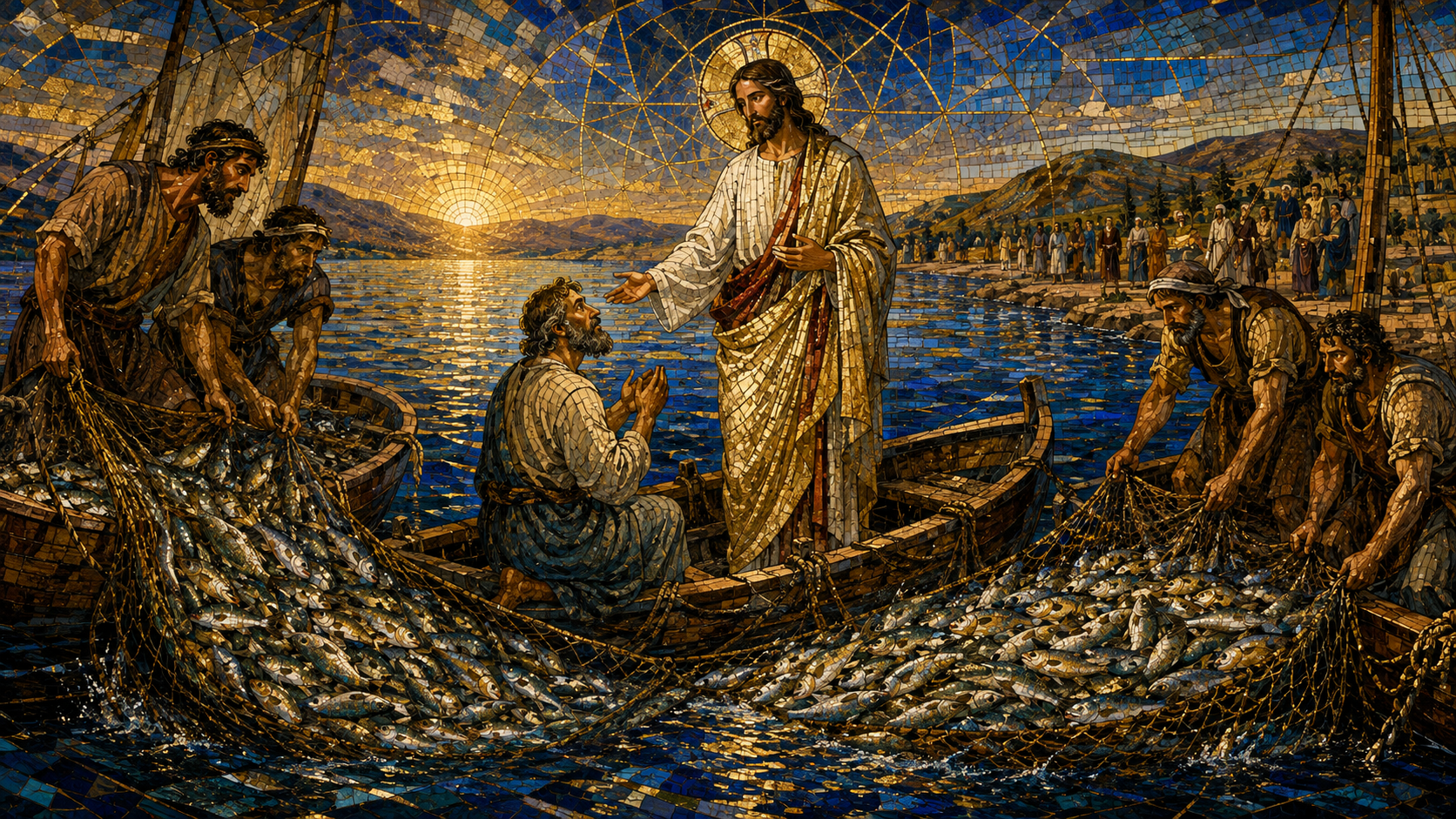
Luke 5:1–11
Today’s interpretive key
Christ enters Simon's ordinary work, commands trust beyond visible results, and turns an impossible catch into a call. Divine abundance awakens humility, gathers companions, and frees the fishermen to leave every security for the Lord who will make them fishers of men.
Luke brings the crowd to the water's edge, where Christ transforms a fisherman's boat into a place of teaching and a night of failure into the threshold of vocation. Nothing in the scene begins with human success. Simon and his companions have worked until morning and caught nothing; their washed nets testify that the effort is over. Yet Jesus asks first for the boat, then for deeper water, and finally for the nets to be lowered again. The Fathers see in this sequence the gracious way Christ enters human work and redirects it. Theophylact praises both the gentleness with which Jesus asks and the willingness with which Simon yields. St Ambrose sees the apostolic net as the ordered words of preaching, which do not destroy those caught but raise them from dangerous depths into life. The immense catch therefore reveals more than mastery over the lake. It anticipates a mission that cannot be achieved by skill or eloquence alone. Simon's obedience rests on Christ's word precisely where experience offers no encouragement. When abundance comes, it does not inflate him. He falls at Jesus' knees, confesses his sin, and discovers that holy fear is answered by a call rather than rejection. The boats reach land full, but the fishermen leave everything. The greater gift is not the catch they can possess; it is the Lord they can follow and the work by which others will be gathered into life.
Douay-AI, modernized from the public-domain Douay-Rheims Bible. View source ↗
And it came to pass that, as the multitudes pressed around him to hear the word of God, he stood by the lake of Genesareth.
He saw two ships standing by the lake, but the fishermen had gone out of them and were washing their nets.
Theophylact says that Christ avoids glory the more it pursues him, separating himself from the press of the crowd by turning toward the boats. The fishermen have stepped ashore and are washing their nets, so the scene carries the stillness of labor apparently finished. Bede reads the fishermen as an image of teachers in the Church and the nets as the discipline of faith. Nets are sometimes spread for a catch and sometimes washed and folded; likewise, a teacher must know when to speak and when to be formed in silence. Christ enters both the work and its necessary intervals.
Going into one of the ships, which was Simon's, he asked him to draw back a little from the land. And sitting down, he taught the multitudes from the ship.
Theophylact draws attention to Christ's gentleness: he asks Simon to move the boat, while Simon shows readiness by obeying. Chrysostom then sees the scene as sacred irony. Jesus sits upon the water and, while appearing to address those on shore, begins to fish for people through his teaching. Augustine reads Simon's boat as an image of the Church, from whose ordered life the Gospel reaches the nations. Before Simon receives the miraculous catch or hears his vocation, he offers Christ a small practical service. The borrowed boat becomes a place where divine teaching can be heard clearly.
When he had ceased speaking, he said to Simon, ‘Launch out into the deep, and let down your nets for a catch.’
Cyril observes that Christ returns from teaching to mighty works and employs fishing itself to fish for his disciples. He does not call Simon away from his craft by despising it; he enters it and gives it a new direction. Ambrose hears a further spiritual depth in the singular command to Simon: launching out signifies entering the profound knowledge of the Son of God. The apostolic nets are interwoven words of proclamation, fitted to lift people from the unstable depths into life. The command therefore joins a real catch on the lake with the future labor of preaching.
Simon answered him, ‘Master, we have labored all night and have taken nothing; but at your word I will let down the net.’
Theophylact stresses what Simon does not say. He does not refuse more labor, defend his expertise, or complain that the command is unreasonable after a fruitless night. He states the failure truthfully and then acts because Jesus has spoken. Ambrose sees in the empty night a sign that apostolic fruit does not arise from human eloquence by itself but from divine calling. This keeps Simon's obedience from becoming a technique for forcing success. He supplies the labor and lowers the net, but the efficacy belongs to Christ's word. Faith works precisely where self-reliance has reached its limit.
When they had done this, they enclosed a very great multitude of fishes, and their net broke.
Cyril calls the miracle an image of the future: those who let down the net of Gospel doctrine will not labor in vain but will gather multitudes from among the nations. The abundance belongs to Christ, who commands both the mission and its fruit. Augustine carefully distinguishes this broken net from the unbroken net in John's post-resurrection account, warning us not to collapse different Gospel signs into one. Here the strain and breaking point toward the mixed and pressured life of the Church in history. Grace gathers more than the fishermen can manage, and its very abundance exposes the need for vigilance and unity.
They beckoned to their partners in the other ship to come and help them. They came and filled both ships, so that they were almost sinking.
Cyril interprets Simon's signal as an image of shared apostolic labor. The first witnesses are joined by evangelists, shepherds, and teachers skilled in handing on the truth; no single worker claims the whole catch. Bede sees the second boat as the Church among the Gentiles, filled alongside the first because the Lord knows all who are his. Yet the heavily laden boats also carry a warning. Bede says they do not actually sink, though they come into danger when those called from the world fall back toward its habits. Mission requires both generous cooperation and watchful perseverance.
When Simon Peter saw this, he fell down at Jesus' knees, saying, ‘Depart from me, for I am a sinful man, O Lord.’
Bede notes that Peter's wonder at the divine gift deepens his fear and reduces his presumption. The catch does not persuade him that he is exceptional; it brings him to his knees. Cyril explains that Peter recalls his sins and, formed by the law's distinction between holy and defiled, trembles before the one who is clean. His request that Jesus depart is therefore a confused form of reverence, not indifference. Peter sees truly that sin cannot claim familiarity with holiness, but he has not yet learned that Christ's holiness approaches precisely to cleanse, pardon, and call the sinner.
For he was wholly astonished, and all who were with him, at the catch of fishes they had taken.
Gregory of Nyssa grounds the miracle in the identity of the speaker. The number of fish comes according to the will of Christ, Lord of both sea and land. His command at the lake bears the same divine authority by which, at creation, light and all creatures came forth. The fishermen's amazement is therefore more than surprise at unusual good fortune. The catch is a created response to the voice of the Word. Peter and his companions stand within a sign that reveals who has entered their boat. Wonder becomes fitting when visible abundance opens the mind to invisible majesty.
So also were James and John, the sons of Zebedee, who were Simon's partners. Jesus said to Simon, ‘Fear not; from now on you shall catch men.’
Ambrose urges every sinner to echo Peter's confession so that the Lord may answer, “Fear not.” Acknowledged sin does not repel Christ; it becomes the place where pardon and vocation are received. The Lord gives human servants a share in work that makes others alive. Bede says the sign especially concerns Peter: as he now takes fish with a net, he will later catch people through words. The image reverses ordinary fishing, because those drawn from dangerous waters are not killed but brought into life. Peter's weakness is neither denied nor allowed to define the future Christ gives him.
Having brought their ships to land, they left all things and followed him.
Chrysostom points to the faith and readiness of the fishermen. Though fishing is their pressing livelihood, they do not postpone Christ's call until circumstances become easier. They bring the boats to shore, leave everything, and follow. The timing sharpens the freedom of their response: they abandon not empty equipment but a miraculous catch. Augustine sees the landing of the boats and the forsaking of all as an image of final release from the storms of this world for those who cling to Christ. Discipleship receives created gifts gratefully, yet refuses to let even abundance compete with the Lord who gives it.
This Gospel does not ask us to pretend that exhaustion is easy or that failure is unreal. Simon names the whole night of labor and the empty result. Faith begins when he lets Christ's word have greater authority than the evidence he can presently see: “At your word I will let down the net.” That obedience is neither passivity nor optimism. Simon rows, lowers the gear, receives help, and works with all the strength the moment demands. Yet he knows that the fruit is gift. Consider where you have already washed the nets—where disappointment has convinced you that no further act of fidelity can matter. Christ may not promise the result you imagine, but he does ask for trust expressed in a concrete response. Give him the boat of ordinary life. Let his teaching occupy your work, your competence, and even your fatigue. Go deeper when he commands it. When grace proves abundant, call your partners rather than claiming the catch as private achievement. And when the gift exposes your smallness, do not confuse humility with flight. Peter says, “Depart from me,” but Jesus answers, “Fear not.” The Lord's holiness reveals sin in order to heal and commission, not to crush the one who kneels before him. Finally, notice what remains on the shore. The fishermen do not follow because the boats are empty; they follow when the boats are full. Discipleship is freedom even from good gifts when the Giver calls. Ask for the courage to receive abundance gratefully, hold it without possession, and leave it without resentment when Christ opens a greater mission.
Read the source Catena Aurea ↗
Ambrose links this moment with the healings that came before it. The people have seen Christ's varied works of mercy, and their desire now disregards inconvenience: evening, distance, and even the edge of the lake do not turn them back. Chrysostom adds that they cling to Jesus not only because of miracles but because grace shines through his whole presence and speech. They listen without breaking the course of his teaching. Their physical pressure around him therefore reveals an inward attraction. The word of God is not background to the wonders; it is what they have come near to hear.