4:38
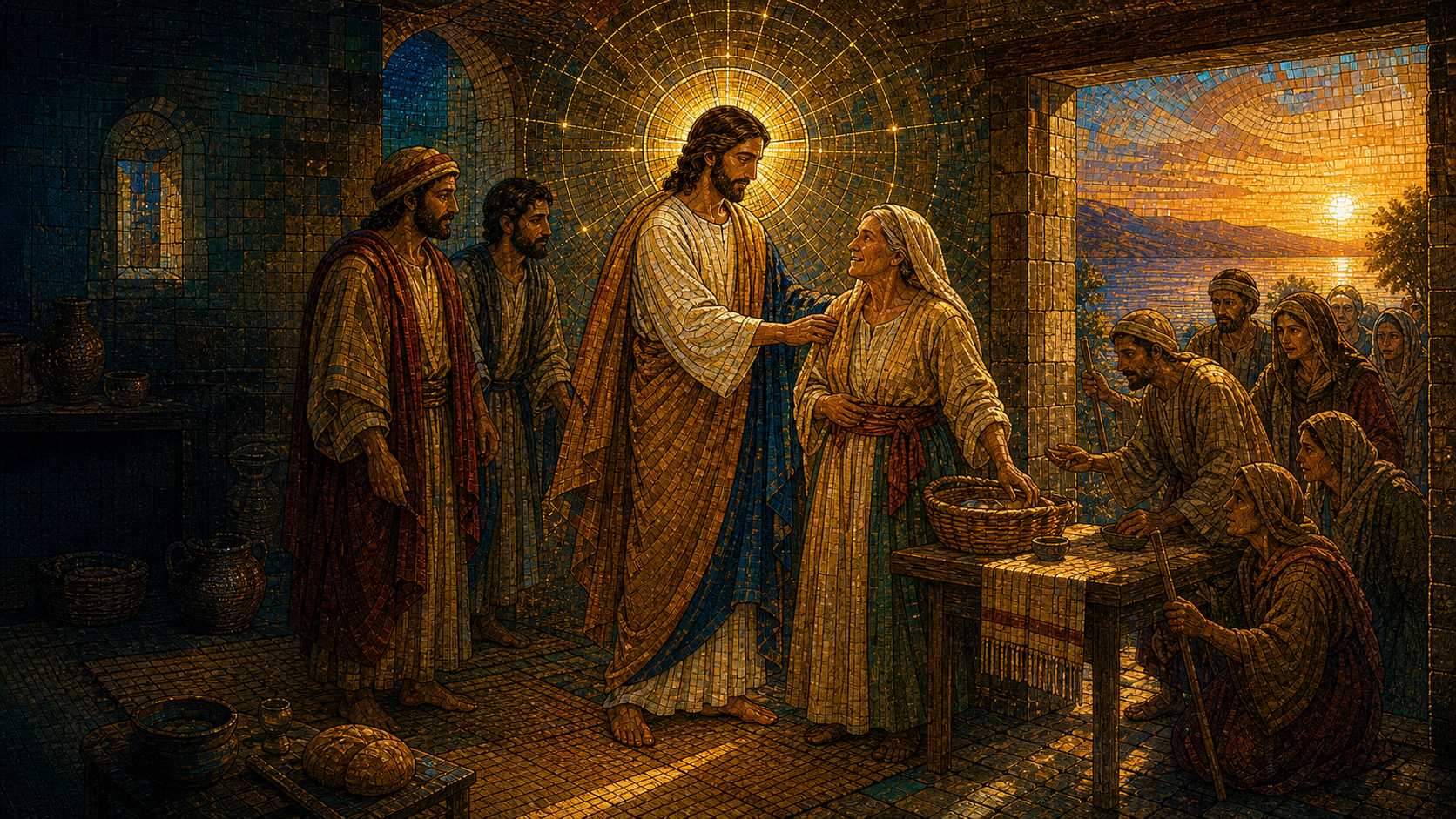
And Jesus, rising from the synagogue, entered Simon's house. Simon's mother-in-law was afflicted with a great fever, and they pleaded with him for her.
Luke 4:38–44
Today’s interpretive key
Christ carries the authority revealed in the synagogue into a family home, then to every sufferer brought to the door. His mercy is personal, his mission cannot be possessed by one town, and the kingdom he preaches moves outward without exhaustion.
Luke leads us from the public assembly into Simon's house, where a great fever has reduced one woman to helplessness. The change of setting does not diminish Christ's authority. The same word that expelled an unclean spirit now commands sickness, and the cure is so complete that Simon's mother-in-law rises at once to serve. The Fathers see more than bodily relief in this movement. St Cyril invites the faithful to receive Christ inwardly, where he extinguishes disordered passions and restores a life capable of pleasing him. As sunset ends the sabbath rest, the doorway fills with people carrying every kind of illness. Jesus does not heal the crowd as an abstraction. He lays his hands on each person, joining divine power to the touch of the flesh he truly assumed. The demons recognize him, but he refuses their testimony; the mystery of Christ will not be entrusted to impure voices. When day comes, he withdraws into solitude. The people seek him and would keep him near, yet mercy cannot become the possession of a single town. He must preach the kingdom of God elsewhere. The Catena therefore gathers the passage into a pattern of Christian mission: receive the Lord, rise into service, bring sufferers to him, seek him in prayer, and follow his movement toward those still waiting. Christ's compassion is intimate without becoming narrow. He visits a poor house, touches individuals one by one, and then continues outward so that other cities may also hear the good news.
Douay-AI, modernized from the public-domain Douay-Rheims Bible. View source ↗
And Jesus, rising from the synagogue, entered Simon's house. Simon's mother-in-law was afflicted with a great fever, and they pleaded with him for her.
And standing over her, he commanded the fever, and it left her. Immediately she rose and ministered to them.
Origen observes that Luke speaks of the fever as though it could hear: Christ commands it, and it does not disregard the one who speaks. The bodily disorder yields to his word. Chrysostom then points to the manner of the healing. Ordinary medicine might bring a fever down, but recovery would still require time before the patient's strength returned. Here everything happens at once. The woman rises immediately and serves the household, showing that Christ has restored not merely a lower temperature but full capacity for action. Her ministry makes the wholeness of the gift visible and directs recovered strength toward loving service.
And when the sun had gone down, all those who had anyone sick with diverse diseases brought them to him. Laying his hands on each one of them, he healed them.
Theophylact first praises the crowd's zeal: even the late hour does not keep them from bringing the sick. Origen notes that sunset also marks the end of the sabbath, after which people believed healing could lawfully occur. Cyril directs attention to Christ's hands. As God, the Word could have dismissed every illness by speech, yet he touches each person to show that the flesh he truly assumed is powerful to give healing. Cyril compares this union to fire communicating heat through metal. The verse joins universal mercy with personal attention: many arrive with diverse diseases, but Christ lays his hands upon every one.
And devils went out from many, crying out and saying, ‘You are the Son of God.’ Rebuking them, he did not allow them to speak, for they knew that he was the Christ.
Chrysostom sees Christ's silence of the demons as an act of humility and order. The spirits speak a true title, yet they must not seize the office entrusted to the apostles or publish Christ's mysteries through impure tongues. Theophylact similarly recalls that praise is unfitting in the mouth of a sinner and may also intensify hostile envy. Bede adds that even the apostles were at times commanded to remain silent so the saving course of the Passion would not be delayed. Recognition alone is not faithful confession. Jesus governs both the expulsion of evil and the manner in which his identity is proclaimed.
And when it was day, he went out into a desert place. The multitudes sought him and came to him, and they tried to keep him from departing from them.
Chrysostom explains that after giving the people abundant favor through miracles, Christ fittingly departs. Once the worker has withdrawn, the works themselves are considered more carefully and acquire a voice of their own. His departure is therefore neither fatigue with suffering nor contempt for those healed. Luke shows the multitudes seeking and following him, in contrast to leaders whose malice resists his power. The people want to keep him near because they have received both his words and his deeds. Yet their desire, sincere as it is, must be enlarged: the healer they seek has a mission that reaches beyond their town.
To them he said, ‘I must preach the kingdom of God to other cities also, for this is why I was sent.’
Victor of Antioch says the Lord is pleased that the people want to hold him back, but he instructs them to release him so others may share his teaching during the limited time of his earthly presence. Mark's parallel emphasizes that Christ came forth willingly, revealing the freedom of his divine nature; Luke speaks of his being sent, emphasizing the incarnation and the Father's decree. These are not rival accounts but complementary truths about one mission. Victor also notes that Luke names the message as the kingdom of God, which is Christ himself. The messenger therefore brings no reality detached from his own person.
And he was preaching in the synagogues of Galilee.
Chrysostom observes that Christ could have remained where he was and drawn everyone toward himself, but instead he travels in search of those who are perishing, like a shepherd seeking a lost sheep and a physician seeking the sick. This becomes an example for the Church's outward movement. His preaching in the synagogues is also deliberate and public. By entering the recognized places of assembly again and again, he prevents opponents from plausibly claiming that he hides in deserted places to deceive people. The mission is both seeking and open: Christ goes toward need, and he teaches where his words can be heard and examined.
The Gospel places Christ's mercy at three scales without dividing it: one woman in a house, a crowd at the door, and cities still beyond the horizon. He is wholly attentive at each scale. Simon's household does not receive a hurried fragment of his care, and the waiting towns do not disappear because Capharnaum wants him to stay. This is the shape of charity governed by mission rather than possession. We may ask where fever has made us passive, where restored strength is meant to become service, and where affection has quietly become an attempt to keep grace for ourselves. Bring the need plainly, as the household interceded for the sick woman. Let Christ's command reach what you cannot master by willpower alone. Then rise. The immediate service of Simon's mother-in-law is not payment for healing; it is restored freedom finding its direction. At the same time, notice how Jesus meets the evening crowd: not as a mass, but by laying his hands on each one. Ask for that patient attention toward the people entrusted to you. Finally, allow the Lord to move beyond the boundaries you would set for him. His kingdom is not secured by holding him back, but received by joining his concern for those who have not yet heard. The mercy that visits your house is already opening its door toward the world.
Read the source Catena Aurea ↗
Cyril asks us to notice that Christ accepts the hospitality of a poor man and chooses poverty for our sake. His entrance into Simon's house teaches disciples to visit the poor and never despise those with little. Bede adds that the Saviour sometimes heals at another person's request and sometimes by his own initiative. In either case, he remains untouched by sinful passions and generously hears faithful prayer. The household does not cure the woman, but it can carry her need to Jesus. Intercession becomes an act of love that opens suffering to the presence of the divine physician.