23:1
Then Jesus spoke to the crowds and to his disciples,
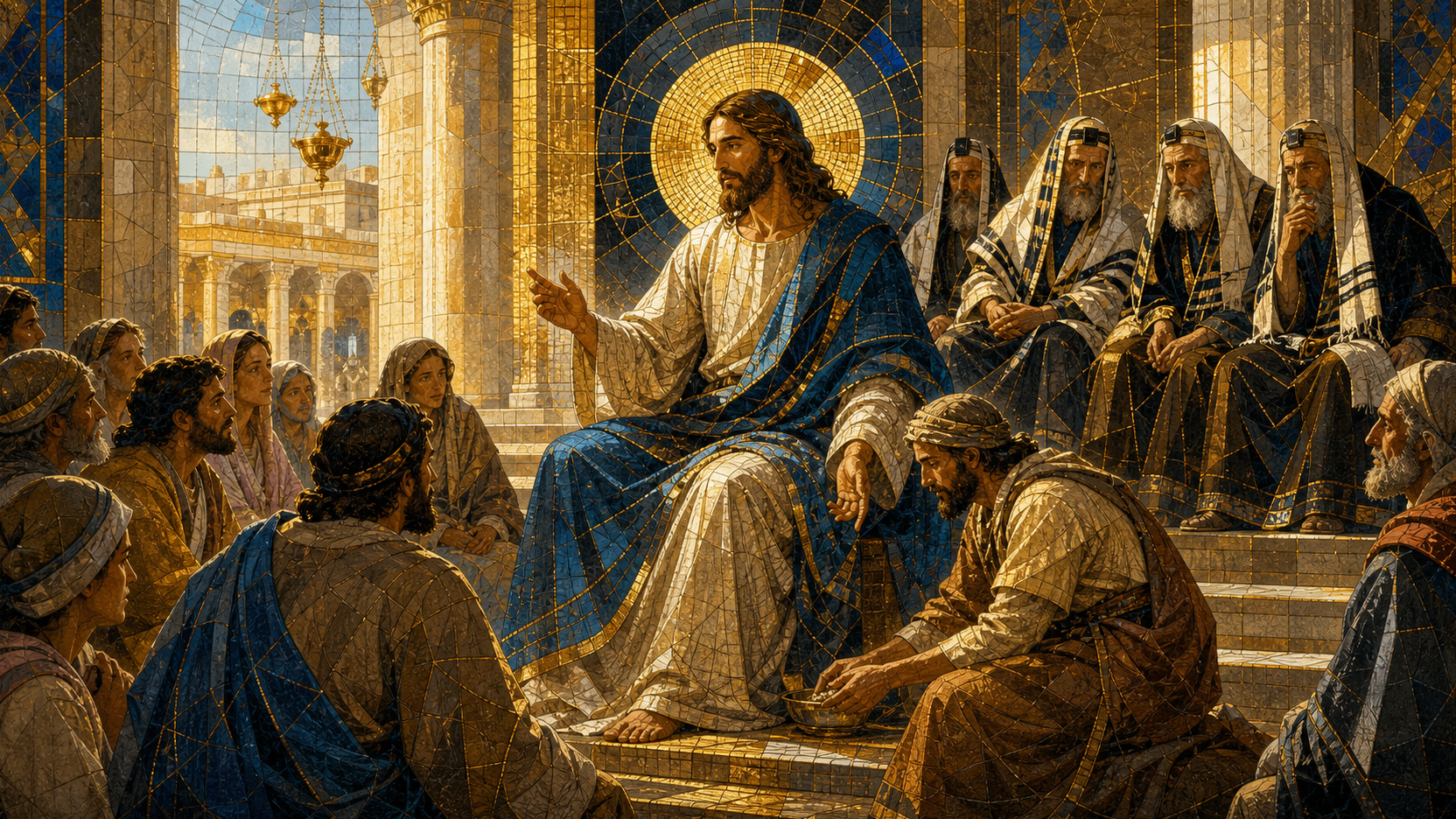
Matthew 23:1–12
Today’s interpretive key
Jesus distinguishes the truth entrusted to an office from the contradiction of a life that refuses to embody it. In his community, sacred teaching cannot become a stage for status: the one Father and the one Master make disciples brothers and turn greatness into service.
Jesus addresses both the crowds and his disciples after the religious authorities have tested him repeatedly. He does not deny the Law they teach from Moses’ chair. Instead, he exposes the fracture between speech and action, warning hearers not to make another person’s inconsistency an excuse for disobedience. The Fathers press this distinction without softening its demands. Chrysostom says a teacher’s failure is especially grave because it harms both the offender and those shaped by his example. Yet the remedy is not contempt for teaching or office. It is integrity: receiving what comes from God, refusing the vanity that turns signs of devotion into theater, and treating authority as ministry. Jesus’ prohibitions concerning Rabbi, father, and master do not erase every human relationship of teaching or spiritual parenthood. Jerome explains that such titles are relative and received; none may rival the heavenly Father as the source of being or Christ as the Master by nature. The passage therefore moves from discernment to conversion. Every disciple stands beneath one Teacher, alongside brothers and sisters, and is raised only by descending into service.
Douay-AI, modernized from the public-domain Douay-Rheims Bible. View source ↗
Then Jesus spoke to the crowds and to his disciples,
saying: ‘The scribes and the Pharisees have sat on the chair of Moses.
Origen reads Moses’ chair as the place claimed by those who profess the Law and interpret it for the people. The image distinguishes an office from the character of the person occupying it. A seat of teaching can bear genuine responsibility even when its occupant fails to embody what is taught. Origen also directs attention beyond the letter toward the spiritual understanding fulfilled in Christ. The verse therefore resists two errors at once: treating office as personal perfection, and despising divine teaching because a teacher is imperfect. The chair is a stewardship under the word, never ownership of it.
Therefore, observe and do everything they tell you; but do not act according to their works, for they say and do not.
Chrysostom says Jesus removes the excuse that a bad instructor makes obedience unnecessary. What the teachers rightly speak from God through Moses is to be received, while their contrary conduct is not to be copied. Their failure is especially serious because a teacher sins not only as a transgressor but also as one appointed to guide others, making the example more damaging. Christ’s distinction demands mature discernment. We must neither confuse truth with the teacher’s personality nor pretend that sound teaching compensates for an unconverted life. The command reaches every Christian whose words instruct another: speech and action must be reconciled.
For they bind heavy and unbearable burdens and lay them on people’s shoulders, but they will not move them with a finger of their own.
Chrysostom identifies a double evil: the leaders demand the utmost rigor from those beneath them while granting themselves wide freedom. Jesus’ words emphasize unwillingness; they do not merely lack strength to help but refuse even the smallest movement of a finger. The Father draws a positive portrait by contrast. A good ruler should be a strict judge of his own conduct and merciful toward others, sharing rather than increasing their load. The verse does not make every demanding command unjust. It condemns the loveless distance by which authority imposes duties without example, accompaniment, or willingness to bear their cost.
They do all their works in order to be seen by others. They make their phylacteries broad and enlarge their fringes.
Jerome recalls that the signs commanded through Moses were meant to keep divine precepts before the hand and eyes: the commands should be fulfilled in works and pondered continually. The Pharisees distort that purpose by enlarging the visible objects in pursuit of public esteem. The problem is not remembrance, fringes, or phylacteries themselves, but devotion converted into display. A person may carry sacred words externally without possessing their knowledge inwardly, just as a chest can contain books without understanding them. The verse asks whether religious practices are truly forming obedience or being used to manufacture an image before others.
They love the first places at feasts and the first chairs in the synagogues,
Rabanus carefully distinguishes occupying an honorable place from desiring it without right measure. Rank may assign someone a particular seat or public recognition, and the external position alone is not condemned. Jesus exposes the will that feeds upon precedence, whether or not it succeeds in obtaining it. This distinction prevents a theatrical humility that seeks praise by visibly choosing the lowest place while remaining exalted inwardly. The verse turns attention from furniture to desire. Where responsibility brings prominence, it should be received soberly; where the heart longs to be first, even a low seat can become another stage for vanity.
and greetings in the marketplace, and to be called Rabbi by others.
Pseudo-Chrysostom says the leaders wish to be called teachers rather than truly to be teachers: they desire the name and neglect the duties. Even a greeting can become food for vanity when a person craves public deference, emphatic acknowledgment, and visible superiority. Jesus therefore reaches beneath etiquette to intention. The danger is not ordinary respect offered to someone who teaches, but an identity built from being noticed and addressed as important. The verse invites anyone with a role, credential, or ministry to ask a direct question: do I want the responsibility and sacrifice of the work, or mainly the social confirmation carried by its title?
But you are not to be called Rabbi, for one is your master, and you are all brothers.
Hilary sees Jesus grounding the disciples’ fraternity in their common parentage and new birth. They have passed beyond merely earthly origin into a family whose life comes from God. No disciple can therefore claim the place of the one Master as though truth originated in himself. Human beings may teach, but they do so as fellow recipients within the same household. The verse does not flatten distinct gifts or responsibilities; it purifies them of domination. A Christian teacher remains a brother who listens before speaking, depends upon grace for understanding, and points away from personal prestige toward Christ, from whom both teacher and learner receive the truth.
And call no one on earth your father, for one is your Father, who is in heaven.
Jerome addresses the apparent difficulty that Scripture and Christian communities do use the language of fathers and teachers. The distinction is between what belongs to God by nature and what human beings receive by participation or respectful usage. An earthly parent is not the ultimate author of life, and a spiritual father cannot replace the Father in heaven. Human fatherhood is genuine when it transparently serves God’s life-giving care; it becomes false when it demands the trust, obedience, or ultimacy that belongs to God alone. Christ’s command therefore protects both divine primacy and every legitimate human relationship from becoming possessive or idolatrous.
Neither are you to be called masters, for one is your master, Christ.
Chrysostom guards Jesus’ words from being divided against the unity of God. When Christ is named the one Master, the Father is not excluded; likewise, calling God the one Father does not exclude the Son. Jerome adds that human teachers may bear the title by resemblance and service, never as the source of truth by nature. The verse directs teaching toward dependence. Skill, study, and office can transmit what is true, but they cannot make another person understand apart from God’s action. A faithful master in the human sense therefore refuses mastery as possession and works so that the learner may become attentive to Christ.
The greatest among you shall be your servant.
Origen says the minister of the divine word should know that Christ, not the speaker, gives fruitfulness. Such a person therefore professes himself a servant rather than a master. Jesus himself, who truly is Master, declared that he stood among his disciples as one who serves. Greatness is not denied but redefined according to its source and purpose. Gifts of understanding, leadership, or speech become great when they are freed from self-display and spent for another’s growth. The verse makes service more than a technique of admirable leadership: it is the truthful posture of one whose work depends entirely upon Christ.
Whoever exalts himself shall be humbled; and whoever humbles himself shall be exalted.’
Remigius interprets the reversal before God. The person who thinks highly of his own merits will be brought low, while the one who remains humble concerning good deeds will be exalted with God. Humility does not call goodness evil or pretend that grace has done nothing. It recognizes that every genuine merit is received, sustained, and judged by God, and therefore cannot become grounds for contempt of another. The final saying gathers the whole passage: public display, coveted titles, and oppressive leadership are forms of self-exaltation. Service, fraternity, and dependence upon the one Master are the low road on which God himself gives true height.
The sharpest contrast in this Gospel is not between teachers and learners but between appearance and truth. A person can speak a command that comes from God while refusing to carry it in life. Christ tells the crowd to distinguish the gift from the unfaithful bearer: receive the truth, but do not copy hypocrisy. That discernment becomes an examination for every disciple, because the desire to be seen can attach itself even to good works, sacred study, and service. Phylacteries and fringes were meant to keep God’s commands near; vanity turned them into measures of public importance. Jesus answers by restoring every relationship to its source. God alone is Father without derivation, and Christ alone gives the growth that makes teaching fruitful. Human authority remains real precisely when it is received as stewardship rather than possession. The greatest therefore does not abandon responsibility but kneels beneath it. Ask where title, visibility, or recognition has begun to feel like proof of worth. Then take the concrete lower place: carry a burden you could have assigned, perform a good work that will not be noticed, or let another receive the honor. Humility is not denial of a gift. It is the freedom to return every gift to the one Master through service of his brothers and sisters.
Read the source Catena Aurea ↗
Pseudo-Chrysostom notices that Jesus does not end after silencing the religious leaders. A word that only defeats an opponent, without improving anyone else, would leave its deepest work undone. Christ therefore turns to the people and his disciples, converting controversy into pastoral teaching. The verse establishes the purpose of the discourse that follows: not fascination with another person’s failure, but protection and reform of those who hear. When hypocrisy is uncovered, disciples are not invited to triumph over the hypocrite. They are called to receive the warning personally and to let truth shape a more coherent life.