22:34
But the Pharisees, hearing that he had silenced the Sadducees, came together.
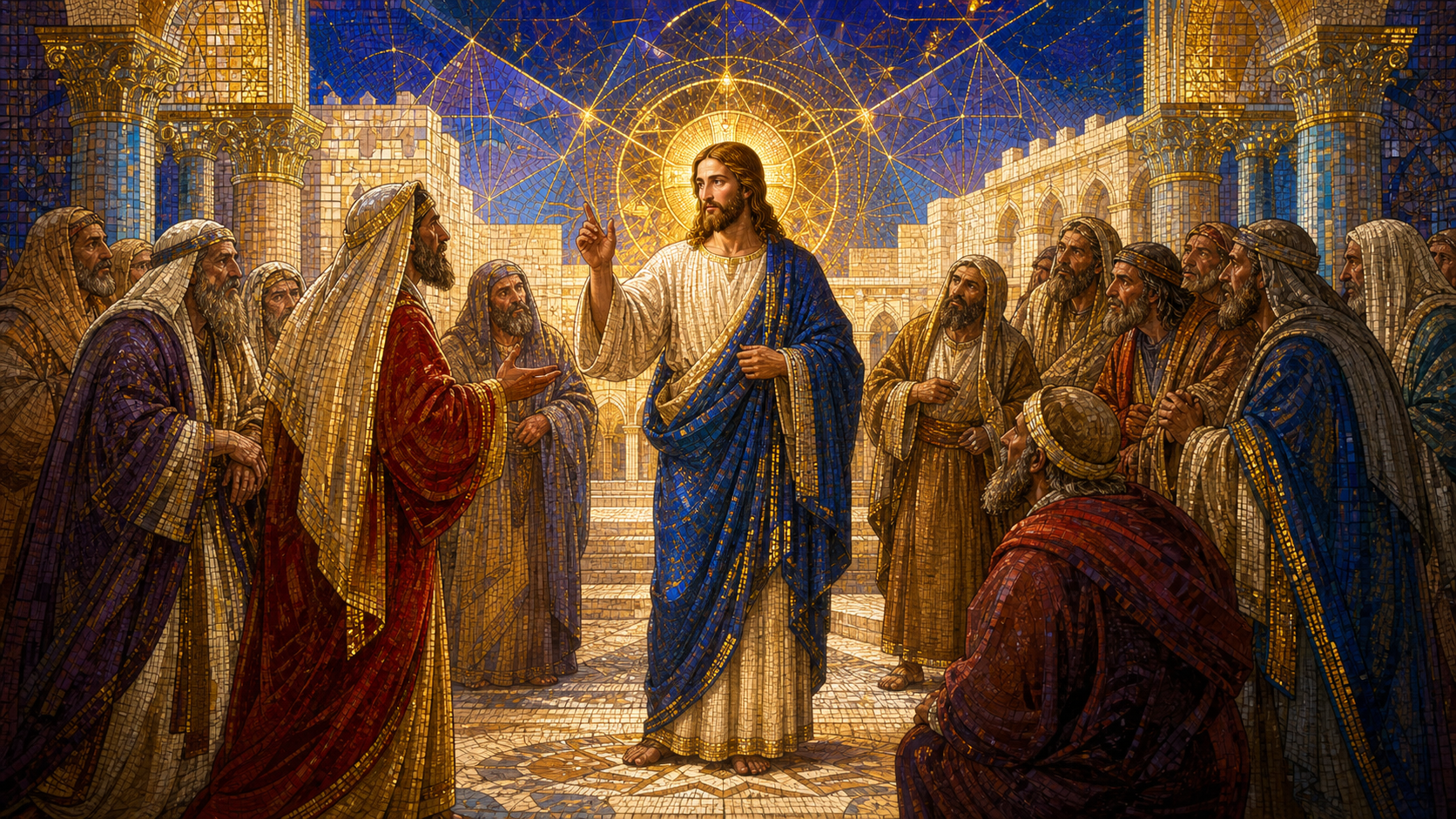
Matthew 22:34–40
Today’s interpretive key
Jesus gathers the whole life of faith into two inseparable loves: God is to be loved with every power of the person, and the neighbor is to be loved within that same Godward movement. The Law and the Prophets do not disappear; their many commands find their unity and purpose in charity.
The Pharisees gather after hearing that Jesus has silenced the Sadducees. Their lawyer’s question is another test, but Christ receives it as an occasion to disclose the heart of the Law. He does not choose an isolated rule from among many. He joins the command of Deuteronomy to love the Lord with the whole person to the command of Leviticus to love one’s neighbor as oneself. The Fathers see both order and unity here. God is loved first and for his own sake; every other rightful love is drawn into that current. The neighbor is not a rival to devotion but the living image in whom love of God becomes active. Augustine insists that no region of life may remain outside this gift: thought, life, and understanding all return to the One from whom they came. Rabanus sees the two tables of the Decalogue gathered beneath these commands. Jesus therefore answers a trap with a map of holiness. Charity is not one topic beside the rest. It is the end toward which revelation directs every command, judgment, promise, and prophetic word.
Douay-AI, modernized from the public-domain Douay-Rheims Bible. View source ↗
But the Pharisees, hearing that he had silenced the Sadducees, came together.
And one of them, a doctor of the law, questioned him, testing him:
Augustine compares Matthew’s account, which calls the question a test, with Mark’s account, where Jesus later tells the scribe that he is not far from the kingdom of God. The two are not incompatible. A man may approach with mixed or even adversarial motives and yet be corrected by the truth he hears. Augustine also allows that testing can mean cautious examination rather than a settled plan to deceive. The verse therefore asks both honesty and hope of the reader: motives matter, but Christ’s answer is not imprisoned by the motive that elicited it. A trap may become a threshold to understanding.
‘Master, which is the greatest commandment in the law?’
Origen notes the tension in the address. The lawyer calls Jesus “Master,” although a true disciple does not merely test the Word but yields himself to learn from him. The question itself may reflect a long-standing debate about priority among the commandments, one that remained unsettled until Jesus declared the answer. Origen thus turns the scene toward the reader: religious language can conceal resistance, and an intelligent question can remain sterile if it seeks victory rather than instruction. To call Christ Master truthfully is to let his judgment order the questions we bring and the lives that must change when he answers.
Jesus said to him: ‘You shall love the Lord your God with your whole heart, and with your whole soul, and with your whole mind.
Augustine reads heart, soul, and mind as the whole range of thought, life, and understanding. Everything we can give is first received from God, so no region of life may rightly remain empty of him or be assigned to a rival final good. Other created things may indeed be loved, but their love must enter the same current by which the whole person tends toward the unchangeable life. This is not emotional intensity alone. It is the ordering of memory, desire, action, and reason toward God, so that every genuine affection is purified and carried toward its proper end in him.
This is the greatest and the first commandment.
Origen says Christ’s answer teaches us that the commandments have an order of greatness. This command is first not by its position in the written sequence but by its supremacy of value. Yet its title must not be separated from its demanding form. Those who claim its greatness must also receive the threefold wholeness Jesus names: heart, soul, and mind cannot be divided into a sacred portion and a private remainder. The first commandment becomes first within us as every faculty learns to serve its proper end. Priority here is not an abstract ranking but the organizing center of obedience.
And the second is like it: You shall love your neighbor as yourself.
Augustine explains that a person should love himself and others in relation to righteousness: we love the righteous for what grace has made them and those not yet righteous so that they may become so. Even self-love is not an isolated end, because our true good is found in God. Therefore one who rightly loves a neighbor seeks together with that person the wholehearted love of God. This guards charity from both selfishness and sentimentality. To love another as oneself is to will his real good with the seriousness given to one’s own, and to understand that the final good of both is communion with God.
On these two commandments depend the whole law and the prophets.’
Rabanus says the entire Decalogue belongs to these two commands: the first table directs us toward love of God, and the second toward love of neighbor. Augustine adds that to “depend” means to be referred to these loves as an end. Jesus is not loosening the Law into a vague feeling. He identifies the purpose that gives every divine command its coherence and truth. Duties of worship and duties of mercy are distinct, yet they belong to one ordered life of charity. Read apart from that end, commands become fragments; fulfilled in love, they reveal the unity of the Law and the Prophets.
The lawyer asks for the greatest commandment, and Jesus answers by giving a whole way of life. Love of God is total because God is not one good competing with others. He is the source and final good of heart, soul, and mind. Augustine’s image is especially searching: every other affection should enter the current that runs toward God, not form a rival stream flowing away from him. This does not diminish the neighbor. It makes love of the neighbor truthful, because we seek not merely another person’s comfort or usefulness but his or her good in God. The second command is like the first precisely because the person before us bears God’s image. Rabanus then shows how the many commandments hang together: duties toward God and duties toward others are the two tables of one covenant, animated by one charity. Today’s examination is therefore concrete. What occupies thought without reference to God? What desire asks to become an ultimate good? Whose need is treated as an interruption rather than an invitation to love? Bring thought, action, memory, and relationship back into their proper order. Love God without remainder, and for his sake learn to will the neighbor’s true good as faithfully as your own.
Read the source Catena Aurea ↗
Jerome observes that the Pharisees had already been confuted in the question about Caesar’s coin and now saw the Sadducees defeated as well. They should have learned caution from both encounters. Instead, hatred and jealousy produce a boldness that ignores correction. Their gathering is therefore more than a neutral consultation: former opponents can unite when they share resistance to Christ. The verse exposes a spiritual danger beyond intellectual error. Evidence may silence an argument without converting the will, and a heart unwilling to yield can turn even another person’s correction into fuel for a new challenge.