16:13
Jesus came into the region of Caesarea Philippi, and he asked his disciples, saying: ‘Whom do people say that the Son of Man is?’
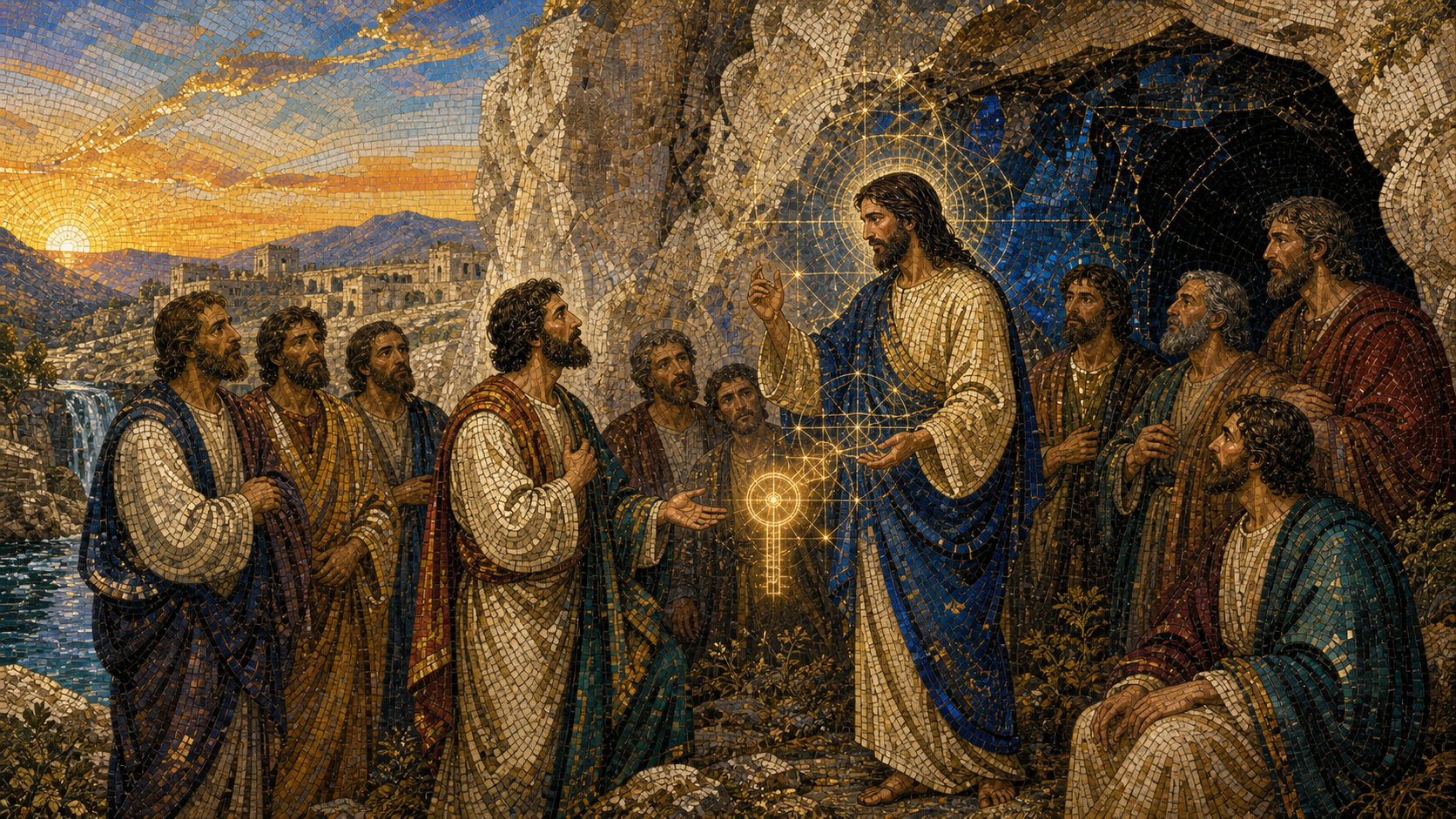
Matthew 16:13–20
Today’s interpretive key
Jesus draws his disciples beyond the shifting opinions of the crowd into the revealed confession of his identity. Peter names him as the Christ and the Son of the living God; Christ answers by naming Peter, promising his Church endurance against hell, and entrusting the keys of the kingdom.
At Caesarea Philippi, amid a landscape marked by imperial power and ancient worship, Jesus asks a question that separates rumor from faith. The crowd’s answers are honorable but insufficient: a prophet returned, a holy figure from Israel’s past. Peter’s confession crosses the decisive threshold. Jesus is not merely one messenger among others but the Christ, the Son who shares the life of the living God. The Fathers insist that this recognition does not arise from ordinary calculation. The Father reveals the Son, and grace enables Peter to speak for the apostolic company. Christ then makes his own declaration. Simon receives the name Peter, the Church is promised a foundation and victory over the gates of hell, and the keys signify a real ministry of discernment, binding, and loosing. Yet the passage ends with silence. The confession is true, but it cannot yet be proclaimed apart from the Cross and Resurrection that will reveal what kind of Christ Jesus is. Christian confession therefore joins revealed truth, ecclesial communion, and patient obedience to the whole mystery of Christ.
Douay-AI, modernized from the public-domain Douay-Rheims Bible. View source ↗
Jesus came into the region of Caesarea Philippi, and he asked his disciples, saying: ‘Whom do people say that the Son of Man is?’
They said: ‘Some say John the Baptist; others Elijah; and others Jeremiah, or one of the prophets.’
Origen explains the different expectations gathered in the disciples’ report. Some follow Herod’s notion that Jesus is John the Baptist; others imagine Elijah returned, Jeremiah appearing again, or another prophet in whom ancient promises might be fulfilled. Each opinion senses prophetic power, yet none reaches the singular identity of Christ. Jeremiah and the prophets pointed forward to realities completed not in themselves but in him. The verse exposes the limit of comparison. Jesus cannot be adequately understood by placing him beside Israel’s holiest messengers, because he is the one to whom their witness and unfinished hopes were directed.
Jesus said to them: ‘But whom do you say that I am?’
Chrysostom sees the second question as an invitation to rise above the multitude’s opinions. The disciples have remained with Jesus, witnessed greater signs, and heard him speak about his divine identity; they must not simply repeat what others think. Jesus waits until his works and teaching have prepared them, then asks for their own judgment. The question is personal without being individualistic, since it is addressed to the apostolic company and answered by Peter for all. Familiarity with Christ creates responsibility: those who have received more light are summoned to confess more truly, not merely to catalogue the beliefs around them.
Simon Peter answered and said: ‘You are the Christ, the Son of the living God.’
Hilary calls this the true and unalterable faith. Peter confesses that the Son comes from God and possesses eternity from the eternal Father, while also recognizing that this divine Son has taken a body and become man. The titles hold the mystery together: “Christ” names the anointed one present in history, and “Son of the living God” declares an identity beyond any merely prophetic office. Peter does not discard what his eyes behold; he sees the Son of God in the man before him. The Church’s confession remains whole only when Christ’s genuine humanity and divine sonship are proclaimed without division.
Jesus answered and said to him: ‘Blessed are you, Simon Bar-Jona, because flesh and blood has not revealed this to you, but my Father who is in heaven.
Jerome understands Jesus’ blessing as the answer to Peter’s testimony. What flesh and blood could not disclose has been revealed by the Father through divine grace. Peter’s words are therefore neither a lucky conclusion nor borrowed teaching from those who opposed Jesus. Jerome also notes the traditional spiritual resonance of Bar-Jona as “son of a dove,” recalling the Holy Spirit, while acknowledging its ordinary patronymic sense. The essential point is that true confession begins in God’s initiative. Peter really speaks and believes, but the light enabling him to recognize the Son is a gift, so blessedness gives rise to gratitude rather than pride.
And I say to you that you are Peter; and upon this rock I will build my Church, and the gates of hell shall not prevail against it.
Jerome emphasizes the force of Christ’s reply. Peter has confessed, “You are the Christ”; Jesus now declares, “You are Peter.” The Lord’s speech is not empty praise but an effective gift, as Simon receives a name derived from the rock. Jerome later understands the gates of hell as vice, sin, and deceptive teaching that ensnares people and draws them toward destruction. These powers are real, but Christ’s promise is stronger. The Church belongs to him—“my Church”—and he himself builds it. Its endurance rests neither on human optimism nor flawless members, but on the word and action of its Lord.
And I will give you the keys of the kingdom of heaven. Whatever you bind on earth shall also be bound in heaven; and whatever you loose on earth shall also be loosed in heaven.’
Rabanus says Peter receives the keys because he has confessed the King of heaven with distinctive zeal. The image signifies both power and discernment: authority to bind and loose, and judgment able to distinguish what is worthy from what is not. This ministry is never independent of God, for its earthly exercise is accountable to heaven. Rabanus also notes that binding and loosing are later shared with the other apostles and continue in the Church’s bishops and priests, while Peter receives the keys in a special manner. The gift therefore serves entry into the kingdom, forgiveness, ordered communion, and the unity of faith.
Then he commanded his disciples to tell no one that he was Jesus the Christ.
Jerome resolves the apparent tension between this command and the disciples’ mission to preach. The confession is true, but public proclamation must wait until Jesus has suffered, died, and risen. Otherwise the title “Christ” could be announced while its saving form remained misunderstood, then be shattered in hearers when they saw him scourged and crucified. The silence is therefore temporary and purposeful, not a denial of Peter’s faith. Jesus prepares the apostles to proclaim the whole mystery: the Christ is the one crucified and raised from the dead. Christian witness must likewise refuse a triumphant title separated from the Paschal mystery that gives it meaning.
The Gospel begins with what others say and ends with what the disciples must temporarily keep silent. Between those two boundaries stands a confession given by the Father and received by the Church. Jesus does not ask for a survey of respectable opinions so that the disciples can choose their favorite. He asks them to speak personally and together: “Whom do you say that I am?” Peter’s answer is not self-created insight. Grace draws him beyond the visible humanity of Jesus without denying it, so that he recognizes the Christ and the Son of the living God. Christ’s answer shows that revealed faith is never merely private. It takes form in a people, a foundation, a ministry of unity, and a promise that the strength of death will not overcome his Church. The command to silence then protects the confession from becoming a slogan detached from the Cross. Today, let the same question reach beneath inherited language and public opinion. Name Christ truthfully in prayer, receive the faith as gift rather than achievement, and make one concrete act of fidelity to his Church. A confession becomes living when the whole life begins to answer with Peter.
Read the source Catena Aurea ↗
Hilary hears more than a request for public opinion. Jesus presents himself as the Son of Man, yet the very question suggests that the disciples must recognize something beyond what appears to ordinary sight. The title safeguards the humanity he truly assumed, while the answer toward which he leads them opens onto his divine identity. Hilary warns that salvation is not served by separating these truths: we must confess the Son of God without forgetting the Son of Man. The question therefore trains faith to behold one Christ, fully encountered in his humanity and known by revelation as divine.