22:1
And Jesus answered and spoke again to them in parables, saying:
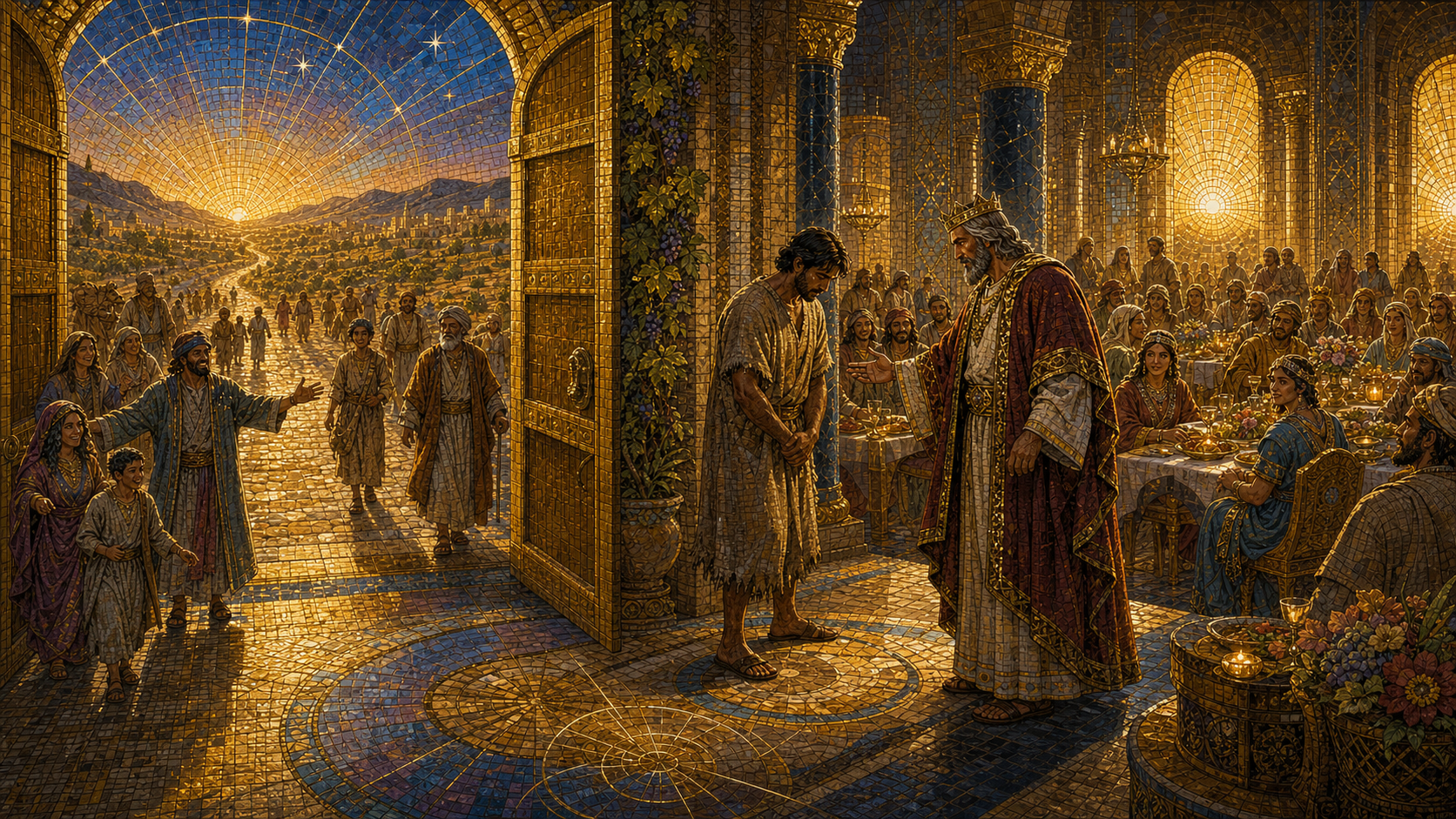
Matthew 22:1–14
Today’s interpretive key
The King refuses to let rejection leave his Son’s feast empty. His invitation reaches the highways and gathers both bad and good, yet grace does not leave the guests unchanged: those called into communion must put on the life of charity that belongs to the wedding.
Jesus tells this parable after the chief priests and elders have challenged his authority and heard that the kingdom will be given to a people who produce its fruit. The image turns from a vineyard to a royal wedding, but the warning deepens. A king prepares a feast for his son and sends servants to those already invited. Their refusal is not caused by scarcity at the table. Everything is ready. Some simply prefer the routines of farm and commerce; others answer the summons with violence. Judgment follows, yet the king’s generosity is not defeated. His servants move outward to the crossroads and gather everyone they find, bad and good alike, until the hall is full. The Fathers read this feast as the present Church, where the call is astonishingly broad but final perseverance cannot be presumed. One guest has entered without a wedding garment. Saint Gregory identifies that garment with charity: faith has brought the man inside, but his life has not taken on the love of the Bridegroom. The parable therefore holds invitation and transformation together. No history places a person beyond the King’s summons, and no outward place at the table makes conversion unnecessary.
Douay-AI, modernized from the public-domain Douay-Rheims Bible. View source ↗
And Jesus answered and spoke again to them in parables, saying:
The kingdom of heaven is like a king who made a marriage feast for his son.
Gregory sees God the Father as the King and Christ as the royal Son. The marriage first evokes the Incarnation: in the Virgin’s womb, the Son truly assumes human nature without becoming two persons. Gregory then speaks of Christ’s union with the Church, the bride joined to him through that same mystery. The image must preserve both truths—the one person of the Redeemer in two natures and the communion he establishes with his people. The kingdom’s invitation is therefore entry into a feast made possible by the Bridegroom’s own self-giving union with humanity.
He sent his servants to call those who had been invited to the marriage, but they would not come.
Origen identifies the servants with the prophets, who called the people toward the Church’s restoration in Christ. Those addressed were not strangers to the promise; they had already been invited and now received a renewed summons when the feast drew near. Other Fathers in the Catena apply the servants to Moses, the prophets, or the apostles reminding Israel of what the Law had announced. Their differences preserve one line of thought: divine preparation precedes the moment of decision. The tragedy is not lack of notice but a will that refuses to come when God’s promise is offered in fulfillment.
Again he sent other servants, saying, ‘Tell those who were invited: Behold, I have prepared my dinner; my calves and fattened cattle are killed, and everything is ready. Come to the marriage.’
Gregory notices that the first call does not mention the slaughtered animals, while the second announces that the feast is fully prepared. He reads the oxen and fattened creatures as figures of the Fathers whose faithful suffering and contemplation nourish those who follow. When words alone are resisted, God also gives examples: lives and deaths that show how difficulties thought impossible can be endured. Other comments in the Catena connect the prepared meal with the riches of divine teaching and the completed work of redemption. Nothing essential is absent; the servants can truthfully say that all is ready.
But they paid no attention and went their own ways, one to his farm and another to his business.
Chrysostom observes that farming and commerce appear entirely reasonable. Precisely for that reason, the verse exposes a subtle refusal: necessary occupations must not be ranked above spiritual things, and plausible duties can become a cloak for indifference. Hilary associates the farm with worldly ambition and trade with covetous absorption, while Gregory describes people so intent on earthly business that they only pretend to attend to Christ’s mystery. The parable does not condemn responsible labor. It reveals the heart’s ordering when a good but limited task is used to dismiss the King whose feast gives every task its final meaning.
The rest seized his servants, treated them shamefully, and put them to death.
Pseudo-Chrysostom reads the murdered servants in light of the disciples killed after Christ’s Ascension, naming Stephen and James as examples. The parable thus distinguishes passive disregard from active persecution: some walk away into their affairs, while others attack the witnesses who continue to announce the feast. Gregory likewise notes that those called may do worse than reject grace; they may become persecutors. The servants possess no feast of their own and speak no private invitation. Violence against them therefore discloses resistance to the King who sent them and to the communion their message offers.
But when the king heard of it, he was angry. Sending his armies, he destroyed those murderers and burned their city.
Jerome understands the armies as the Roman forces under Vespasian and Titus, through whom Jerusalem was devastated. Pseudo-Chrysostom explains that such an army can be called God’s because creation belongs to him and historical powers act only within his providence. The Catena also cautions that anger is attributed to God figuratively: divine judgment is not the turbulence of human passion but the just punishment of evil. The verse is severe because the servants’ murder is severe. Mercy’s invitation does not erase moral truth, and the King’s patience must not be mistaken for indifference toward violence.
Then he said to his servants, ‘The marriage feast is indeed ready, but those who were invited were not worthy.
Gregory emphasizes the King’s determination: because the first guests refuse, he does not permit his Son’s wedding feast to remain empty. God’s word will find a place where it may dwell. Remigius says the mystery of the divine work in human history has been completed; the feast truly is ready. The unworthiness of the invited lies in resisting God’s righteousness and preferring their own. Their failure does not diminish what the King has prepared. Instead, it becomes the occasion for the servants to move farther outward, showing that divine generosity is not exhausted by the rejection it encounters.
Go therefore into the highways, and as many as you find, call to the marriage.’
Pseudo-Chrysostom interprets the highways and their crossings as the many conditions and occupations of human life. The servants are to call people from every profession, not merely those already near religious privilege. Jerome sees the Gentile peoples in these crossings, while Hilary associates the roads with the present age in which the past may be remitted. The command is deliberately expansive: whoever is found is to hear the invitation. It does not declare every road equally good, but it insists that no road prevents the King from calling a person into the wedding feast of his Son.
His servants went out into the roads and gathered together all they found, both bad and good, and the marriage feast was filled with guests.
Origen says the servants gather without first judging whether those found had been good or bad. Yet he immediately rejects the idea that the bad are meant to remain bad. They are called to put off conduct unworthy of the wedding and to clothe themselves with mercy and kindness. Gregory adds that the present Church contains good and bad together and that the good must learn to endure the presence of the bad. The filled hall therefore displays both the breadth and the aim of grace: all sorts are welcomed, and all are summoned toward a life fitting the feast.
The king went in to see the guests, and he saw there a man who was not wearing a wedding garment.
Gregory asks what the wedding garment can signify except charity. Christ wore this garment when he came in love to unite the Church to himself. A person can therefore enter the visible feast through faith and still lack the love that makes faith living and fits a guest for communion with the Bridegroom. Origen describes the garment through mercy and kindness, while Hilary speaks of the Holy Spirit’s grace preserved in purity. The King’s inspection reveals what outward presence cannot settle. Being among the guests is real privilege, but it is ordered toward transformation in the charity of Christ.
He said to him, ‘Friend, how did you come in here without a wedding garment?’ But he was silent.
Jerome explains that the King calls the man friend because he was invited and entered through faith. The rebuke concerns the life that failed to match this gift, like a filthy garment brought into the beauty of the wedding. Jerome also reads the garment as the Lord’s commandments and the works belonging to the new person. The guest’s silence shows that no excuse survives the full disclosure of judgment, when creation and the angels bear witness to the truth. The question is not asked from ignorance; it uncovers a contradiction the guest can neither deny nor explain away.
Then the king said to the attendants, ‘Bind his hands and feet, and cast him into the outer darkness; there shall be weeping and gnashing of teeth.’
Gregory interprets the bound hands and feet as a severe judgment upon powers that would not be restrained from evil through repentance. Sin had already prevented good works; punishment now makes that bondage manifest. He distinguishes blindness of heart, an inward darkness already known in this life, from the outer darkness of final condemnation. Augustine similarly calls disordered desires the chains that bind the sinner. The bodily images of weeping and gnashing of teeth underscore the gravity of the sentence and, as Jerome notes, affirm the resurrection of the body. Grace is free, but its rejection has a real end.
For many are called, but few are chosen.
Gregory says that some never begin a good course and others fail to continue the good they began. Because no one yet sees the whole shape of his future, each person should watch over his own life with humility rather than presume upon having heard the call. Jerome observes that the end of the feast matters, not merely its beginning. Hilary distinguishes the generosity that invites all from the judgment that discerns a worthy response. The verse does not narrow the sincerity of the invitation. It makes clear that being called seeks completion in persevering charity, not confidence in an outward place among the guests.
The parable moves through three acts of divine initiative. The King prepares; the King sends; the King fills the hall. Human refusal never makes the feast less ready, nor does it exhaust his will to share the joy of his Son. The summons passes from those who expected it to people found at the crossings of the world, and the servants are told to gather without first sorting the worthy from the unworthy. That breadth should destroy despair. It should also destroy contempt, because every guest stands at the table by invitation. Yet the King who welcomes also comes to see. Saint Gregory’s reading of the wedding garment as charity prevents us from turning inclusion into indifference. The Church can contain good and bad together in the present age, but the grace that admits us is ordered toward a life clothed in Christ’s love. Saint Jerome adds the commandments and the works of the new person; Saint Hilary speaks of the Holy Spirit’s grace kept pure. These are not competing garments but ways of seeing one transformed life. The speechless guest has no answer because the invitation itself supplied every reason to prepare. Receive the feast today as gift, then let the gift become visible: prefer God to the urgent business that crowds him out, honor the servants who carry his word, welcome those gathered from unfamiliar roads, and practice the charity without which even correct belief remains undressed.
Read the source Catena Aurea ↗
Chrysostom connects this parable directly with Jesus’ declaration that the kingdom will be given to a nation producing its fruits. The answer is therefore not a detached illustration but Christ’s response to the leaders’ resistance and their intention to destroy him. The Interlinear Gloss similarly understands his answering as a meeting of their evil thoughts. Jesus does not surrender the truth when opposition hardens; he speaks again, clothing judgment and mercy in a royal story whose meaning will expose refusal while revealing the people gathered into his kingdom.