1
At that hour the disciples came to Jesus, saying, “Who do you think is the greater in the kingdom of heaven?”
Matthew 18:1–5, 10, 12–14
Today’s interpretive key
Christ overturns the disciples’ search for rank: heavenly greatness begins in humble conversion, receives the little one as Christ himself, and shares the Father’s vigilant desire that none should perish.
The disciples come to Jesus with a question about precedence. Their eyes are fixed on the summit—who stands highest in the kingdom—yet Jesus answers by placing a child in the center. The living measure of greatness is not influence, achievement, or privileged nearness, but conversion from rivalry into the childlike humility that receives life as a gift. Christ then turns the lesson outward. The little ones are not merely examples to admire; they are persons to welcome, protect, and seek. Their dignity rests in Christ’s identification with them, in the angels who behold the Father’s face, and in the Father’s own will that not one be lost. The shepherd who leaves the ninety-nine reveals how divine humility moves: God does not calculate that one vulnerable life is expendable. He goes after the wanderer, rejoices at the finding, and teaches his disciples that care for the least is the true form of life in his kingdom.
Douay-AI, modernized from the public-domain Douay-Rheims Bible. View source ↗
At that hour the disciples came to Jesus, saying, “Who do you think is the greater in the kingdom of heaven?”
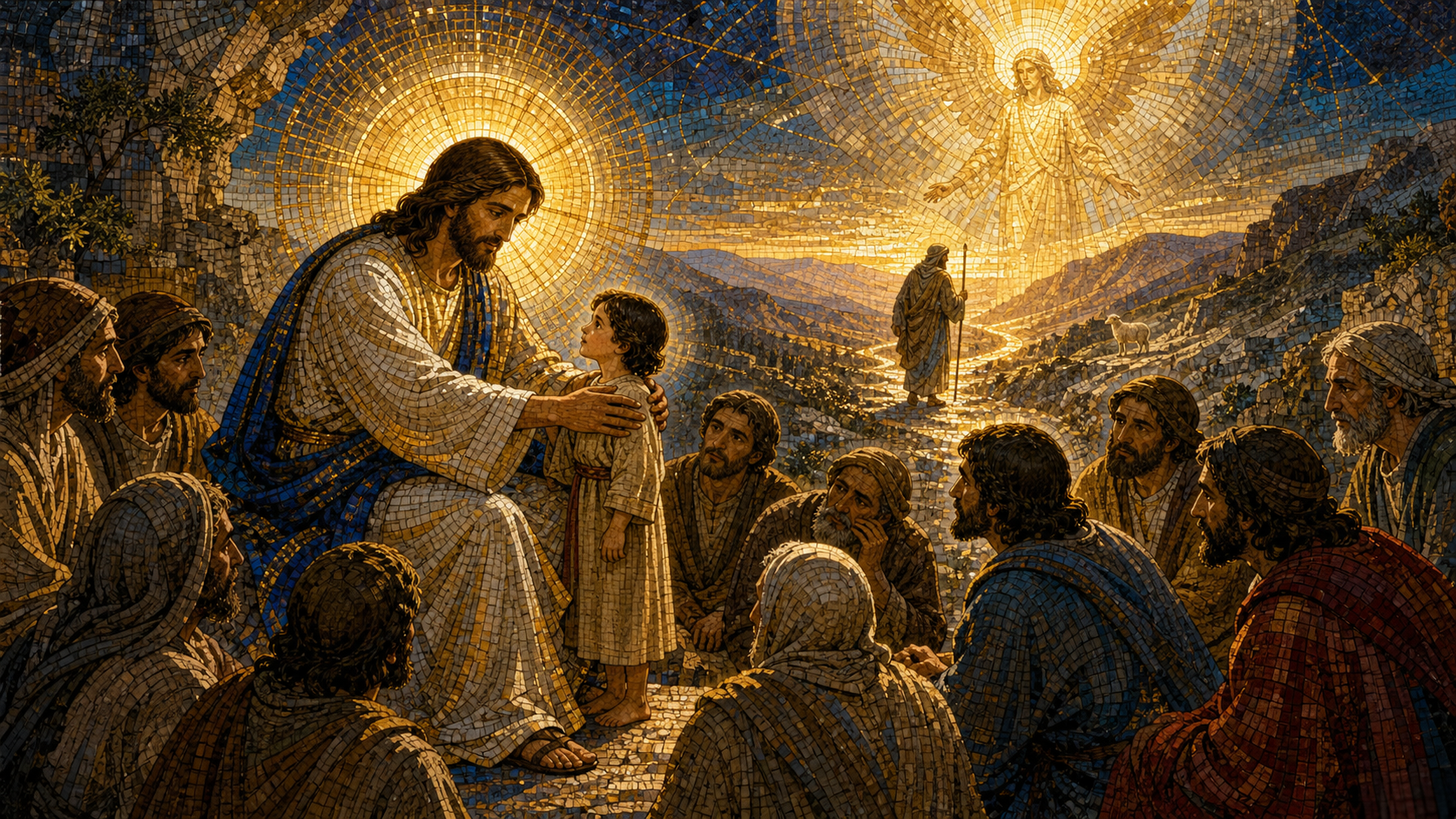
And Jesus called a little child to him and set him in the midst of them,
Jerome says Jesus recognizes the disciples’ ambitious thoughts and heals their struggle for precedence by awakening a different kind of emulation: the desire to become lowly. The child’s tender age visibly expresses the innocence they must seek. Jerome also points beyond the example to Christ himself, who stands among his disciples as the true little one, the Lord who came not to be served but to serve. The gesture is therefore more than an illustration. Jesus places before them both a human sign of unguarded humility and the pattern of his own self-emptying holiness.
and said, “Amen, I say to you, unless you are converted and become as little children, you shall not enter into the kingdom of heaven.
Jerome explains that Christ commands neither literal childhood nor ignorance. He calls the disciples to the innocence naturally associated with infancy: freedom from obstinate anger, refusal to nurse an injury, purity of desire, and speech without a divided intention. This is a demanding moral conversion, not sentimental admiration of children. The disciples must turn away from the rivalry exposed by their question and become children in malice while remaining mature in understanding. Entrance into the kingdom cannot be separated from this reformation of the heart, because heavenly life is incompatible with prideful calculation and concealed resentment.
Whoever therefore shall humble himself as this little child, he is the greater in the kingdom of heaven.
Jerome reads the child’s humility through the example of Christ himself. The greatest is the person who does not seize elevation but lowers himself after the Lord who chose service. Humility here is not self-hatred or denial of God-given gifts. It is release from the need to secure worth by standing above another. The kingdom reverses the disciples’ imagined ladder: voluntary lowliness becomes the road to exaltation because it conforms the believer to Christ. Greatness is measured by likeness to the humble King, not by distance from those judged smaller.
And whoever shall receive one such little child in my name receives me.
Chrysostom moves from becoming little to receiving the little. Christ promises a reward to those who honor humble believers for his sake, then gives something greater than reward: he identifies himself with the one welcomed. Jerome adds that the welcome is not based on worldly merit or on flattering an impressive person, but on reverence for the Master whose humility the little one bears. Christian hospitality therefore tests ambition at its root. To receive someone who offers no social advantage is to receive Christ, while contempt for the lowly reveals that status still governs the heart.
See that you do not despise one of these little ones, for I say to you that their angels in heaven always see the face of my Father who is in heaven.
Jerome marvels at the dignity of the human soul: from birth, each has an angel appointed to its care. The little one whom society is tempted to overlook is therefore attended by a heavenly minister who beholds the Father. Gregory the Great explains that the angels can be sent to serve us without losing contemplation of God; their mission does not remove them from his presence. Christ’s warning joins ethics to worship. To despise the vulnerable is to misjudge someone whose life is held before God, while reverence for them brings earthly perception into agreement with heaven.
What do you think? If a man has a hundred sheep, and one of them should go astray, does he not leave the ninety-nine in the mountains and go to seek that which has gone astray?
Gregory interprets the hundred sheep as the fullness of rational creation, angels and humanity together. When humanity strays, the Creator himself becomes the shepherd who seeks it. The ninety-nine remain on the mountains, a figure of the heavenly host abiding in the heights, while Christ descends to recover the lost creature on earth. Hilary similarly sees the single sheep as one human being who contains, in figure, the whole wandering race. The parable reveals the Incarnation as a search: God’s majesty does not make the lost beneath his notice but sends the Son to bring humanity home.
And if it happens that he finds it: Amen, I say to you, he rejoices more for that sheep than for the ninety-nine that did not go astray.
Gregory asks why greater joy is spoken over the recovered sinner than over those who remained. He observes that people conscious of grave wandering often rise through sorrow into ardent love, repairing earlier losses with zealous fidelity, while some who feel secure in uprightness attempt little beyond avoiding serious sin. Yet he carefully denies that every penitent surpasses every righteous person; some innocent souls practice heroic humility and renunciation. The comparison praises the transforming energy of repentance. The shepherd rejoices because what was endangered has been restored, and the recovered life now burns with gratitude for mercy.
Even so, it is not the will of your Father, who is in heaven, that one of these little ones should perish.
Jerome ties the conclusion directly back to the warning against contempt. The wandering sheep is not an isolated story about recovery; it explains why the little one must never be dismissed. The Father does not will the ruin of even one, and the shepherd’s search embodies that saving desire. Human freedom can still resist grace, so the verse does not pretend that no one is ever lost. It reveals instead that such loss cannot be blamed on divine indifference. Disciples who call God Father must therefore oppose contempt with patient care and make his desire for the little one their own.
Jesus does not simply add humility to a list of admirable virtues. He makes conversion toward littleness the doorway into the kingdom. The disciples’ question assumes that greatness can be possessed over others; the child in their midst reveals a life that is received, dependent, and free from the calculated struggle for rank. The Fathers do not confuse this childlikeness with immaturity. Saint Jerome describes it as innocence without malice, duplicity, or cherished resentment, while Saint John Chrysostom shows that receiving such a person for Christ’s sake reaches Christ himself. The command therefore becomes both inward and communal: surrender ambition, and refuse to treat the weak, poor, new, or easily overlooked as spiritually disposable. Verse ten discloses their astonishing dignity. The angels who minister to them never lose the vision of the Father, so earthly smallness is held within heavenly attention. The shepherd’s search then shows what that attention means in action. God’s care is not satisfied by the safety of the many while one is missing. Christ seeks the lost human creature, and heaven rejoices in restoration. The Father’s will that none of these little ones perish gives the whole passage its golden thread: humility learns to see with God’s regard, welcome with Christ’s presence, and seek with the shepherd’s persevering love.
Read the source Catena Aurea ↗
Chrysostom sees the question arising after Peter received a distinctive honor. The disciples are ashamed to state their jealousy plainly, so they ask more generally who is greatest in heaven. He judges their weakness honestly but also notes how much higher their concern already stands than ordinary ambition: they seek precedence in the kingdom, not worldly power. Christ does not dismiss them for the mixed motive. Their failure becomes the occasion for instruction, showing that hidden rivalry should be brought into his presence, where desire for greatness can be converted rather than merely concealed.