24
Amen, amen, I say to you: unless a grain of wheat falls into the ground and dies,
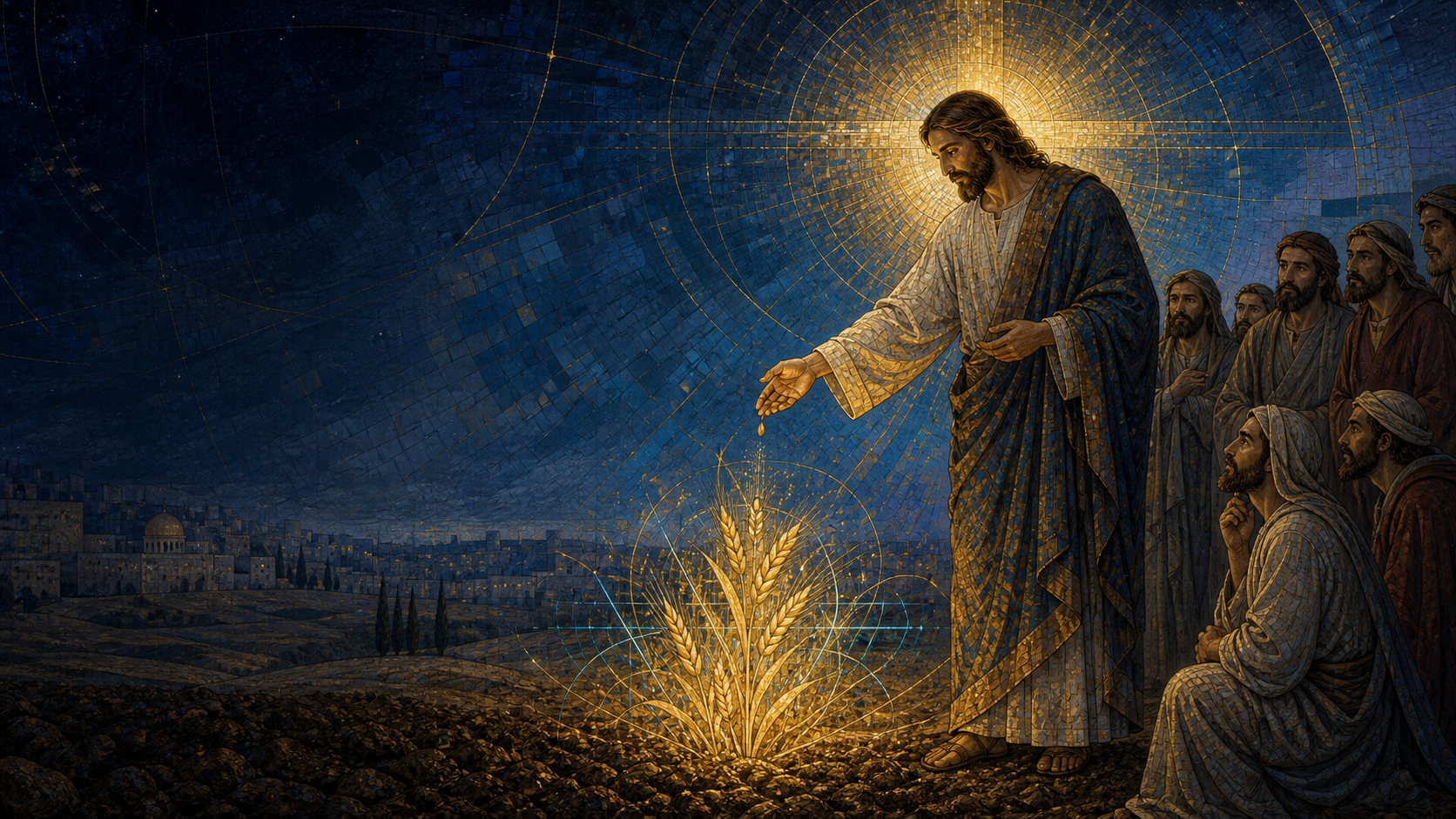
John 12:24–26
Today’s interpretive key
Christ reveals that his death will not end his work but multiply its fruit, and he calls every servant to follow him through self-giving love into the honor of the Father.
A group of Gentiles has asked to see Jesus, and their desire becomes a sign that his mission is opening toward every nation. Yet Christ does not answer with a spectacle or a promise of effortless triumph. He points instead to a grain of wheat disappearing into the earth. What looks like loss is the appointed path to abundance: the seed does not bear fruit by protecting itself, but by surrendering the form it presently has. Jesus speaks first of his own approaching Passion, where glory will be revealed through death and resurrection. Then he extends the same pattern to his disciples. To cling to life as a private possession is finally to lose it; to refuse the world’s demand for self-preservation at any cost is to keep life for eternity. Service therefore means more than admiration. The servant follows the Lord’s road, stays where Christ is, and receives a promise beyond all earthly acclaim: the Father himself will honor the one who serves the Son.
Douay-AI, modernized from the public-domain Douay-Rheims Bible. View source ↗
Amen, amen, I say to you: unless a grain of wheat falls into the ground and dies,
it remains alone. But if it dies, it brings forth much fruit. Whoever loves his life will lose it; and whoever hates his life in this world will keep it unto eternal life.
Augustine distinguishes holy detachment from self-destruction. To “hate” one’s life in this world means refusing to prefer temporary safety when obedience to God is at stake; it never licenses a person to take his own life. Chrysostom likewise reads the warning as resistance to the soul’s disordered desires and as preparation for the disciples’ own suffering. Christ consoles them by revealing that death accepted in fidelity is not the extinction of life. Attachment that makes this world ultimate loses what it grasps, while love courageous enough to relinquish the lesser good receives life in its eternal fullness.
If anyone serves me, let him follow me; and where I am, there also shall my servant be. If anyone serves me, my Father will honor him.
Chrysostom says a servant follows by imitating the master’s life and death; Christian service cannot be separated from Christ’s self-offering. Augustine adds that Christ’s servants seek his interests rather than their own, doing works of mercy and every good work for his sake, even to laying down life for others. The promise then discloses the deepest reward: not status apart from Jesus, but presence with him. To be where the only Son is becomes the adopted child’s honor, and the Father confirms that communion. Following is costly, yet it leads precisely where Christ has gone.
The grain of wheat is not a decorative comparison placed beside the mystery of Christ; it is the shape of that mystery. Jesus enters death freely, not because death is good in itself, but because obedient love passes through it and breaks its claim to finality. Buried alone, he rises with a harvest: peoples once far apart are gathered into one faith, sinners receive new life, and the apparent defeat of the Cross becomes the glory by which the Son draws the world toward the Father. The disciple cannot praise this pattern from a safe distance. Christ joins service to following. Every lesser death accepted for his sake—the surrender of vanity, resentment, comfort, control, and the demand to preserve oneself at another’s expense—places life within his fruitful obedience. This is not contempt for God’s gift of life, still less a summons to self-destruction. The Fathers insist that Christ condemns disordered attachment, especially when fidelity is made to compete with survival. Saint Lawrence’s martyrdom gives the feast its living witness: he did not seek death, but when service to Christ required steadfastness, he refused to purchase safety by betrayal. The promised reward is not merely compensation after hardship. It is communion: “where I am, there also shall my servant be.” To follow Christ is already to let his destination govern the present. The Father’s honor rests upon the servant whose hidden surrender becomes, in Christ, a seed of eternal fruit.
Read the source Catena Aurea ↗
Augustine connects the Gentiles’ desire to see Jesus with the worldwide faith that will follow Christ’s Passion and Resurrection. Their arrival signals glory, but that glory must pass through humiliation: the grain is Christ, surrendered to death and multiplied in those who come to believe. Bede sharpens the image by saying that Christ died alone and rose with many. The seed’s burial is therefore not disappearance or defeat. It reveals the divine fruitfulness of self-giving love, in which the one Son enters death and brings a gathered people into risen life.