18:21
Then Peter came to him and said, “Lord, how often shall my brother offend against me, and I forgive him? Up to seven times?”
Matthew 18:21–19:1
Today’s interpretive key
The King cancels a debt beyond repayment and commands the forgiven heart to become merciful in turn: divine pardon is received truly when it passes through us to the brother who owes far less.
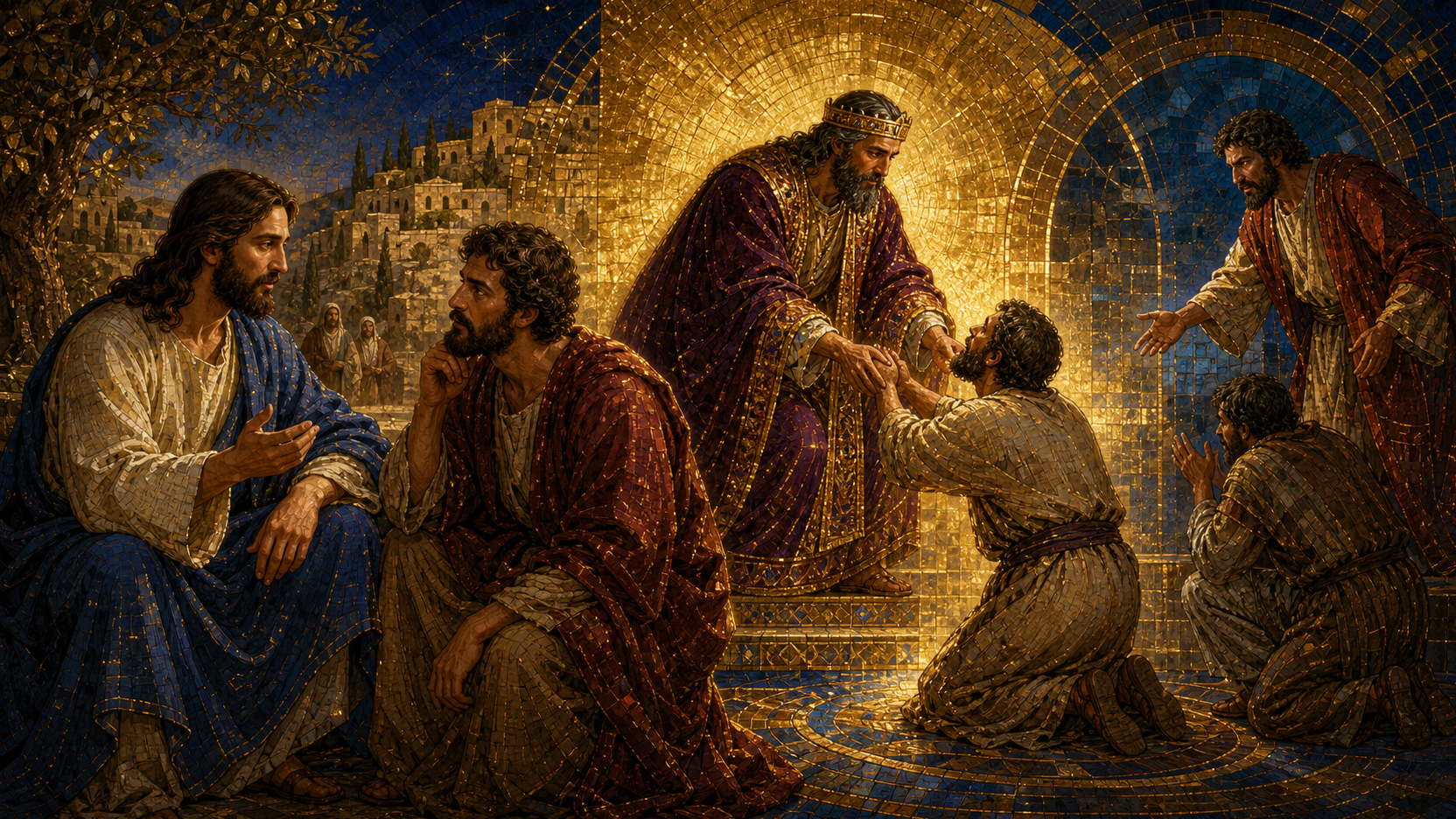
Peter wants forgiveness to have a generous boundary. Seven pardons already sound heroic, yet Jesus removes the boundary and replaces arithmetic with a kingdom. A servant stands before his king owing more than a lifetime could repay. He asks only for time, but receives something far greater: release and complete remission. The gift should have remade his relation to every other debtor. Instead, he leaves mercy behind at the palace door and demands immediate payment from a fellow servant whose debt is small beside his own. The parable exposes a contradiction that can take root in a religious life: pleading for divine compassion while treating another person only by the measure of strict obligation. Christ does not deny justice or pretend that wounds are unreal. He reveals that disciples live first as people whose impossible debt has been forgiven. Mercy becomes their new economy, and forgiveness from the heart is its necessary fruit. The final movement into Judea gives the teaching weight and direction. Jesus himself continues toward the place where mercy will cost him everything.
Douay-AI, modernized from the public-domain Douay-Rheims Bible. View source ↗
Then Peter came to him and said, “Lord, how often shall my brother offend against me, and I forgive him? Up to seven times?”
Jesus said to him, “I do not say to you, up to seven times, but up to seventy times seven.”
Chrysostom says that seventy times seven is not a definite maximum after which resentment becomes lawful. The number signifies something endless and enduring. Christ therefore moves Peter away from counting offences toward becoming a person whose mercy does not run out on schedule. This does not call evil good or forbid wise protection from continued harm. It refuses to make vengeance the heart’s final answer. The disciple forgives repeatedly because divine compassion, not the offender’s arithmetic, supplies the pattern. Mercy becomes a stable form of life rather than an exceptional concession.
Therefore the kingdom of heaven is likened to a king who wished to take account of his servants.
Chrysostom explains that Jesus adds the parable so no one will regard limitless forgiveness as merely burdensome. The king’s accounting reveals the hidden proportion between the mercy we need and the mercy we are asked to give. Remigius identifies the servants broadly with humanity, created by God and answerable for the manner of life each has received. Judgment is therefore personal without being arbitrary: the King examines what his servants have done. Yet the account will disclose not only debt but the astonishing generosity that makes a new life possible.
And when he had begun to take the account, one was brought to him who owed him ten thousand talents.
Augustine connects the ten thousand talents with the fullness of offences committed against God’s law. The precise symbolism serves the parable’s central contrast: this is not a manageable balance awaiting a disciplined payment plan. The servant’s condition is ruinous. Remigius adds that the accounting searches a person’s life and deeds, bringing moral reality into the King’s light. Recognition of such debt is not meant to produce despair. It prepares the servant to know mercy as gift. Only someone who understands how much has been remitted can perceive why hardness toward another is so grievous.
And since he had nothing with which to pay, his lord commanded that he, his wife, his children, and all that he had should be sold, and payment made.
Remigius sees the inability to pay as the sinner’s inability to raise and free himself by his own resources. Nothing within the debtor can balance the account. The threatened sale displays what justice would require and strips away every illusion of self-sufficiency. Chrysostom nevertheless cautions that the king’s command is not spoken from cruelty. It is a severe mercy intended to awaken the servant’s plea and prepare him to receive pardon consciously. The truth about the debt must be faced, because grace is cheapened whenever the need from which it rescues us is concealed.
But that servant, falling down, begged him, saying, ‘Have patience with me, and I will pay you all.’
Remigius reads the servant’s posture as the sinner’s humbling of himself before God. His request for patience seeks time and space to correct what has gone wrong. The promise to repay everything exceeds his power, but the plea at least abandons defiance and confesses need. Repentance often begins before a person fully understands grace: we ask for another chance to repair the impossible, while God prepares a gift greater than delay. The king listens to the bowed servant, showing that honest supplication opens the place where divine clemency can be received.
And the lord of that servant, moved with pity, let him go and forgave him the debt.
Chrysostom marvels at the abundance of the king’s love. The servant requested a short delay; the lord answers with release and cancellation of the whole debt. The accounting allowed him to recognize the greatness of the gift, so that mercy received might teach mercy toward others. Pity does not pretend the obligation never existed. It assumes its cost and frees the debtor from it. The verse gives the parable its center: before disciples are commanded to forgive, they are shown as recipients of a compassion immeasurably larger than anything they could have secured for themselves.
But when that servant had gone out, he found one of his fellow servants who owed him a hundred pence; and laying hold of him, he seized him by the throat, saying, ‘Pay what you owe.’
Chrysostom emphasizes the speed of the reversal. The king’s pardon is still sounding in the servant’s ears when he uses his new freedom harshly against a fellow servant. Augustine’s numerical contrast shows that both obligations are real, yet the hundred pence is slight beside ten thousand talents. Christ does not deny that one person may truly owe another. He exposes the monstrous disproportion of receiving vast compassion while refusing even patience. Going out from the king becomes an interior departure: the servant leaves behind the mercy that should have transformed how he sees every debtor.
And his fellow servant, falling down, begged him, saying, ‘Have patience with me, and I will pay you all.’
Origen notices Scripture’s careful repetition and distinction. The first debtor fell before the king; the second falls before a fellow servant and makes the same appeal for patience. The echo should awaken recognition. The one who begged for mercy now encounters his own need embodied in another person. This is the moral moment hidden within many conflicts: another’s frailty speaks a language we have already used before God. The fellow servant asks only time, not cancellation. Even this modest request is enough to test whether pardon has penetrated the first servant’s heart or merely changed his circumstances.
And he would not, but went and cast him into prison until he paid the debt.
Augustine interprets the servant’s refusal as nourishing thoughts directed toward the other man’s punishment. Remigius says his wrath grows as he pursues vengeance and consigns his brother to prison. The brief sentence therefore reveals an interior process: mercy is rejected, anger is cultivated, and power is used to confine. Justice has been separated from the compassion by which the servant himself lives. Christ warns that an unforgiving heart does not remain private. It constructs prisons in relationships and communities, holding another person indefinitely within the identity of debtor and refusing the possibility of restored fellowship.
Now his fellow servants, seeing what was done, were deeply grieved, and they came and told their lord all that was done.
Remigius offers several readings of the fellow servants: they may signify angels, the Church’s preachers, or the faithful who sorrow when someone forgiven refuses forgiveness. Their report is not malicious gossip. They carry grief over a brother’s ruin into the lord’s presence. Unforgiveness is therefore never wholly isolated; it disturbs the communion in which mercy is meant to circulate. The fellow servants neither imitate the cruelty nor ignore it. Their sorrow becomes an appeal to the king, suggesting the proper response when another is oppressed: truthful witness joined to grief, not delight in condemnation.
Then his lord called him and said to him, ‘You wicked servant, I forgave you all the debt because you begged me.’
Chrysostom observes that the king did not call the servant wicked when he owed ten thousand talents. Then he showed pity without reproach. The name appears only after the servant has treated his fellow with merciless severity. The deepest wickedness exposed by the parable is therefore not simply indebtedness but the refusal to become compassionate after receiving compassion. The king’s words recall both the size of the gift and the servant’s own pleading. Memory is morally necessary: when we remember how we stood before God, superiority over another debtor becomes impossible to sustain.
‘Should you not then have had compassion also on your fellow servant, even as I had compassion on you?’
Chrysostom places the two actions side by side: the lord had pity on an unpayable debt, while the servant denied patience over a small one. The question reveals the proper fruit of pardon. Mercy is not a private possession that leaves relationships unchanged; it establishes a pattern the forgiven person is obliged to imitate. The servant is not asked to create compassion from nothing. He has already encountered it personally. Christian forgiveness begins by receiving God’s pity so deeply that another person’s need no longer appears foreign. Grace becomes visible when the recipient starts to resemble the Giver.
And his lord, being angry, delivered him to the torturers until he paid all the debt.
Remigius reads the lord’s anger as divine judgment upon persistent sin and the torturers as an image of unending punishment. Chrysostom distinguishes this sentence from the earlier threat of sale: that first severity aimed at correction and produced a plea, while this judgment follows the servant’s deliberate rejection of received mercy. The verse should not be softened into mere symbolism without consequence. Christ warns that hardness of heart endangers the one who clings to it. To demand an economy without mercy is finally to place oneself under the same impossible demand.
“So also shall my heavenly Father do to you, if you do not forgive your brothers, each from the heart.”
Augustine says it is better to speak sharply while forgiving in the heart than to use smooth words while remaining inwardly unrelenting. He compares needed correction to a surgeon’s knife: firmness may serve healing without extinguishing charity. Jerome likewise says that “from your hearts” excludes feigned reconciliation. Christ therefore commands neither denial nor sentimental speech. He commands the surrender of cherished vengeance. Forgiveness may require time, truth, boundaries, and discipline, but gentleness must not disappear from the deepest intention. The disciple seeks the brother’s good because the Father’s mercy has become the heart’s governing reality.
And it came to pass, when Jesus had ended these words, that he departed from Galilee and came into the regions of Judea beyond the Jordan.
Chrysostom notes that Jesus had earlier withdrawn from Judea because of hostility, but now returns toward its borders because his Passion is near. The geographical transition is therefore theological movement. The one who has just commanded forgiveness from the heart goes willingly toward the place where divine mercy will be enacted through his suffering. He does not teach pardon from safety and then leave its cost to others. His journey gives the parable flesh: Christ advances toward those who oppose him and toward the sacrifice by which an unpayable human debt will be released.
The Fathers hear Christ’s answer to Peter as the end of spiritual bookkeeping. Saint John Chrysostom insists that seventy times seven does not establish a larger ceiling; it signifies forgiveness that remains open and enduring. The parable then shows why. Our offences against God exceed the claims we hold against one another as ten thousand talents exceed a hundred pence. The comparison does not make human injury trivial. It places every injury within the prior wonder of divine mercy. The first servant receives more than he dares request, yet the gift never reaches his conduct. He can repeat the language of need before the king but cannot recognize the same need when his fellow servant kneels. This is why the command reaches the heart. A polished reconciliation can conceal an interior refusal, while genuine forgiveness may coexist with prudent boundaries, truthful correction, and the slow healing of memory. What cannot coexist with the Gospel is the settled desire to withhold from another the mercy on which we ourselves live. Jesus ends the parable and sets out toward Judea. His journey turns the teaching into action: the King will bear the cost of remission, and those released by him are sent to make that mercy visible in a world of debts, wounds, and new beginnings.
Read the source Catena Aurea ↗
Jerome locates Peter’s question within Jesus’ preceding commands about the little ones, fraternal correction, and prayer in agreement. Peter is not changing the subject; he is trying to discover how long the work of restored communion must continue. Seven appears generous, suggesting repeated patience rather than quick retaliation. Yet the question still imagines a point at which charity may be exhausted. Christ receives this limited generosity and opens it into the measure of the kingdom, where forgiveness begins not from the offender’s worthiness but from God’s inexhaustible mercy toward the disciple.