22
Immediately Jesus required his disciples to get into the boat and go before him across the water, until he had dismissed the people.
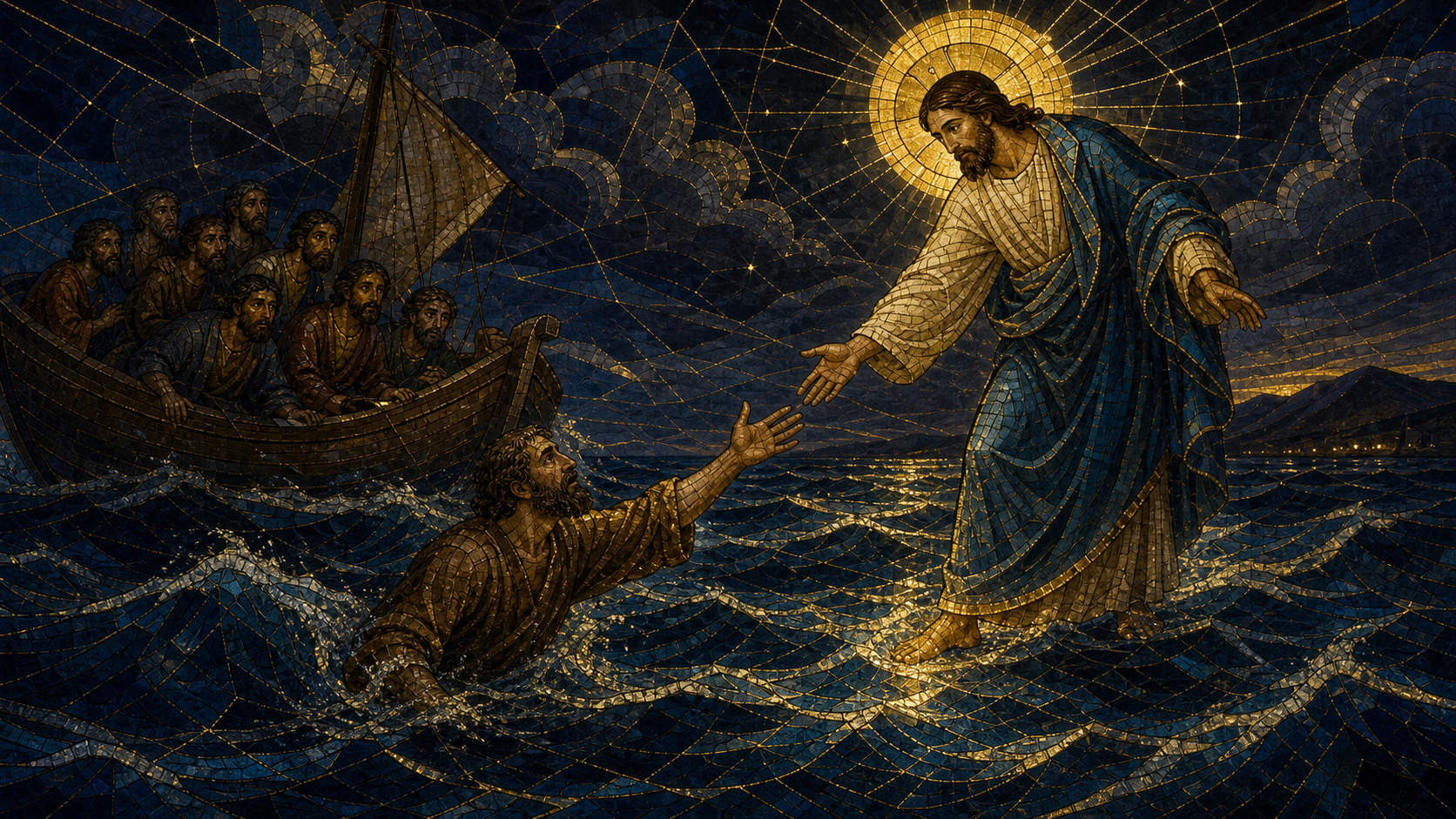
Matthew 14:22–33
Today’s interpretive key
Christ comes across the storm to his struggling disciples, calls Peter beyond natural strength, catches him at the instant of failure, and leads the boat from fear into adoration of the Son of God.
The disciples enter the night at Christ’s command, yet obedience does not spare them the contrary wind. While Jesus prays alone on the mountain, their boat is driven and tossed far from safety. He comes only in the fourth watch, walking upon the very sea that threatens them. His presence first deepens their fear because they cannot recognize the form that rescue takes. Then his voice gives courage. Peter answers with a daring request: he does not ask merely for proof, but to come to Jesus where human power cannot stand. For a moment, sustained by the Lord’s command, he walks. When his attention fixes on the wind, fear overtakes him and he begins to sink. His brief cry receives an immediate hand. Christ corrects his little faith without withholding salvation, and the lesson reaches beyond Peter: the one who commands the waves, bears a disciple upon them, and stills the wind is not merely a wonder-worker. The boat becomes a place of worship, and terror gives way to the confession that Jesus is truly the Son of God.
Douay-AI, modernized from the public-domain Douay-Rheims Bible. View source ↗
Immediately Jesus required his disciples to get into the boat and go before him across the water, until he had dismissed the people.
After dismissing the multitude, he went up the mountain alone to pray. When evening came, he was there alone.
Chrysostom presents the mountain and the evening solitude as Christ’s instruction in prayer. He neither remains constantly among crowds nor avoids them altogether; service and withdrawal each have their proper time. After giving himself to the hungry multitude, he seeks stillness in place and hour, teaching disciples to guard space for undistracted prayer. Augustine adds that his retreat also refuses the crowd’s attempt to make him an earthly king. Prayer here is not escape from love but its purification: Jesus turns from applause and political expectation toward the Father before returning to those endangered on the sea.
But the boat, in the midst of the sea, was tossed by the waves, for the wind was against them.
Chrysostom compares this danger with the earlier storm in which Jesus was present in the boat. Now the disciples must struggle while he appears absent, as though a teacher were advancing them toward a harder lesson. Jerome emphasizes the immediacy of the contrary wind once they are separated from the Lord. The scene does not imply abandonment; it exposes how quickly security fails when measured only by sight. Tossed in the middle of the sea, they cannot return by their own ease or advance by their own strength. The opposing wind becomes the setting in which deeper reliance will be learned.
In the fourth watch of the night, he came to them, walking upon the sea.
Chrysostom notes that Jesus allows the disciples to be tossed through the night rather than granting immediate relief. The delay awakens longing, fixes their memory upon him, and teaches them not to demand a swift end to every trial. Jerome explains that the fourth watch means the danger has continued until the final portion of the night. Yet when Christ comes, he does not skirt the threatening sea or wait for calm water. He walks upon it. The very element that displays the disciples’ helplessness lies beneath his feet, revealing that no hostile force can prevent the Lord from reaching those he loves.
When they saw him walking upon the sea, they were troubled, saying, “It is an apparition.” And they cried out in fear.
Chrysostom observes that the disciples’ fear increases at the very moment rescue approaches. After surviving the waves, they mistake Christ for an apparition because terror cannot yet interpret what their eyes behold. He often permits the final stage of a trial to feel most severe, not to destroy the faithful, but to deepen the gain of perseverance and make deliverance more fully received. Jerome also uses their reaction to defend the reality of Christ’s body: the apostles know the difference between their embodied Lord and what they imagine to be a phantom. Their cry exposes confusion, but it also draws forth his revealing voice.
Immediately Jesus spoke to them, saying, “Take heart; it is I. Do not be afraid.”
Chrysostom says Jesus reveals himself when the disciples cry out, so that fear may turn into a greater joy at his presence. He does not begin by explaining the waves; his voice itself creates confidence. Jerome hears depth in the unqualified words “It is I,” connecting them with the divine name revealed to Moses. The one approaching through darkness is not another danger among dangers but the Lord whose being and authority do not depend upon the sea. The command not to fear is therefore more than encouragement. It rests upon who Christ is and upon his immediate nearness to those who cannot rescue themselves.
Peter answered him and said, “Lord, if it is you, command me to come to you upon the waters.”
Augustine places Peter’s request between honest weakness and confidence in Christ: by himself he cannot walk upon the sea, but in the Lord he may receive the ability. Jerome sees Peter’s characteristic ardor, believing that the Master’s will can make a heavy body tread where nature offers no support. His words are not an independent leap or a demand that Jesus endorse private ambition. Peter asks to be commanded and directs the whole venture toward Christ: “come to you.” Faith begins by receiving its path and power from the Lord, not by inventing danger to prove its own intensity.
And he said, “Come.” Peter stepped down from the boat and walked upon the water to come to Jesus.
Chrysostom praises Peter’s warmth and faith. He believes not only that Christ can walk upon the sea, but that Christ can enable another to do the same. The request is shaped by love rather than display, because Peter does not ask merely to walk on water; he asks to come to Jesus. Christ’s brief “Come” is enough. The command carries the power required for obedience, and Peter truly steps beyond the boat’s support. Jerome notes that Peter’s bodily walking also confirms the concrete character of the miracle. Grace does not erase created weakness; it enables the disciple to move through it toward the Lord.
But seeing the strong wind, he was afraid; and as he began to sink, he cried out, saying, “Lord, save me.”
Chrysostom notes the strange proportion of Peter’s fear: he has crossed the greater obstacle of the waves, yet the lesser force of the wind unsettles him. Such inconsistency exposes ordinary human weakness. Jerome says the brief temptation teaches Peter that salvation comes not from the boldness of his request but from the Lord’s power. Faith still burns within him, yet frailty pulls him downward. Augustine sees the saving movement in Peter’s return: as he begins to sink, he does not pretend strength or surrender to the sea. His compact prayer names both his peril and his confidence—only the Lord can save him.
Immediately Jesus stretched out his hand and took hold of him, saying, “O you of little faith, why did you doubt?”
Augustine asks whether the Lord would abandon in peril the man whose earlier request he had heard; the answer appears in Christ’s immediate grasp. Chrysostom stresses that Jesus first catches Peter rather than commanding the wind to stop. The true danger is not the tempest’s strength but the disciple’s weakened faith, for firm reliance upon Christ would have sustained him even there. Correction therefore comes within rescue, not as a condition Peter must satisfy before receiving help. Like a mother returning a fallen chick to safety, Christ supports the disciple whose zeal outran his maturity and teaches him where his security truly lies.
When they came up into the boat, the wind ceased.
Christ does not still the wind before Peter is caught and brought back. Chrysostom sees this order as revealing that the disciple’s faith, rather than the weather, was the heart of the trial. Once Jesus and Peter enter the boat, the wind ceases, and the long night turns toward recognition. Rabanus draws the scene inward: wherever the Lord is present by grace, the wars of the heart are brought to rest. This does not mean every outer hardship instantly disappears, but the narrative makes its central claim visible. Peace is not manufactured by exhausted sailors; it arrives with Christ received among them.
Those in the boat came and adored him, saying, “Truly, you are the Son of God.”
Chrysostom traces a gradual revelation: Jesus has commanded the sea, walked upon it, enabled Peter to walk, saved him in peril, and brought the wind to rest. The disciples respond by adoring him and naming the truth toward which these works point. Jerome argues that their worship cannot be reduced to surprise at an accidental calm; the confession concerns Christ’s identity. The rescue of one disciple and the peace of the whole boat open into doctrine and worship. Christian deliverance reaches its proper end when gratitude moves beyond the gift to the giver and recognizes in Jesus the divine Son.
The Gospel does not promise a life without contrary winds. The disciples are in the boat because Jesus sent them, and still the night lengthens, the waves strike, and the Lord seems absent. The Fathers read this boat as an image of the Church: vulnerable to the storms of history, yet unable to sink because Christ intercedes and comes to her. His delay is not indifference. It enlarges endurance, desire, and the capacity to recognize that salvation rests in him alone. Peter makes that truth personal. His boldness is real faith, because he knows that Christ’s command can enable what nature cannot. His failure is also real: looking away from the Lord toward the wind, he discovers that fervor is not self-sustaining. Yet the decisive movement is neither his courage nor his collapse. It is the immediate reach of Jesus. The Lord allows Peter to learn his weakness without allowing the sea to claim him. Correction comes from the same mouth whose command upheld him, and mercy from the hand that catches him. Christian faith therefore has neither the pride that pretends it cannot fall nor the despair that imagines failure is final. It ventures at Christ’s word, cries to him when sinking, receives his grasp, and returns with him to the boat. There the wind ceases, and experience ripens into adoration: truly, he is the Son of God.
Read the source Catena Aurea ↗
Chrysostom sees purpose in Christ sending away both witnesses and disciples after feeding the multitude. The miracle cannot be dismissed as something sustained by his visible presence, and Jesus refuses to gather popular praise around himself. Jerome notices another detail: the disciples have to be constrained because love makes them unwilling to leave their teacher even briefly. Obedience therefore carries them where affection would not choose to go. Their coming trial begins not in rebellion but in compliance with Christ’s command, teaching that fidelity may lead through darkness before its wisdom becomes clear.