14
And when he came to the multitude, a man approached him, falling on his knees before him and saying:
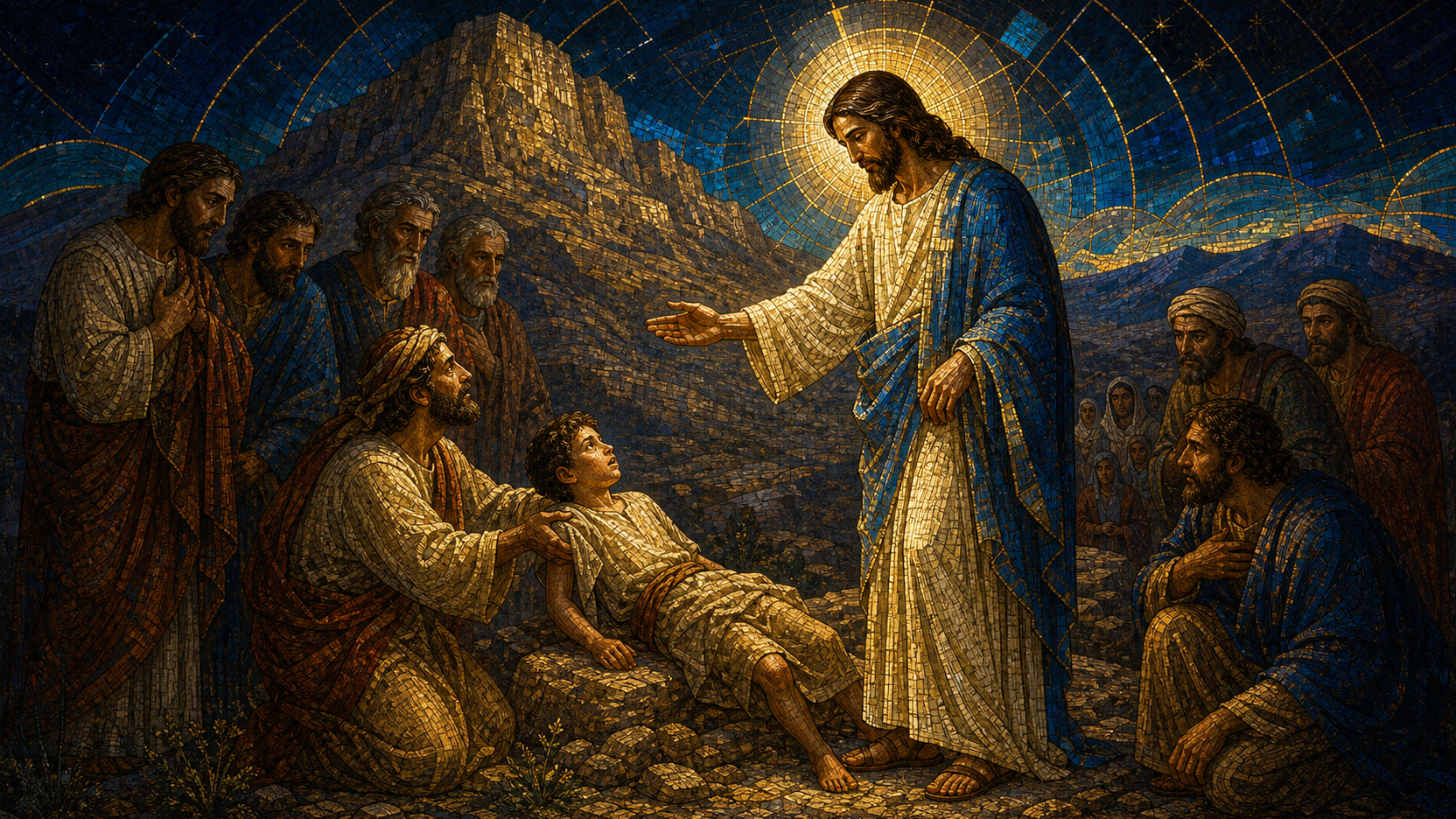
Matthew 17:14–20
Today’s interpretive key
Christ descends from the mountain into a father’s anguish, succeeds where the disciples have failed, and teaches that living faith is neither technique nor self-confidence: it depends upon God through prayer and fasting.
Jesus returns from the glory of the Transfiguration to a crowd gathered around suffering and failure. A father falls to his knees and brings his son’s torment before the Lord after the disciples have been unable to cure him. Christ’s severe words expose unbelief without turning away from the afflicted child: he commands that the boy be brought directly to him, rebukes the devil, and restores the child at once. In private, the disciples do not hide their failure. They ask why the authority previously entrusted to them did not bear fruit. Jesus points to the weakness of their faith and gives the image of the mustard seed—small in appearance, yet alive with a strength that does not originate in itself. The concluding word on prayer and fasting protects this teaching from presumption. Spiritual authority is not mastery over God or a method possessed by the disciple; it grows through communion, humility, and a life ordered toward him.
Douay-AI, modernized from the public-domain Douay-Rheims Bible. View source ↗
And when he came to the multitude, a man approached him, falling on his knees before him and saying:
“Lord, have pity on my son, for he is a lunatic and suffers greatly: he often falls into the fire and often into the water. I brought him to your disciples, and they could not cure him.”
Chrysostom observes that the spirit repeatedly drove the boy toward fire and water, dangers that could easily have killed him. The fact that the child still lives shows that divine Providence has restrained the evil even before the visible healing. Jerome then cautions against making the disciples’ failure a simple verdict on their power: a cure may be hindered by weakness of faith in those who seek it. The father’s report is honest, but it also exposes the limits of every merely human helper. His son’s condition and the disciples’ inability now lead the whole need beyond them to Christ himself.
Then Jesus answered and said, “O unbelieving and perverse generation, how long shall I be with you? How long shall I endure you? Bring him here to me.”
Jerome refuses to hear Christ’s words as weary irritation or a loss of gentleness. He compares them to a physician grieving that the patient repeatedly acts against the treatment: the skill is not exhausted, but resistance keeps frustrating its work. Jesus is angry with sin rather than hostile toward the person caught within it. That distinction appears in the command that follows. He does not dismiss the father, shame the child, or abandon the disciples. “Bring him here to me” turns reproof toward mercy. Unbelief is named truthfully so that the afflicted one may be brought to the source of healing.
And Jesus rebuked him, and the devil went out of him, and the child was cured from that hour.
Jerome clarifies that Christ’s rebuke is directed against the devil rather than against the afflicted child. Remigius draws from this a pastoral rule: those who teach and shepherd should attack sins while helping human beings. The distinction matters because evil degrades the person whom Christ intends to restore. Jesus does not confuse the child with the power tormenting him, nor does he make healing depend upon a prolonged display. His word expels the devil, and the child is cured from that hour. Divine authority appears here as liberation—decisive against evil and wholly ordered toward the sufferer’s good.
Then the disciples came to Jesus privately and said, “Why could we not cast him out?”
Chrysostom recalls that the disciples had already received authority over unclean spirits. Their inability therefore raises a painful question: have they forfeited the grace entrusted to them? They approach Jesus apart, not merely from embarrassment, but because the matter is spiritually weighty and cannot be settled by appearances before the crowd. This private honesty is itself part of discipleship. They do not blame the father, invent a success, or pretend that the failed attempt is unimportant. They return to the giver of the gift and ask to understand. Christ can form servants who allow failure to become truthful dependence and teachable prayer.
Jesus said to them, “Because of your unbelief. For amen, I say to you: if you have faith like a grain of mustard seed, you shall say to this mountain, ‘Move from here to there,’ and it shall move; and nothing shall be impossible to you.”
Jerome warns against treating the mustard seed as an image of defective or merely minimal faith. Scripture elsewhere speaks of faith that moves mountains; the seed is small to the eye yet great in its properties and fruit. Gregory adds that mustard releases its strength when bruised, as a holy person’s hidden fervor becomes manifest under persecution. The power is therefore not theatrical confidence or a guarantee that every wish will be fulfilled. It is faith made living through reliance upon God, able to face obstacles beyond human strength. What appears slight becomes effective because its source and object are the faithful Lord.
“But this kind is not cast out except by prayer and fasting.”
Chrysostom presents prayer as indispensable and fasting as its powerful companion. Fasting brings sobriety, curbs disordered desire, and helps prayer become wakeful and steady; prayer directs that disciplined freedom toward God. He does not reduce fasting to a feat of bodily strength. Those unable to undertake a strict fast can still refuse indulgence, while no one is excused from prayer. Remigius widens the lesson further: fasting includes abstinence from sinful passions, and prayer includes the whole pattern of pious action. The practices do not purchase divine power. They humble and ready the disciple to depend upon God in serious spiritual conflict.
The passage moves from helplessness to restoration, but it refuses every easy account of spiritual power. The father cannot rescue his son, and the disciples discover that a gift once received cannot be treated as an automatic possession. Christ alone commands the evil and heals the child. Yet he does not leave the disciples in humiliation; their private question becomes instruction. The mustard seed does not celebrate vague optimism or the size of human confidence. The Fathers see in it a faith whose apparent littleness conceals living force, especially when trial presses it open. Such faith can confront what seems immovable because it relies upon the Lord rather than upon itself. Prayer and fasting make that dependence concrete. Prayer turns the whole person toward God; fasting loosens the appetites that scatter attention and feed self-reliance. Neither practice manipulates grace. Together they school the disciple in humility, clarity, and readiness for God’s work. When our strength fails, the Gospel does not direct us toward performance. It sends us with the father and the child to Christ: bring the need to him, ask honestly, and let faith be sustained by communion with the One for whom nothing is impossible.
Read the source Catena Aurea ↗
Origen contrasts Peter’s desire to remain in the blessedness of the mountain with Christ’s descent to those too weak to ascend. Charity does not seek its own advantage, so Jesus returns to the multitude and makes himself accessible to the suffering below. The kneeling father also reveals that faith may intercede for another: some ask healing for themselves, while others bring before Christ the pain of those they love. The father cannot enter his son’s affliction or cure it, but he can approach, kneel, and speak. His helplessness becomes the beginning of prayer rather than the end of hope.