24
Then Jesus said to his disciples: “If anyone wishes to come after me, let him deny himself, take up his cross, and follow me.”
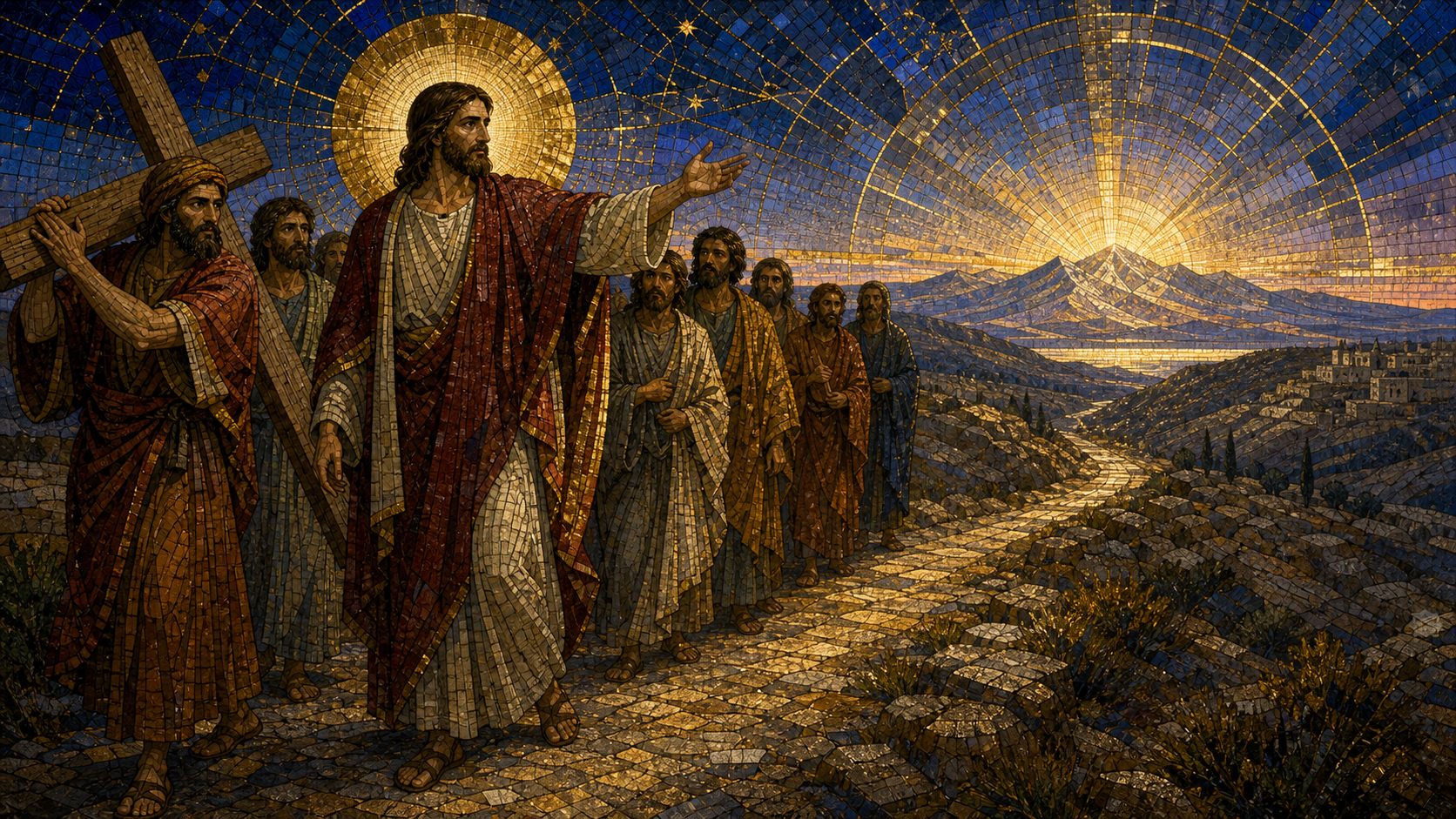
Matthew 16:24–28
Today’s interpretive key
Christ does not conceal the cost of discipleship: the road after him passes through self-denial and the cross. Yet the life surrendered for his sake is the life truly found, and no possession can equal the soul he comes in glory to judge and save.
Immediately after rebuking Peter for resisting the Passion, Jesus turns from one disciple to every would-be follower. He neither compels nor disguises the way: whoever wishes to come after him must deny himself, take up his cross, and follow. Self-denial is not contempt for God’s creation but a refusal to let the fallen self become lord. The apparent paradox that follows measures two kinds of life. A person may preserve comfort and safety while losing the soul’s eternal good; another may surrender even earthly life for Christ and discover it restored in him. The whole world cannot compensate for a soul’s ruin, because nothing created can purchase it back. The crucified teacher is also the Son of Man who will come in his Father’s glory with the angels and render to each according to his works. His final saying directs the disciples toward the approaching Transfiguration, a foretaste of the kingdom hidden within the path of the cross.
Douay-AI, modernized from the public-domain Douay-Rheims Bible. View source ↗
Then Jesus said to his disciples: “If anyone wishes to come after me, let him deny himself, take up his cross, and follow me.”
For whoever would save his life will lose it; and whoever loses his life for my sake will find it.
Origen reads Christ’s paradox on both the bodily and moral levels. Whoever clings to present life from fear of death may preserve it briefly while losing communion with eternal life. Whoever contends for truth even to death loses only the present form of life and finds it more fully in Christ. The same pattern governs daily conversion: denying oneself means relinquishing the flesh’s disordered pleasures, while saving the soul through works of piety. Jesus is not praising destruction or loss by itself. The promise belongs specifically to the life given up for his sake and therefore entrusted to the source of life.
For what does it profit a man if he gains the whole world and suffers the loss of his own soul? Or what exchange will a man give for his soul?
Chrysostom asks the hearer to imagine gaining not merely safety or wealth but mastery of the entire world. Even that impossible abundance brings no profit if the soul perishes. The pleasures of servants cannot relieve a master who himself lies in misery, and countless crowns cannot cure a body seized by an incurable disease. Ordinary goods may be exchanged when lost, but a person has no second soul to offer as ransom for the first. Origen adds that even almsgiving is not a self-supplied purchase price. The saving ransom comes from God through the precious blood of his Son.
For the Son of Man will come in the glory of his Father with his angels, and then he will render to everyone according to his works.
Chrysostom hears in “the glory of his Father” no lesser or separate splendor: the Son comes in the Father’s own glory, revealing their unity. The promise consoles Peter, who fears the death Jesus has foretold, but it also carries the seriousness of judgment. Christ will render to each according to works, bringing punishment for sin and crowns for righteousness. Jerome notes how the angelic triumph answers the disciples’ terror at suffering and the cross. The Lord who first came in humility to bear sins will not remain hidden. His glorious appearing will disclose the true value of every act of faithful following.
Amen, I say to you: there are some standing here who will not taste death until they see the Son of Man coming in his kingdom.
Chrysostom connects this promise with the revelation that immediately follows. Because Jesus has spoken of death and of a glory that might seem remote, he allows some disciples to behold beforehand as much of that glory as mortal sight can receive. He does not yet name them, sparing the others grief at being passed over. Remigius identifies the fulfillment in the three taken up the mountain, where the transfigured Christ shines with the radiance of his kingdom. The vision does not cancel the Passion; it strengthens the witnesses to understand that the Lord who goes toward death already possesses the glory in which he will come.
Jesus joins freedom, sacrifice, and hope in one summons. “If anyone wishes” preserves the willing character of discipleship, but willingness does not soften its shape: the follower must renounce the fallen self’s claim to rule, receive the cross, and walk behind Christ. The Fathers refuse to reduce this to suffering for its own sake. Chrysostom insists that the reason and direction matter; the cross becomes Christian because it is borne for Christ while learning his virtues. Origen distinguishes the life anxiously protected for the present age from the life entrusted to Christ and kept for eternity. That choice exposes the poverty of every worldly bargain. Even possession of the whole world cannot ransom a soul once lost; its true ransom comes from God, not from an exchange the creature can supply. The promised judgment therefore gives weight to present deeds without leaving disciples in dread. The Son who now speaks of rejection will come in the Father’s own glory, and the Transfiguration will soon allow chosen witnesses to glimpse that kingdom. The road of self-denial is not a descent into nothingness. It follows the crucified and glorious Lord toward the only life that cannot be taken away.
Read the source Catena Aurea ↗
Chrysostom places this saying directly after Peter’s attempt to turn Jesus away from the Passion. Christ shows that resisting the cross would harm not only his mission but the disciple who hopes to be saved. Yet the invitation remains free: “If anyone wishes” addresses every rank and condition without compulsion. Denying oneself reaches beyond enduring insults; it means refusing to spare the fallen self even when faithfulness becomes costly. Suffering alone is not enough, since wrongdoers also suffer. The decisive words are “follow me”: the cross is borne for Christ, together with the active practice of his virtues.