1
And after six days, Jesus took Peter and James, and John his brother, and brought them up onto a high mountain apart.
Matthew 17:1–9
Today’s interpretive key
On the mountain, Christ’s hidden glory shines through his humanity. The Law and the Prophets bear witness to him, the Father names him as the beloved Son, and frightened disciples are raised by his touch to follow him toward the cross and resurrection.
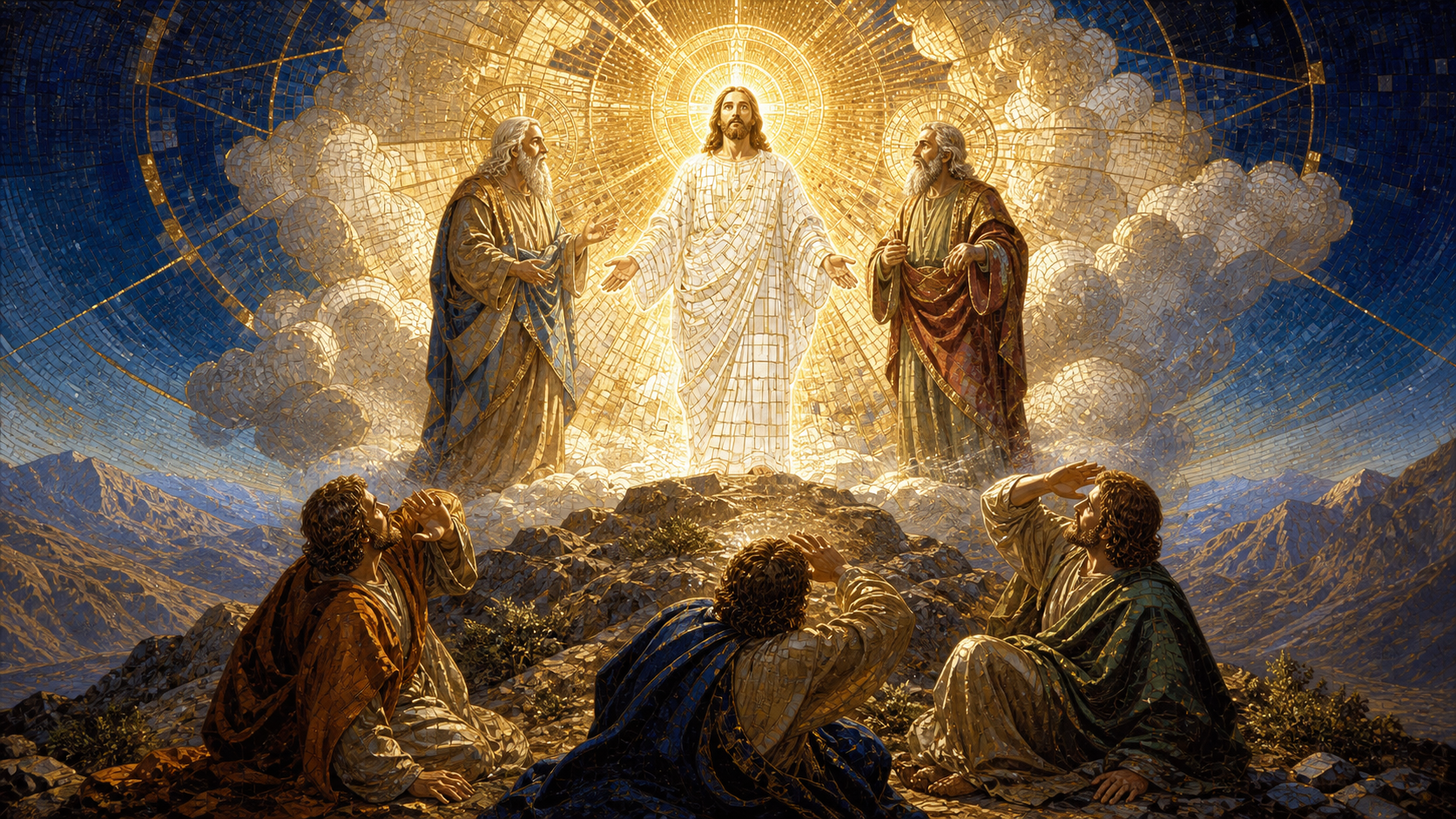
Six days after promising that some of his disciples would see the Son of Man in his kingdom, Jesus leads Peter, James, and John apart onto a high mountain. There his face shines like the sun and his garments become dazzling white. Moses and Elias appear beside him: the Law and the Prophets do not compete with Christ but converse with and testify to their Lord. Peter wishes to preserve the radiant moment, yet the bright cloud interrupts him and the Father directs every heart toward the Son: “Hear him.” Glory does not remove the path Jesus has already announced. The same Lord whose splendor casts the disciples to the ground draws near, touches them, and tells them not to fear. When they look up, Jesus alone remains. They must descend in silence, carrying a vision whose meaning will become clear only when the Son of Man has passed through death and risen.
Douay-AI, modernized from the public-domain Douay-Rheims Bible. View source ↗
And after six days, Jesus took Peter and James, and John his brother, and brought them up onto a high mountain apart.
And he was transfigured before them. His face shone like the sun, and his garments became white as snow.
Jerome insists that Christ did not discard his bodily reality or exchange it for an illusion. His familiar face and garments remained, but were clothed in glory: the transformation increased their brightness without destroying their substance. The disciples thus received a true anticipation of the majesty in which the Lord will come in his kingdom. Remigius notes that the sun is used because human sight knows nothing brighter, not because the Creator’s radiance can be measured by a creature. The vision accommodates divine splendor to the disciples’ capacity while confirming that the body destined for suffering is also the body of glory.
And behold, Moses and Elias appeared to them, talking with him.
Chrysostom gives several reasons for the appearance of Moses and Elias. Their presence distinguishes Christ from the prophets people imagined him to be and answers accusations that he opposed the Law or usurped the Father’s glory. Moses represents the giver of the Law and one who died; Elias represents prophetic zeal and one taken from earthly life. Together they show Christ’s authority over life and death. They also prepare the disciples for the cross, since both had faced rulers and danger for God’s people. Hilary therefore sees Christ standing between the Law and the Prophets, which proclaim him yet remain his servants.
Peter answered and said to Jesus, “Lord, it is good for us to be here. If you will, let us make three tabernacles here: one for you, one for Moses, and one for Elias.”
Chrysostom reads Peter’s proposal in light of Jesus’ recent prediction of suffering. The apostle loves his Master and sees the mountain’s solitude as safety from those plotting in Jerusalem; unable to repeat his earlier protest, he suggests remaining there under three tents. Remigius also recognizes Peter’s genuine delight and obedient qualification, “If you will.” Yet Jerome exposes the proposal’s confusion: Moses and Elias must not be placed beside Christ as equal lords. The Law and the Prophets dwell within the one Gospel and lead to the Son. Peter’s affection is real, but it must be purified into obedience to Christ’s saving mission.
While he was still speaking, behold, a bright cloud overshadowed them. And behold, a voice from the cloud said, “This is my beloved Son, in whom I am well pleased. Hear him.”
Jerome says the Father answers Peter’s mistaken proposal on the Son’s behalf. The voice distinguishes Christ from Moses and Elias: this is the beloved Son, while they are servants who themselves prepare a dwelling for the Lord in their hearts. Chrysostom observes that the cloud is bright because God intends to teach rather than threaten; from it the Father bears unmistakable witness. “Hear him” therefore gathers the vision into a command of obedience. Christ’s unity of will with the Father includes his willing journey to the cross. Peter must not resist that path, but trust the Son whom the Father loves and approves.
When the disciples heard this, they fell upon their faces and were very much afraid.
Jerome identifies three sources of the disciples’ terror: awareness that Peter had spoken wrongly, the bright cloud covering them, and the Father’s voice sounding from heaven. Human weakness cannot sustain such glory by its own power, so soul and body bow to the earth. Chrysostom adds that the isolated height, the transfiguration, the intense light, and the enveloping cloud all deepened their awe beyond what crowds experienced at Christ’s baptism. Their prostration is not the end of revelation. It strips away mastery and self-confidence, leaving them ready to receive consolation from the Son whose majesty has overwhelmed them.
And Jesus came and touched them, and said, “Arise, and do not be afraid.”
Jerome pictures the disciples lying powerless until Jesus approaches them. His gentle touch banishes fear and gives strength back to their unnerved bodies; then his spoken command completes what his hand begins. He removes fear before offering further teaching, because terrified hearts cannot yet receive it. The sequence displays the character of Christ’s authority. The Son acclaimed by the Father does not remain remote within the cloud or demand that the disciples recover themselves. He crosses the distance, touches their frailty, and commands them to rise. Reverence before divine glory thus becomes courage through personal contact with the incarnate Lord.
And lifting up their eyes, they saw no one except Jesus alone.
Jerome explains that Moses and Elias disappear so the Father’s testimony cannot be misunderstood as referring equally to any of the three. The disciples find Jesus standing alone after the cloud has passed: the unique beloved Son remains. He also reads the moment within salvation history. When the shadows and figures of the Law and the Prophets have fulfilled their purpose, both are found gathered into the Gospel of Christ. Their disappearance does not reject their testimony; it reveals its destination. The disciple who truly hears Moses and the prophets finally lifts his eyes to the Lord to whom they pointed and obeys Jesus alone.
And as they came down from the mountain, Jesus charged them, saying, “Tell the vision to no one until the Son of Man has risen from the dead.”
Jerome says Jesus forbids immediate publication because so astonishing a vision might be dismissed, while the scandal of the cross following such glory could confuse hearers who lacked the resurrection’s light. The command joins mountain and Calvary, splendor and suffering, into one mystery. Remigius adds that premature acclaim might provoke resistance to the passion through which redemption would be accomplished. Hilary looks beyond the silence: once filled with the Holy Spirit, the apostles will become witnesses of these divine deeds. They descend not to bury the truth forever, but to await the event that makes its meaning and proclamation complete.
The Transfiguration is not an escape from the Gospel’s difficult road. Christ allows three disciples to behold the glory that is always his, then leads them back down the mountain toward Jerusalem. Moses and Elias confirm that the Law and the Prophets converge upon him; the Father’s voice leaves no room to treat Jesus as merely one teacher among others. “Hear him” means receiving both his radiant majesty and his teaching about the cross. The disciples fall because created strength cannot master divine glory, yet Jesus does not leave them crushed. He approaches, touches them, and commands courage. When every supporting sign has withdrawn, they see Jesus alone—the same embodied Lord who will suffer, die, and rise. Christian contemplation must therefore become faithful descent: prayer opens our eyes to Christ’s splendor so that we can follow him into service, trial, and hope. We do not build tents to hold a passing consolation. We listen, rise at his touch, and carry the promise of resurrection into the valley below.
Read the source Catena Aurea ↗
Chrysostom explains that Jesus did not fulfill his promise immediately. The interval guarded the other disciples from jealousy and awakened a more eager desire in the three who would ascend. Peter, James, and John were chosen for a privileged witness, yet Matthew records their preference without resentment, showing the apostolic company’s freedom from vain glory. Remigius adds that the high mountain and solitude teach an interior ascent: whoever seeks contemplation must lift the heart above disordered pleasures and become wholly attentive to heavenly things. The separation is not contempt for others, but preparation for a testimony that will later strengthen them.