22
Immediately Jesus compelled his disciples to get into the boat and go before him across the water, while he dismissed the people.
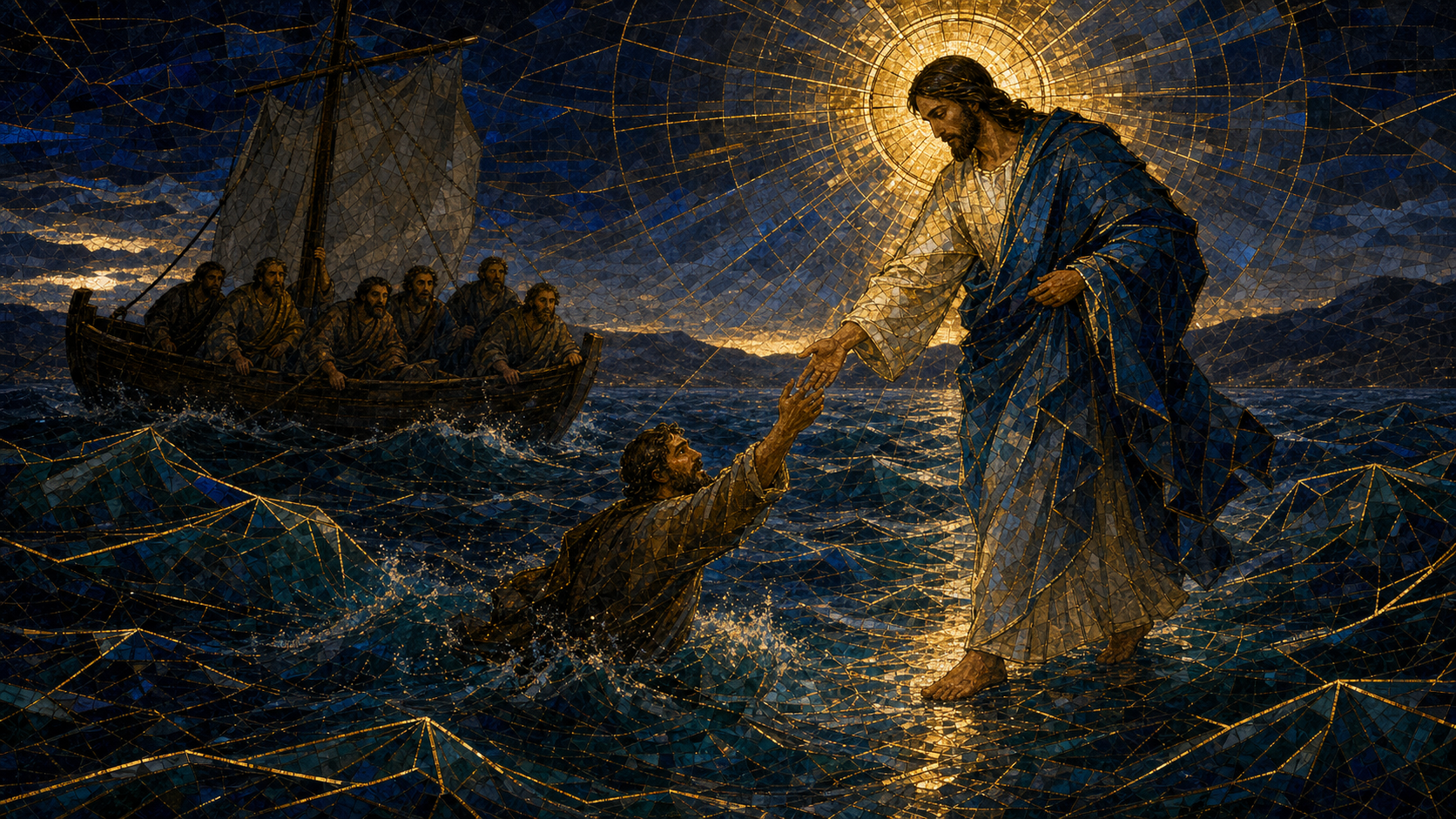
Matthew 14:22–36
Today’s interpretive key
Christ comes to his storm-tossed disciples, calls Peter beyond natural strength, rescues faltering faith, and brings healing wherever his presence is received.
After feeding the multitude, Jesus sends his disciples across the sea and withdraws alone to pray. Night deepens, the wind turns against the boat, and the disciples labor far from shore without the visible presence of their Lord. Yet Christ has not abandoned them. He comes in the darkest watch, walking upon the very waters that threaten them, and his voice changes terror into courage. Peter discovers both the daring made possible by Christ's command and the weakness that returns when fear commands his attention. His cry is answered at once by an outstretched hand. The calm that follows leads the boat to adoration, and the crossing opens into a land where the sick reach for the hem of Christ's garment. The passage moves from separation to presence, from fear to confession, and from desperate need to healing grace.
Douay-AI, modernized from the public-domain Douay-Rheims Bible. View source ↗
Immediately Jesus compelled his disciples to get into the boat and go before him across the water, while he dismissed the people.
After dismissing the multitude, he went up a mountain alone to pray. And when evening came, he was there alone.
Chrysostom sees in Christ's withdrawal a deliberate lesson about both crowds and solitude. After a great sign, Jesus does not pursue public praise or gather admirers around himself; he releases the multitude and seeks the stillness of the mountain. Yet he does not reject people as though isolation were always holier. He has served them fully, and now he prays alone. The pattern joins active mercy to hidden communion with the Father. Evening finds Christ physically apart from disciples and crowd, but his solitude is fruitful, not empty. The one who will come to the distressed boat first remains in prayer.
But the boat, in the midst of the sea, was tossed by the waves, for the wind was contrary.
Chrysostom compares this storm with the earlier tempest in which Jesus was aboard the boat. Now the disciples are alone to their senses, and the trial therefore reaches more deeply. Christ leads them by degrees into stronger endurance: first they learned that he could quiet a storm while present; now they must discover that his care reaches them even across distance and darkness. Jerome observes that the contrary wind rises while the Lord remains on the mountain, and danger continues until he comes. The delay is not neglect. It exposes the limits of the disciples' strength and prepares them to recognize their deliverer more fully.
And in the fourth watch of the night, he came to them, walking upon the sea.
Chrysostom says that Christ allows the disciples to be tossed through the night so their longing for him may deepen and their memory of deliverance may endure. He teaches them not to demand immediate release from every trial but to bear hardship courageously. Jerome explains that the fourth watch is the final three-hour portion of the night, showing how long their danger lasted. Then Jesus approaches by walking upon the sea. He does not merely send relief from afar; he makes the threatening water itself his road. What the disciples cannot cross by exhausted effort lies under the feet of the one coming to save them.
Seeing him walk upon the sea, they were troubled and said, “It is an apparition.” And they cried out for fear.
Chrysostom observes that the disciples' fear increases at the very moment rescue draws near. Worn by the storm and unable to imagine a man walking on the waves, they interpret Christ's approach as an apparition. The Lord permits this final intensification so that relief may be received with greater joy and his presence remembered more firmly. Jerome notes that their confused cry reveals the depth of their terror. The verse exposes how suffering can distort recognition: exhausted hearts may mistake grace for a new threat. Yet Christ does not turn away because they misunderstand him. He comes close enough for his word to overcome their frightened conclusion.
Immediately Jesus spoke to them, saying: “Take heart. It is I. Do not be afraid.”
Jerome lingers over Christ's words, “It is I,” spoken without further identification. The disciples may recognize his familiar voice through the darkness, but Jerome also hears an echo of the divine name revealed to Moses: the one who is has come to them. Chrysostom notes that the speech itself removes fear and prepares confidence. Jesus has not yet stilled the wind; he first gives the disciples himself. Their courage is therefore rooted neither in calm weather nor in their ability to control the boat. It arises because the Lord stands upon the chaos and makes his presence known: take heart, recognize me, and do not fear.
Peter answered and said: “Lord, if it is you, command me to come to you upon the waters.”
Augustine places the heart of Peter's request in dependence: “I cannot do this by myself, but in you I can.” Peter confesses both human weakness and the gift he expects from Christ. Chrysostom likewise praises his ardent faith and love. Peter does not ask for a display detached from Jesus; he asks to come to him. Nor does he merely request Christ's prayer. He believes the Master's command itself can uphold another man upon the sea. His boldness is still immature, but its direction is true. Faith ventures beyond natural capacity only when it listens for Christ's word and moves toward Christ himself.
And he said, “Come.” Peter went down out of the boat and walked upon the water to come to Jesus.
Chrysostom sees this as a greater disclosure of Christ's authority over the sea. Jesus not only walks upon it himself but enables another to do so at his command. Peter's movement is not a technique he has acquired or a power he now possesses independently. The verse holds cause and purpose together: Christ says, “Come,” and Peter walks in order to come to Christ. Jerome also insists that Peter's real human body upon the yielding water confirms the bodily reality of the Lord who walks before him. The impossible path remains sustained by the person and word of Jesus from first step to last.
But seeing the wind strong, he was afraid; and as he began to sink, he cried out, saying: “Lord, save me.”
Jerome says Peter is allowed a brief temptation so his faith may grow and he may learn that salvation comes from the Lord's power, not from his own daring request. Faith burns in him, but human weakness draws him downward. Chrysostom notes the paradox that Peter has overcome the greater obstacle—the waves—yet is shaken by the wind. Such instability belongs to fallen human nature. Still, Peter does not surrender to the sea or attempt to rescue himself. His fear becomes prayer. The disciple who looked away from Christ calls back to him, naming both the only savior and his immediate need: Lord, save me.
Immediately Jesus stretched out his hand, took hold of him, and said: “You of little faith, why did you doubt?”
Augustine asks whether the Lord would desert in danger the man whose first appeal he had answered, and points to the Gospel's decisive word: immediately. Jesus catches Peter as soon as he cries. Chrysostom explains that Christ does not first silence the wind, because the deeper danger lies in Peter's wavering faith, not in the storm's strength. The outstretched hand both saves and teaches. Jesus' question exposes doubt without denying the faith that brought Peter from the boat and returned him to prayer. Divine help stands where human strength fails, and correction is received within the grasp of mercy rather than from a distant shore.
And when they had come up into the boat, the wind ceased.
The Catena's comment under the name Rabanus draws the spiritual meaning plainly: it is no wonder that the wind ceases when the Lord enters the boat, because where Christ is present by grace, inner wars are quieted. The literal calm also completes the sign. Jesus has walked over the sea, upheld Peter upon it, caught him when he sank, and now stills the contrary wind by entering the vessel. The disciples do not produce peace through better seamanship. Calm arrives with Christ. His presence does not make their earlier struggle unreal; it reveals the one toward whom every faithful struggle was carrying them.
Those who were in the boat came and adored him, saying: “Truly, you are the Son of God.”
Chrysostom traces how Jesus leads the disciples gradually beyond what they had understood. He had previously rebuked the sea; now he walks upon it, commands Peter to do the same, saves him when he falters, and brings the wind to silence. The accumulated signs draw those in the boat to worship and a fuller confession: truly, you are the Son of God. Their words answer the earlier terror that called him an apparition. The same figure once misread in darkness is now adored in the calm. Deliverance becomes revelation, and revelation asks for more than relief—it summons those saved to acknowledge who their savior is.
Having crossed the water, they came into the country of Genesar.
Remigius connects the arrival directly to Jesus' earlier command that the disciples cross ahead of him. The narrative now tells where that commanded passage ends: the country of Genesar. After the night of contrary wind, fear, rescue, and adoration, the boat reaches an actual shore. This quiet geographical statement seals the faithfulness of Christ's direction. The disciples were sent across, not abandoned in the middle. Their route included a storm they could not master, yet the Lord joined them and brought the journey to completion. Obedience is vindicated not by an easy passage but by arrival in the company of Jesus.
When the men of that place recognized him, they sent throughout all that country and brought to him all who were diseased.
Jerome says the people recognize Jesus through his fame, even if many have not previously seen him face to face. He praises their faith because they are not content that only the sick of their own immediate place should be healed. They send throughout the surrounding country and bring all who suffer to Christ. Knowledge of the Lord becomes responsibility for the neighbor. The men of Genesar do not guard access, calculate worthiness, or select easier cases. They spread the news and carry the diseased toward the one who has just brought his disciples through the sea. The shore becomes a new scene of shared mercy.
They begged him that they might touch only the hem of his garment; and as many as touched were made whole.
Chrysostom observes that the people no longer insist that Jesus enter each house or lay his hand upon every sick person. Their faith has matured through the witness of the woman healed by touching his garment, and they beg only for the hem. The power does not belong to cloth considered apart from Christ; the garment is the point of their bodily contact with the Lord they trust. The Evangelist then gives an unrestricted result: as many as touched were made whole. Chrysostom finally directs Christian readers beyond the hem to Christ's own body, received as a still greater gift from the same merciful Lord.
The disciples do not escape the contrary wind because they obeyed Christ; obedience carries them into it. Nor does the Lord's solitude on the mountain mean indifference. While they strain through darkness, he prays, sees, and comes. The sea remains real, the wind remains strong, and Peter's fear is not imaginary. Yet none of these has final authority. The decisive word is Christ's command: come. Peter can stand where nature offers no footing because the Lord who calls also sustains. When his attention contracts around the storm, he begins to sink, but even failing faith remembers how to pray: Lord, save me. The answer is immediate and personal—Christ's own hand. Christian courage is therefore neither denial of danger nor confidence in self. It is sustained attention to Jesus, honest dependence when courage fails, and trust that the one who commands the waters can also draw the sinking disciple up. When he enters the boat, fear becomes worship. When he reaches the shore, suffering reaches for him and is made whole.
Read the source Catena Aurea ↗
Jerome notices the force of the command: Jesus must compel the disciples because they do not willingly leave their teacher even for a moment. Their reluctance springs from love, yet love must still obey when Christ sends them ahead. Chrysostom adds that Jesus separates the witnesses from the newly fed crowd so the miracle cannot be dismissed as an illusion sustained by his visible presence. The departure therefore serves both testimony and formation. The disciples carry the memory of abundance into a night where they will feel empty of help, and the Lord prepares to reveal that his power is not confined to the shore.