1
Then scribes and Pharisees came to him from Jerusalem, saying:
Matthew 15:1–2, 10–14
Today’s interpretive key
Christ turns attention from outward observance to the heart, exposing every tradition without divine roots and warning that blind guidance ends in a shared fall.
Religious leaders arrive from Jerusalem with a charge against the disciples: their hands have not been washed according to an inherited custom. After answering the accusers, Jesus calls the multitude nearer and asks for more than passive hearing. He teaches them to discern where true defilement begins. The human person is not corrupted by ordinary food entering the body, but by evil that comes from within and passes outward through speech and action. When the Pharisees take offense, Christ does not soften the truth to preserve their authority. He distinguishes what the heavenly Father plants from what merely wears the appearance of religion. False growth will not last, and teachers who refuse the light cannot safely lead others. The passage calls every disciple to an interior faith whose practices are rooted in God and whose guidance begins by seeing clearly.
Douay-AI, modernized from the public-domain Douay-Rheims Bible. View source ↗
Then scribes and Pharisees came to him from Jerusalem, saying:
“Why do your disciples transgress the tradition of the ancients? For they do not wash their hands when they eat bread.”
Jerome marvels that the accusers fault the Son of God for neglecting human traditions. The issue is not ordinary cleanliness but a ritual washing added by the elders, as Remigius explains. Chrysostom points out that their own wording betrays the weakness of the charge: they ask why the disciples transgress tradition, not why they break the Law of Moses. Jerome then interprets the washing morally. The hands most in need of purification are the mind's deeds, so that God's word may be carried out through them. External practices can assist devotion, but they cannot substitute for obedient action or claim divine authority merely because they are old.
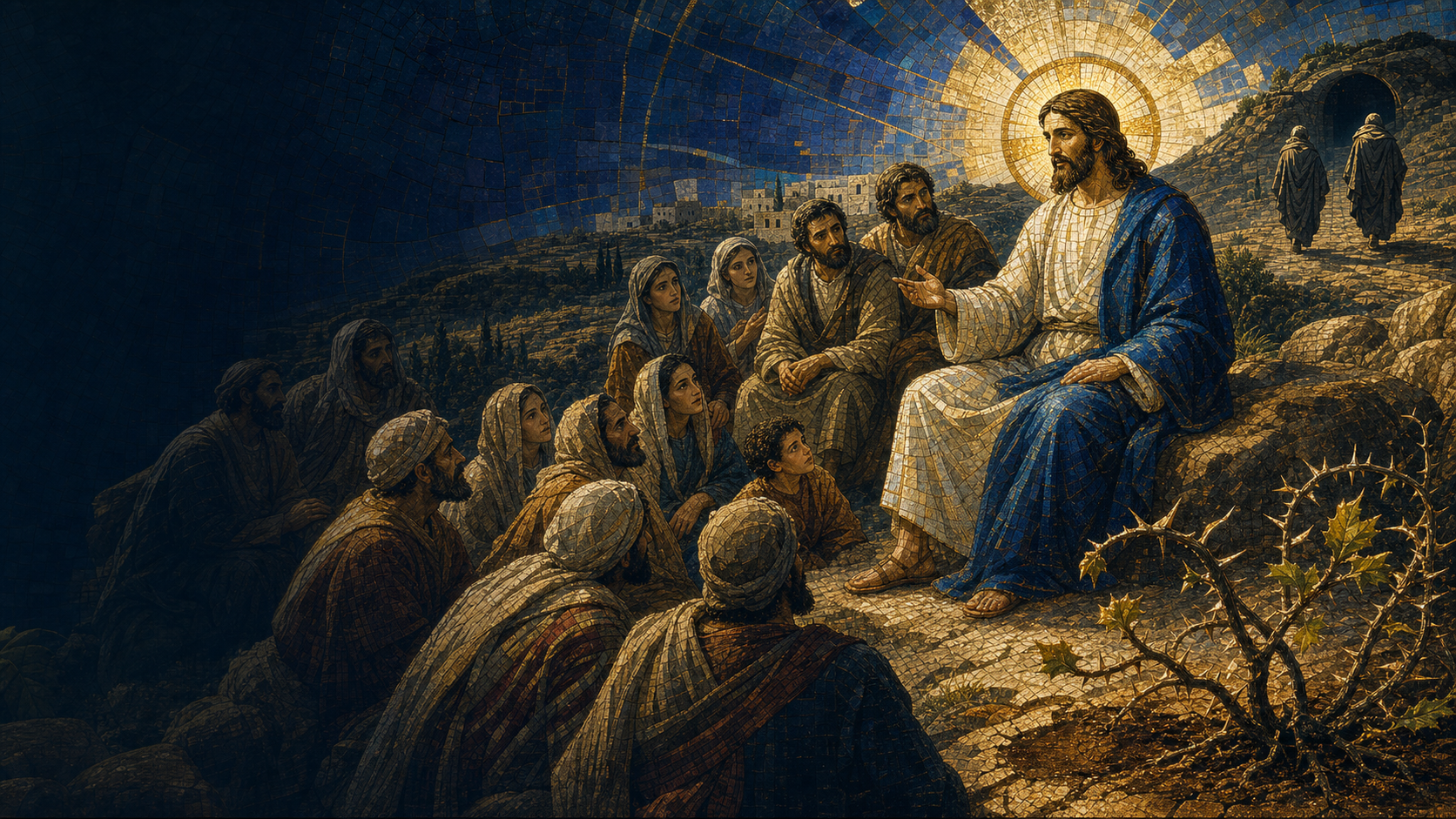
And calling the multitudes together to him, he said to them: “Hear and understand.”
Chrysostom sees care in the way Jesus delivers this demanding teaching. Having answered the Pharisees, he turns toward the multitude and calls them near, showing concern for their good. He does not cast the doctrine before them without preparation. The command to hear and understand rouses both attention and judgment: they must receive the words and apply their minds to their meaning. Christ also teaches without crudely attacking Moses or reducing the matter to a slogan about food. He leads his hearers through a truth rooted in the nature of moral action. The crowd is invited beyond inherited assumptions into thoughtful, obedient discernment.
It is not what enters the mouth that defiles a man; but what comes out of the mouth, this defiles a man.
Augustine insists that Christ's saying does not condemn the Old Testament. Creatures are good by nature, while the ritual distinctions of the former law served as temporary signs that trained God's people and pointed beyond themselves. Once their fulfillment is revealed in Christ, those figures must not be mistaken for claims that matter itself is evil. Jerome adds that Scripture's language of defilement concerns what is made morally common or unclean. Jesus directs attention to the responsible center of the person. Food entering the body is a creature; corrupt speech proceeding from the heart expresses consent, intention, and sin. Defilement is moral before it is ceremonial.
Then his disciples came and said to him: “Do you know that the Pharisees were offended when they heard this word?”
Chrysostom distinguishes the offended Pharisees from the crowd Jesus has called to understand. The leaders offer no answer because Christ has not only refuted their claim but uncovered the fraud beneath it. Their silence is not conversion; it hardens into offense. The disciples notice the reaction and bring it to Jesus, perhaps expecting him to ease the stumbling block. Jerome explains that scandal can mean an occasion of falling, but the following response shows that not every offended reaction requires truth to be withdrawn. Pastoral care attends patiently to weakness that desires understanding, while stubborn authority that rejects correction must not be allowed to govern the teaching.
But he answered them: “Every plant that my heavenly Father has not planted shall be rooted up.”
Hilary identifies the unplanted growth as human tradition used under a religious covering to transgress the Law. Christ is not rejecting what God commanded; Chrysostom observes that he has just defended the command to honor father and mother. The warning therefore judges counterfeit authority, not divine revelation. Remigius broadens the principle: false doctrine and superstitious observance cannot last because they do not come from the Father, while what is of God endures. The image asks about origins before appearances. A teaching may spread, gather defenders, and cause offense when challenged, yet its permanence depends upon whether God planted it in truth or human pride manufactured it.
“Let them alone. They are blind and leaders of the blind; and if the blind lead the blind, both will fall into the pit.”
Rabanus explains the leaders' blindness as the absence of light from God's commandments. Their condition does not remain private, because they draw others after themselves while wandering in error. The shared fall reveals the grave responsibility of both teaching and discernment. Jerome connects Christ's command to leave them with the apostolic counsel to withdraw after repeated admonition from someone fixed in perversity. This is not contempt for the confused or permission to abandon every difficult person. It recognizes that guides who repeatedly reject truth can use continued attention to extend their influence. Mercy seeks sight; prudence refuses to call blindness reliable leadership.
Jesus does not dismiss the body, communal worship, or faithful discipline. He exposes the fatal mistake of treating outward observance as though it could replace obedience of the heart. A custom may appear venerable and still become corrupt when it competes with God's command or shields the will from conversion. Christ therefore calls the crowd to hear and understand: holiness reaches deeper than surfaces. What enters from outside does not possess the moral agency to stain the soul; what the heart consents to and sends into the world does. The same test applies to teaching. What the Father plants bears the life of truth, while doctrine rooted in pride, manipulation, or mere human prestige cannot endure. Offense alone is not proof that a hard word is false. The necessary question is whether the guide sees by the light of God's command. Christian discernment must therefore examine both roots and fruit: the source from which a practice grows, the obedience it serves, and the kind of speech and action it produces.
Read the source Catena Aurea ↗
Chrysostom notes that these scribes and Pharisees arrive after Christ has performed many signs and healed the sick who touched his garment. Their resistance has not yielded before abundant evidence. He also observes that the Evangelist identifies Jerusalem because its religious leaders enjoyed higher rank and were therefore exposed to greater pride. Remigius sharpens the contrast: men who came from the holy city and taught the Law should have approached Jesus as learners, yet they came to find fault. Sacred office and knowledge are genuine goods, but they become dangerous when prestige makes correction unwelcome and inquiry becomes accusation.