13
When Jesus heard this, he withdrew from there by boat to a desert place apart; and when the multitudes heard of it, they followed him on foot out of the cities.
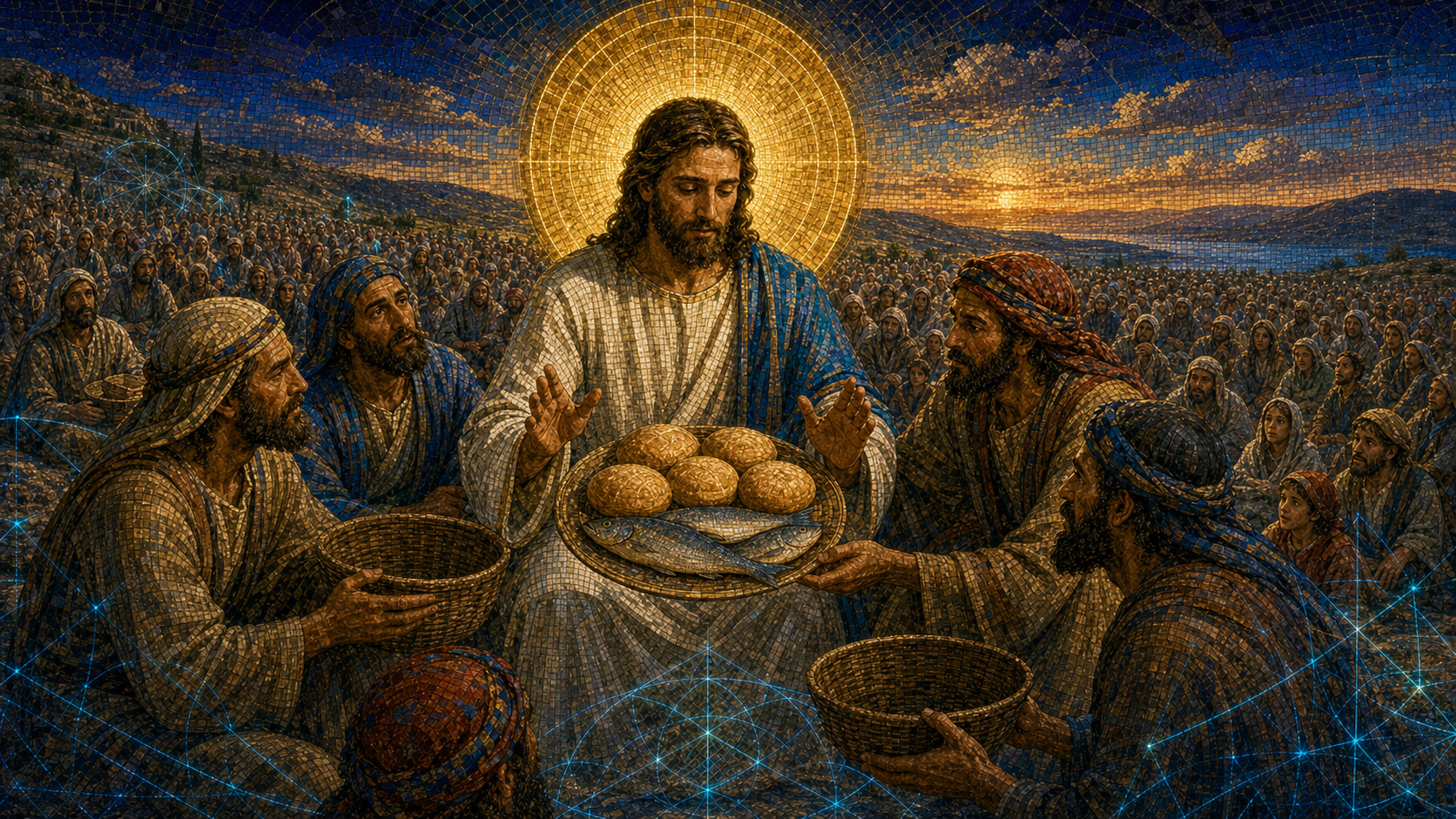
Matthew 14:13–21
Today’s interpretive key
Christ receives the crowd with compassion, places their hunger before his disciples, and turns a small offering into a feast whose abundance reveals the Father's providence.
Jesus withdraws after hearing of John the Baptist's death, but the crowds follow him beyond the cities. Solitude becomes encounter: he sees their need, heals the sick, and remains with them until evening. When the disciples can see only a late hour, an empty place, and insufficient food, Christ draws them into his own compassion. He does not dismiss the need or bypass their poverty. He asks them to give, receives the little they possess, blesses and breaks it, and places the gift back into their hands for the multitude. Everyone eats and is filled, while twelve baskets remain. In Christ, scarcity becomes a summons to trust, service becomes participation in divine generosity, and the desert becomes a table.
Douay-AI, modernized from the public-domain Douay-Rheims Bible. View source ↗
When Jesus heard this, he withdrew from there by boat to a desert place apart; and when the multitudes heard of it, they followed him on foot out of the cities.
And when he came forth, he saw a great multitude, had compassion on them, and healed their sick.
Chrysostom honors the zeal of people who left their cities and searched for Jesus, yet he insists that Christ's response exceeds any reward their effort could deserve. The Gospel names compassion as the cause of the healings: the Lord sees the multitude's misery and freely moves toward it. He heals all their sick without first demanding a demonstration of faith from each one. Human longing is real and their pursuit matters, but mercy begins in Christ. His coming forth turns a lonely place into a place of visitation, where need is seen rather than overlooked and weakness is met by divine generosity.
And when it was evening, his disciples came to him, saying: “This is a desert place, and the hour is now past. Send away the multitudes so that they may go into the towns and buy themselves food.”
Chrysostom sees the crowd's endurance until evening as evidence of faith: absorbed in seeking the Lord, they do not press forward to complain of hunger. The disciples notice the real need but have not yet learned what Christ intends, so their solution is dismissal. Jesus has led everyone into a setting where no neighboring supply can explain what follows. The desert removes suspicion from the miracle and exposes the disciples' limited expectation. Yet the place is not truly empty, because the one who feeds the world is present; nor is the hour beyond him, because the Lord who commands is not constrained by time.
But Jesus said to them: “They have no need to go. Give them something to eat.”
Jerome says that Christ summons the apostles to the breaking of bread so that their own testimony will make the miracle unmistakable: they know they possess no store capable of feeding the crowd. Chrysostom observes that Jesus does not immediately announce what he will do, since the disciples are not ready to grasp it. Instead, his command stretches their obedience beyond their calculation. The people need not depart from Christ to find life elsewhere. By telling the disciples to feed them, the Lord makes servants participants in his compassion and prepares their hands to become witnesses of a gift whose source can only be divine.
They answered him: “We have nothing here but five loaves and two fish.”
Chrysostom hears both limitation and virtue in the disciples' answer. They remain earthbound enough to measure the command only against five loaves and two fish, speaking to Jesus as though his power were confined to ordinary means. Yet their tiny supply also shows their detachment: twelve men carry little food because spiritual concerns have taken precedence over bodily provision. Christ does not shame them for stating what they have. The inventory becomes the beginning of the sign. Faith need not pretend that five loaves are many; it must learn that an honest account of poverty is not a final account when the little is offered to the Lord.
He said to them: “Bring them here to me.”
Chrysostom emphasizes that the disciples do not reserve their little supply for themselves when Jesus asks for it; they obey. Christ chooses to multiply existing bread and fish rather than create a meal with no visible beginning. In this way he confirms that the material world is his own good creation and reveals himself as Lord of both land and sea, the giver behind the earth's fruit and the water's life. The command also trains every disciple in mercy: even when what we possess appears too small for the need, we are not excused from bringing it to Christ and giving what he asks.
And when he had commanded the multitudes to sit down on the grass, he took the five loaves and the two fish; and looking up to heaven, he blessed, broke, and gave the loaves to his disciples, and the disciples gave them to the multitudes.
Chrysostom explains that Jesus looks to heaven and blesses in order to show his relation to the Father and to teach thanksgiving even in ordinary food. Christ's divine equality is not denied by this prayer; elsewhere his sovereign works display it openly, while here he directs his disciples to the giver of every gift. Jerome then lingers over the breaking: in the Lord's hands, division becomes a sowing, and fragments yield a manifold harvest. Jesus gives the loaves to the disciples so that the multitude receives from him through them. Grace has one source, yet it honors servants by making their hands instruments of its distribution.
And they all ate and were filled. And they took up what remained: twelve full baskets of fragments.
Chrysostom notes that the sign ends neither with a token taste nor merely enough food. All are filled, and the fragments exceed the original loaves, preventing anyone from dismissing the event as an illusion. The disciples' own hands distribute the meal and gather what remains, so their bodies and memories bear testimony to Christ's work. Jerome adds that each apostle fills a basket, receiving visible proof that real bread was truly multiplied. The simple menu also teaches moderation and common charity: Christ gives the same sustaining food to all, while the careful gathering of leftovers shows that divine abundance is never permission for waste.
And the number of those who ate was five thousand men, besides women and children.
Jerome draws attention to the correspondence between five loaves and five thousand men, seeing the numbers themselves as part of the Evangelist's ordered testimony. Chrysostom points to the crowd's remarkable endurance: so vast an assembly remained with Jesus, women and men alike, while food was still left over after everyone had eaten. The final count therefore magnifies both the people's zeal and the Lord's abundance. What began as provisions scarcely sufficient for the disciples becomes a feast for thousands, with women and children beyond the numbered men. The verse closes every path to a merely symbolic scarcity; this is generosity made visible at overwhelming scale.
The disciples are not rebuked for noticing the crowd's hunger. Their mistake is to imagine that the only answer lies elsewhere: send the people away, let them buy what they need. Jesus answers by drawing his followers nearer to the need—give them something to eat—and then nearer to himself—bring the loaves and fish here. The miracle does not erase creaturely means; it gathers them into thanksgiving, blessing, breaking, and distribution. Christ remains the giver, yet the bread reaches the crowd through disciples whose own hands testify to what he has done. The twelve baskets preserve that testimony after everyone is satisfied. Christian generosity begins neither in confidence that we possess enough nor in denial that resources are small. It begins by refusing to dismiss the hungry, placing what is truly available before Christ, and obeying the next act of service. The Lord who feeds the world is present even in the desert, and what is entrusted to him can become abundance for others.
Read the source Catena Aurea ↗
Jerome rejects the idea that Jesus withdrew because death had mastered him. Christ mercifully denied his enemies an immediate opportunity to add another murder, reserving his Passion for its appointed hour, and he also taught disciples not to rush presumptuously into danger. The Evangelist therefore says that he withdrew, not that he fled in terror. Jerome adds that the desert would test the people's faith. Their response confirms the point: they leave their cities and follow on foot, accepting effort and distance in order to remain near the Lord whose presence they desire.