54
And coming into his own country, he taught them in their synagogues, so that they wondered and said: “How did this man come by this wisdom and these miracles?”
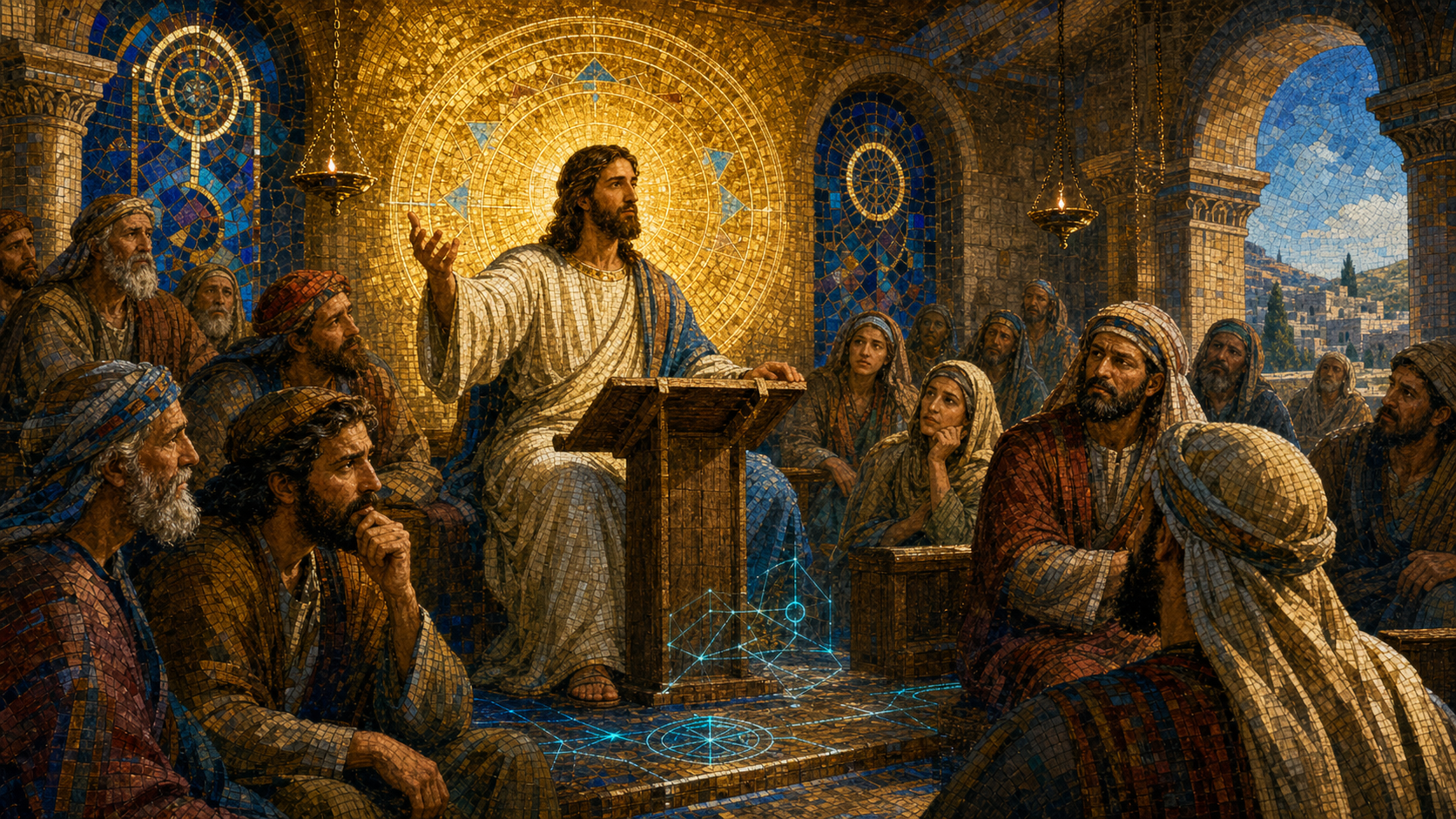
Matthew 13:54–58
Today’s interpretive key
Familiarity becomes a veil when it reduces Christ to what seems explainable; faith receives the divine wisdom present in the humility of his real human life.
Jesus returns to the place where his face, family, and ordinary history are familiar. His teaching astonishes the synagogue, yet wonder does not ripen into faith. The people ask the right question—where this wisdom and power come from—but use what they know of his household to close the question rather than pursue it. The scandal is not that Christ's humanity is unreal, but that divine wisdom has drawn so near within it. The townspeople cannot reconcile heavenly authority with the carpenter's home they recognize. Their refusal reveals a danger close to every believer: sacred things can become so familiar that we stop allowing them to disclose the living God.
Douay-AI, modernized from the public-domain Douay-Rheims Bible. View source ↗
And coming into his own country, he taught them in their synagogues, so that they wondered and said: “How did this man come by this wisdom and these miracles?”
Is this not the carpenter's son? Is not his mother called Mary, and his brethren James, Joseph, Simon, and Jude?
Jerome exposes the contradiction in their reasoning: they marvel that Wisdom possesses wisdom and that Power performs mighty works, then suppose the carpenter's household explains him away. Their knowledge is partial rather than false—Jesus truly belongs to this human family—but they make what is humble a boundary around what God may reveal. Jerome also clarifies that Scripture's “brethren” names close relatives, not other children of the Blessed Virgin. The verse therefore safeguards both the reality of Christ's human kinship and the mystery his neighbors miss. Familiar facts are not meant to abolish wonder; received rightly, they lead deeper into the Incarnation.
And are not all his sisters with us? Where, then, did he get all these things?
Hilary sees the townspeople held by the visible conditions of Christ's embodied life. They know his relatives and the trade associated with his home; meanwhile, the wisdom of his teaching and the power of his works compel their admiration. Instead of allowing those works to correct their narrow judgment, they use his familiar surroundings to resist belief. Their question—where he received all this—thus reveals both the strength of the evidence and the closure of their response. The Incarnation confronts that closure: divine power does not cease to be divine when it comes clothed in a body, a neighborhood, and relationships that others regard as ordinary.
And they were scandalized because of him. But Jesus said to them: “A prophet is not without honour, except in his own country and in his own house.”
Chrysostom directs attention to Christ's mercy. His countrymen speak of him contemptuously and convert their familiarity into offense, yet he does not answer with anger or insult. He calmly names the recurring fate of a prophet: strangers may perceive a gift that neighbors refuse to honor. Jerome adds that people often judge someone by remembered weakness or childhood rather than by the works now before them, as though growth were suspicious only in another person. Christ's saying exposes this jealous narrowing of sight. His mild reply also models prophetic freedom: truth need not retaliate when rejected, but neither does charity pretend that contempt is faith.
And he worked not many miracles there because of their unbelief.
Jerome insists that Christ's power was not defeated by their unbelief. He refrained from many miracles because further signs, received without faith, would only deepen his countrymen's responsibility for rejecting what they had seen. Chrysostom similarly explains that Christ seeks the hearer's profit, not a display of himself; where wonders would not lead to salvation, multiplying them would increase condemnation rather than heal. Even so, he performed some works, leaving them no ground to claim that faith was impossible for lack of any sign. The verse is therefore both warning and mercy: unbelief truly withholds fruit, while Christ's restraint refuses empty spectacle and unnecessary judgment.
Nazareth's questions are not foolish in themselves. The mystery truly is astonishing: the one whose mother and relatives they know speaks with wisdom and acts with divine power. Their failure lies in deciding that the familiar must set the limits of what God can do. Christ does not deny the humility of his human household; he reveals that God's glory can be present there without spectacle. The same test returns whenever Scripture, the sacraments, the Church, or an ordinary neighbor seems too well known to bear a fresh summons from God. Faith does not abandon reason. It lets reason remain open before the evidence of grace. Christ answers rejection without bitterness, yet unbelief still closes the place to gifts he desires to give. Today, ask not only where his wisdom comes from, but whether you will receive it.
Read the source Catena Aurea ↗
Chrysostom identifies Christ's own country here as Nazareth and notes that, although Capharnaum had seen more of his miracles, Nazareth was given teaching that caused no less wonder. The townspeople therefore encounter genuine evidence: wisdom stands before them in words they cannot explain by ordinary expectations. Their amazement could have become a doorway to faith, but they remain fixed on the question of origin without following it toward God. Christ nevertheless teaches them. He does not withhold the truth because he knows their familiarity may resist it; he offers his countrymen the same saving doctrine that has stirred others.