36
Then, having sent away the multitudes, he came into the house; and his disciples came to him, saying: “Explain to us the parable of the cockle of the field.”
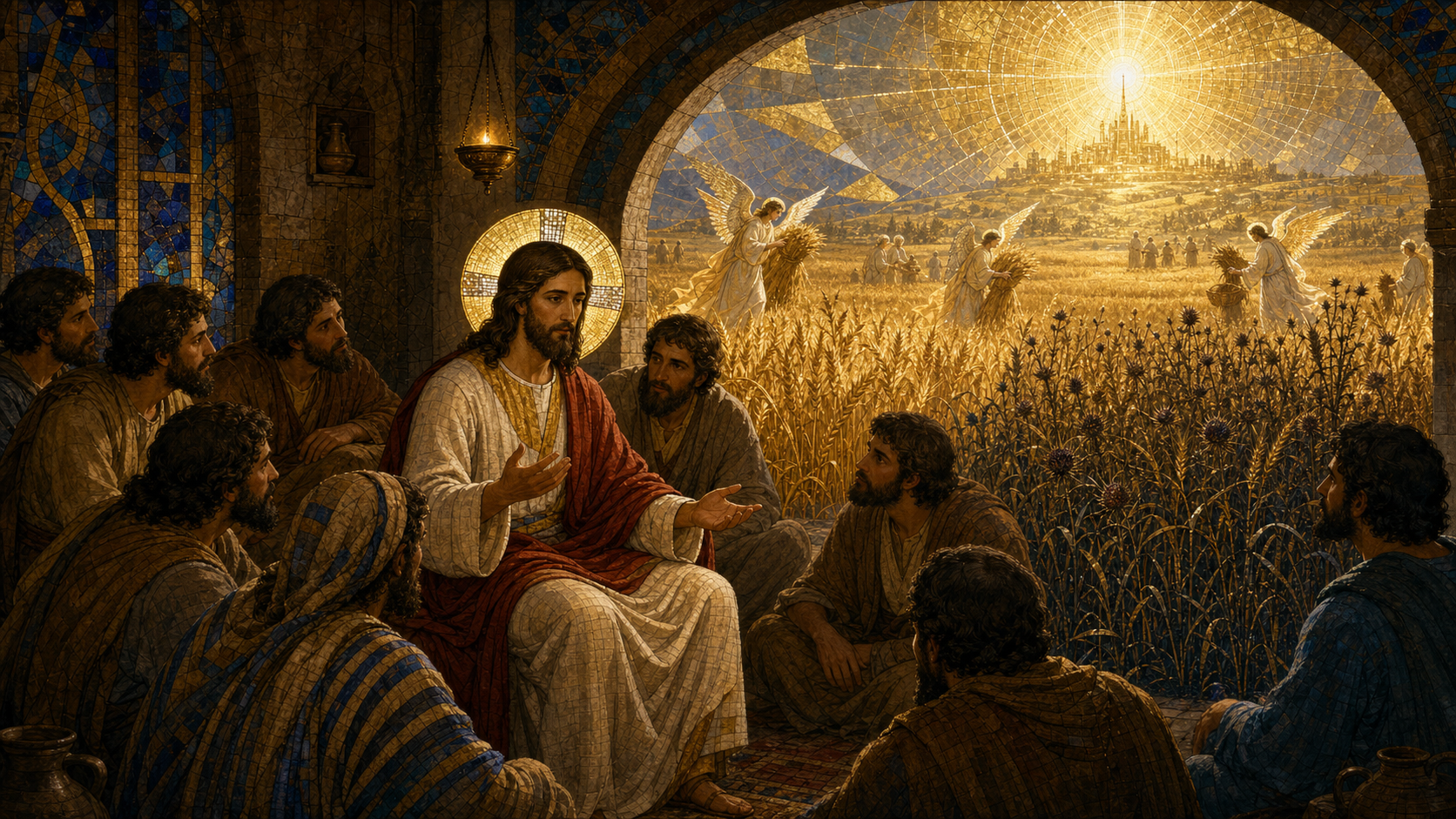
Matthew 13:36–43
Today’s interpretive key
Christ reveals himself as the sower, names the hidden conflict within the world, and promises a final harvest in which evil is removed and the just shine in the Father's kingdom.
Away from the crowd, the disciples ask Jesus to uncover the meaning of the parable of the cockle. His answer leaves no part of the image undefined: the sower, field, seed, enemy, harvest, and reapers all belong to a single account of history under divine judgment. The present world holds a painful mixture of good and evil, but it is neither abandoned to the enemy nor destined to remain confused. The field belongs to the Son of Man. He sows children of the kingdom within it, permits time for growth, and promises that his angels will gather away every scandal. The final word is not darkness, but the radiance of the just in their Father's kingdom.
Douay-AI, modernized from the public-domain Douay-Rheims Bible. View source ↗
Then, having sent away the multitudes, he came into the house; and his disciples came to him, saying: “Explain to us the parable of the cockle of the field.”
He answered and said to them: “He who sows the good seed is the Son of Man.”
Remigius pauses over Christ's title, “Son of Man.” The one who sows the good seed does not speak of himself in a way that obscures the humanity he truly assumed. The title can therefore teach humility, guard the confession that Christ is genuinely man, and lead believers through faith in his humanity toward knowledge of his divinity. The sower is not a distant power who leaves the field to another; it is the incarnate Son himself who acts within the world. Every good seed begins in his initiative, and the humility of his self-naming reveals the manner in which divine life enters human history.
The field is the world. The good seed are the children of the kingdom, and the cockle are the children of the wicked one.
Augustine insists that Christ's explanation does not support the Manichaean claim that evil belongs to a separate created substance or that false material has been inserted into Scripture. The cockle signifies people who imitate the devil's fraud and become children of the evil one by their impiety. This preserves both the goodness of creation and the moral seriousness of the parable. The field remains the world sown by Christ; evil is not an equal creation standing beside his work. The contrast between the seeds reveals opposed forms of life and allegiance, calling hearers away from imitation of the enemy and toward the character of the kingdom.
The enemy who sowed them is the devil. The harvest is the end of the world, and the reapers are the angels.
Chrysostom identifies the enemy's craft as the attempt to mingle error continually with truth. Yet the devil neither owns the field nor controls its completion. Christ also uses harvest imagery for conversion already taking place through preaching, but here the same image points to the end of the world, when the fruit of hearing the word is fully disclosed. The two uses are not confused: one names the gathering of people into faith, while this one names the final examination of what their lives have borne. The angels reap under Christ's authority, so the outcome rests with the Lord who sowed and who brings history to judgment.
Just as the cockle, therefore, is gathered up and burned with fire, so shall it be at the end of the world.
Augustine reads the first separation of the cockle from the wheat as a sign that the wicked will finally be distinguished from the righteous. He also observes that good angels can carry out duties of punishment with a good spirit, just as a just judge or a just law may do, whereas the wicked cannot perform works of mercy with a rightly ordered heart. The fire therefore does not picture rage escaping divine government. It belongs to a judgment administered under God's order. The comparison warns that the present mixture is temporary and that moral difference, often obscured now, will not be erased at the world's end.
The Son of Man shall send his angels, and they shall gather out of his kingdom all scandals and those who work iniquity.
Rabanus attends closely to the present force of “those who work iniquity.” Christ does not say simply those who once did wrong, as though repentance could never change a sinner's course. Those delivered to punishment are the ones who remain in their sins. This distinction does not weaken the warning about scandals or iniquity; it makes the warning urgent in the present. The kingdom cannot finally retain what causes others to fall or what persists in opposition to God's will. Yet the time before the angels' gathering is also the time in which a person may turn, cease the work of iniquity, and seek the mercy that conversion receives.
And they shall cast them into the furnace of fire; there shall be weeping and gnashing of teeth.
Chrysostom places the furnace and its anguish within a wider vision of God's dealings with humanity. The Lord is ready to show mercy and slow to punish: when the good seed is sown, Christ himself performs the sowing; when punishment comes, he sends angels as ministers. This distinction does not make the judgment unreal, for the weeping and gnashing of teeth express the grievous consequence of iniquity. It does show that destruction is not the delight of the sower. The verse must therefore be heard without either denial or cruelty—with sober fear of sin, trust in God's patient mercy, and refusal to claim the judge's office for ourselves.
Then shall the just shine like the sun in the kingdom of their Father. He who has ears to hear, let him hear.
Chrysostom explains that Christ compares the brightness of the just to the sun because human experience knows no clearer visible image of radiance. The comparison does not imply that their promised glory can rise no higher; it accommodates heavenly truth to what hearers can presently grasp. After the removal of every scandal, the children of the kingdom are not merely preserved from loss but made resplendent in their Father's kingdom. The final command concerning ears turns the vision into a present appeal. A person must do more than register the words: hear their spiritual meaning, let the promised light expose present darkness, and live toward the glory Christ reveals.
Jesus does not disclose the harvest so that we may sort the world into people we presume to condemn and people we presume to save. He gives the interpretation to awaken moral seriousness, endurance, repentance, and hope. The enemy is real, scandal wounds, and unrepented iniquity has an end; yet the field remains Christ's, the seed is his work, and judgment belongs to the Son of Man and his angels. Until the harvest, the Church calls sinners to conversion and guards the good seed without pretending that evil is harmless. To hear with the ears Christ asks for is to let the promised radiance govern the present life: turn from iniquity, refuse to become a stumbling block, and grow as a child of the kingdom toward the Father's light.
Read the source Catena Aurea ↗
Chrysostom notices that Jesus' many parables had not moved the crowd to ask what they meant. After dismissing the multitude, he enters the house, and the disciples approach him without the hesitation they had felt before. They have heard that knowledge of the kingdom's mysteries is given to them, so they now ask with freedom and trust. They pass over the more evident images of mustard seed and leaven and seek an explanation of the cockle, whose likeness to the earlier sowing conceals a further teaching. Their private question models attentive discipleship: receive Christ's word, recognize what remains obscure, and draw near to the Teacher.