31
Another parable he proposed to them, saying: “The kingdom of heaven is like a grain of mustard seed, which a man took and sowed in his field.”
Matthew 13:31–35
Today’s interpretive key
God's kingdom begins in hidden littleness, grows beyond human expectation, transforms what receives it, and discloses mysteries long prepared in divine wisdom.
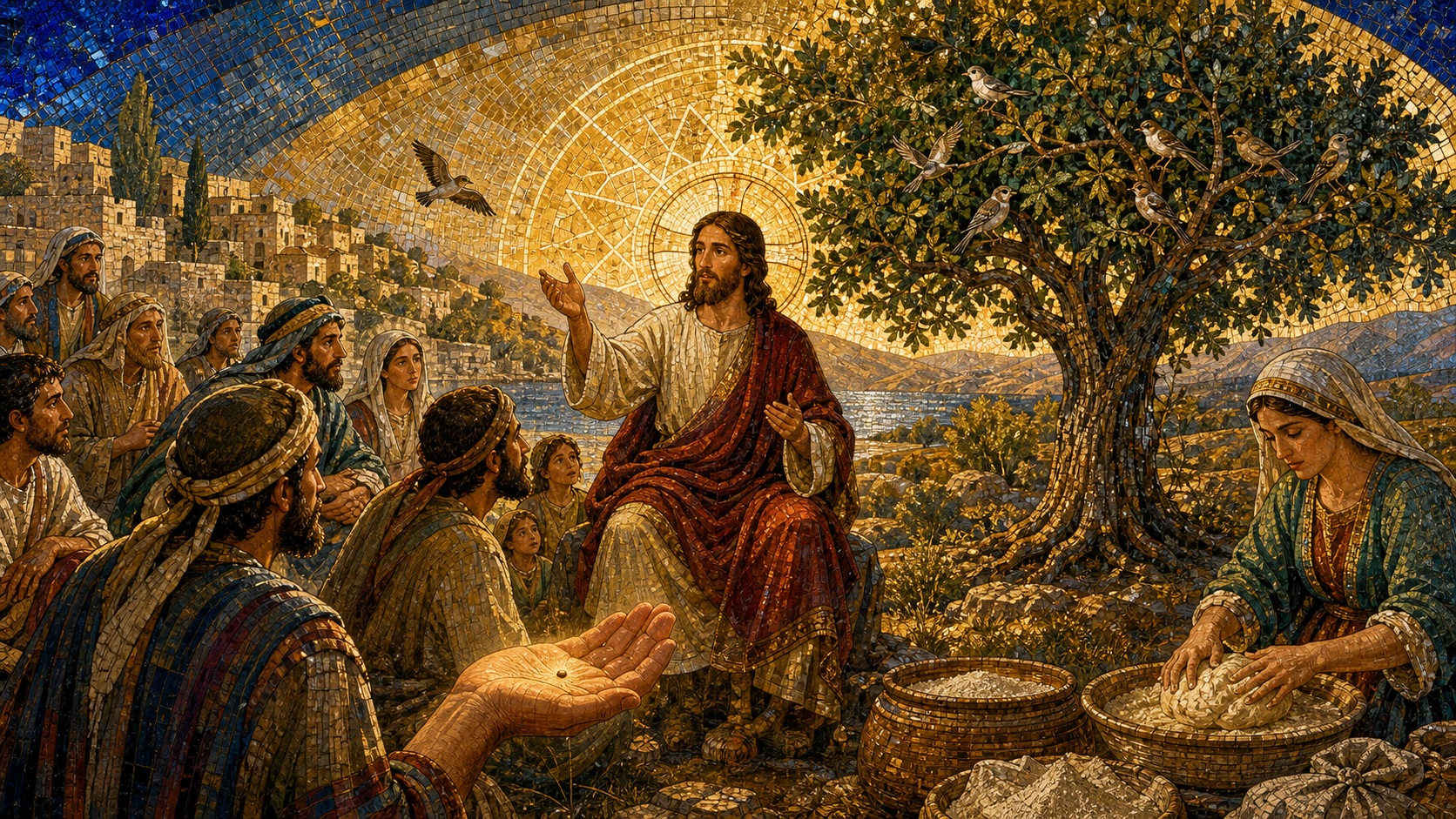
Jesus places two ordinary beginnings before the crowd: a seed small enough to rest in a hand and leaven hidden within meal. Neither announces its future by outward grandeur. Yet the seed becomes a shelter, and the leaven quietly changes the whole mass. The kingdom advances with this same divine patience. Christ's word may appear fragile beside the scale of the world, but its life is not measured by appearances. Received in faith, it grows, gathers, and transforms. Even the parables themselves share this pattern: familiar images carry mysteries hidden from the world's foundation and open them to attentive hearts.
Douay-AI, modernized from the public-domain Douay-Rheims Bible. View source ↗
Another parable he proposed to them, saying: “The kingdom of heaven is like a grain of mustard seed, which a man took and sowed in his field.”
It is indeed the least of all seeds; but when it has grown, it is greater than all herbs and becomes a tree, so that the birds of the air come and dwell in its branches.
Gregory reads the seed christologically. Christ was planted like a grain in the garden of the sepulchre: in his Passion he accepted the lowliness of death, and in his Resurrection he rose in the power of divine majesty. The contrast between seed and tree therefore holds together humiliation and glory without separating them. The birds dwelling in the branches signify holy souls who rise above earthly thoughts on the wings of virtue. They find breathing room and consolation in the teaching that grows from Christ. What seemed buried and defeated becomes a shelter wide enough for lives drawn upward by grace.
Another parable he spoke to them: “The kingdom of heaven is like leaven, which a woman took and hid in three measures of meal, until the whole was leavened.”
Chrysostom says the leaven teaches the same confidence as the mustard seed. A small portion is folded into a great mass of flour and gradually communicates its power throughout the whole. In the same way, the disciples will be cast among peoples who seem able to overwhelm them, yet their preaching will not be destroyed. Hiddenness is not failure; it is the manner in which the leaven does its work. Christ thus prepares them for tribulation without allowing fear to define their mission. The transformation may be quiet and progressive, but the Gospel carries an active power that reaches far beyond the apparent strength of its messengers.
All these things Jesus spoke in parables to the multitudes, and without parables he did not speak to them.
Chrysostom explains that Jesus speaks of seeds and leaven because he is teaching ordinary hearers who need visible realities to lead them toward the kingdom. The comparisons do not make divine truth trivial. They give the mind a recognizable starting point and invite it to move from nature's patterns toward God's action. Matthew's statement describes this occasion before the multitudes; it does not deny that Jesus spoke plainly at other times. Here, however, the parabolic form shapes the whole discourse. Christ accommodates himself to his listeners, fixing his teaching in their memory while also summoning them beyond the surface of the image.
So that what had been spoken by the prophet might be fulfilled: “I will open my mouth in parables; I will utter things hidden from the foundation of the world.”
Jerome identifies the prophecy with the psalm attributed to Asaph. The psalm recounts Israel's deliverance from Egypt, yet its opening announces that the history also bears a figurative depth. In Christ, the speaker promised by the psalm opens his own mouth and discloses mysteries long held within God's saving works. The parables are therefore neither improvised puzzles nor merely clever illustrations. They reveal continuity between the Lord who acted in Israel's history and the Son who now teaches the crowds. What was hidden from the world's foundation is not newly invented; it is brought into the light by the one in whom the ancient signs find their fullness.
The mustard seed and the leaven correct our instinct to confuse God's power with immediate spectacle. The kingdom can be truly present before it is socially impressive, and grace can be changing a life before the change becomes visible. Christ asks for neither passivity nor anxious control. The seed must be received and sown; the leaven must be taken and hidden in the meal. Our part is faithful consent to the small beginnings God gives, confidence in the life he has placed within them, and patience while his word reaches places we cannot yet see. The tree's shelter and the fully leavened meal reveal the end already promised within the beginning.
Read the source Catena Aurea ↗
Chrysostom places this parable beside the earlier warnings that much seed is lost and that tares grow among the wheat. The disciples could have wondered how many would finally believe. Jesus answers their fear with the mustard seed: the kingdom's beginning may look slight, but its future does not depend on outward scale. The first preachers were few and appeared weak beside the nations, yet divine strength worked through their proclamation. The man who sows therefore entrusts something small to the field without despising it. Faith receives the seed according to its present littleness while trusting the life God has placed within it.