19
And many of the Jews had come to Martha and Mary, to comfort them concerning their brother.
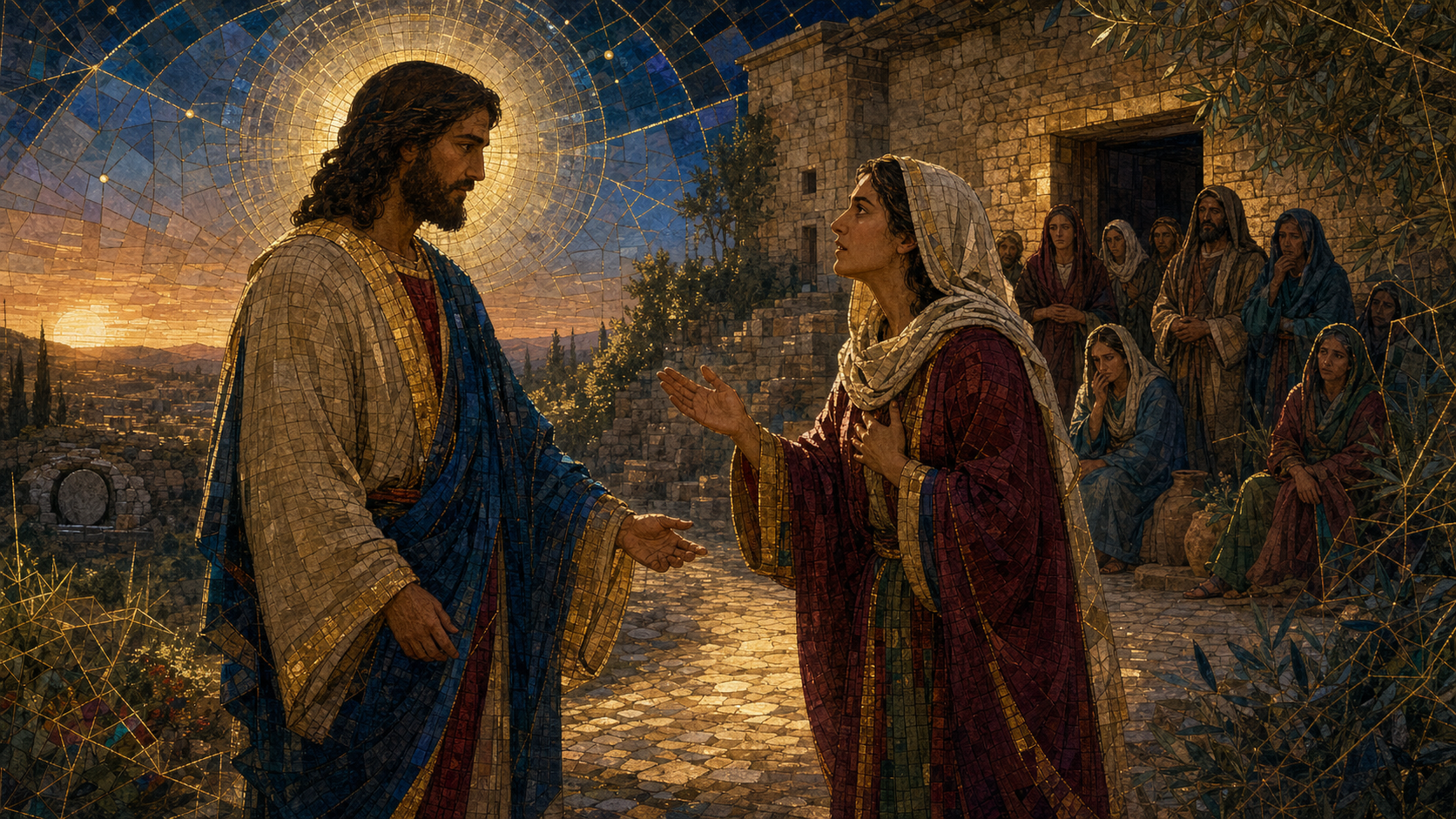
John 11:19–27
Today’s interpretive key
Jesus meets Martha within her grief, draws her hope from the last day into his living presence, and receives her confession that he is the Christ, the Son of the living God.
Bethany is crowded with mourners, but Martha leaves the house to meet Jesus on the road. Her first words hold sorrow and trust together: she names what death has taken and still turns toward the Lord. Jesus does not offer her a distant explanation. He leads her through the promise of resurrection until the promise stands before her as a person: “I am the resurrection and the life.” The encounter reaches its center not at the tomb, but in a question addressed to faith. Martha answers for herself and for the Church, confessing that the one who has come into the world is Christ, the Son of the living God.
Douay-AI, modernized from the public-domain Douay-Rheims Bible. View source ↗
And many of the Jews had come to Martha and Mary, to comfort them concerning their brother.
Martha therefore, as soon as she heard that Jesus had come, went to meet him; but Mary sat at home.
Chrysostom notices that Martha does not immediately bring Mary with her. She seeks a private word with Jesus and tells him what has happened before calling her sister. This is not a rivalry between the women but a careful movement within sorrow: Martha goes out with the hope she possesses, and only after Christ strengthens that hope does she return for Mary. The verse shows faith in motion before faith is fully instructed. Martha does not yet understand all that Jesus will reveal, but she turns toward him, brings the wound of the household into his presence, and becomes ready to hear more.
Martha therefore said to Jesus: “Lord, if you had been here, my brother would not have died.”
Theophylact identifies the limit within Martha's belief: she knows that Jesus could have prevented Lazarus's death if he had been present, but she does not yet understand that his power is not constrained by distance. Her words therefore contain both confession and incompleteness. She calls him Lord and trusts what he can do, yet speaks as though absence placed the sick man beyond his reach. Jesus does not reject this imperfect beginning. He receives her grief and will lead her beyond a merely local healer toward the one who is resurrection and life everywhere. Honest but unfinished faith becomes the place of deeper revelation.
But even now I know that whatever you ask of God, God will give you.
Augustine hears restraint as well as confidence in Martha's words. She does not explicitly demand that Lazarus be restored, because she cannot claim to know whether returning to mortal life would be good for him. Instead, she acknowledges Christ's power and leaves the action to his judgment: he can act if he wills, but she will not prescribe what he must do. Her prayerful posture is neither passive nor controlling. It brings a great desire before the Lord while recognizing that divine wisdom sees more than grief can see. Hope becomes an act of trust precisely where it refuses to seize the outcome.
Jesus said to her: “Your brother shall rise again.”
Chrysostom observes the measured form of Jesus' reply. He does not say that he must petition God for Lazarus, as Martha's words might suggest, but neither does he immediately announce his independent divine power in terms that would overwhelm her present understanding. He begins with the promise, “Your brother shall rise again.” The statement is true on more than one horizon and invites Martha to disclose what she believes about resurrection. Christ teaches by leading rather than crushing the learner. His answer opens room for her existing faith, then prepares it to receive the revelation that resurrection is not only an event he foretells but life present in him.
Martha said to him: “I know that he shall rise again in the resurrection on the last day.”
Augustine notes that Jesus' promise does not specify when Lazarus will rise. Martha therefore answers with the resurrection she already knows and trusts: the raising of the dead on the last day. Of that final hope she is certain; of an immediate restoration she remains unsure. Her response is not a failure of faith, for she confesses a central truth. Yet the Lord intends to deepen that truth by showing that the future resurrection depends upon his own living person. Christian hope is not an impersonal timetable. The last day has authority because the Son who stands before Martha is himself the source of the life then revealed.
Jesus said to her: “I am the resurrection and the life. Whoever believes in me, though he be dead, shall live.”
Chrysostom sees Christ correcting Martha's assumption that he acts only by asking another for power. If Jesus is the resurrection and the life, he needs no helper to make the dead live. Nor can his power be confined to a place, as though physical absence prevented him from healing. He is present in divine authority everywhere. The saying also widens the conversation beyond Lazarus: everyone who believes is summoned to see that the giver of every good and the source of resurrection stands before Martha. Even bodily death cannot sever the believer from the life Christ gives, because resurrection is grounded in who he eternally is.
And everyone who lives and believes in me shall not die forever. Do you believe this?
Augustine distinguishes bodily death from eternal death. One who lives in the flesh and believes in Christ may still die for a time in the body, yet will not die forever. Faith is already the life of the soul, which Christ preserves until the body rises never to die again. The promise neither minimizes the grave nor grants mortal life without end; it places bodily death inside the greater permanence of communion with Christ. Then doctrine becomes address: “Do you believe this?” The Lord seeks not bare awareness of an idea but the confession through which the hearer entrusts life and death to him.
She said to him: “Yes, Lord, I have believed that you are Christ, the Son of the living God, who has come into this world.”
Augustine treats Martha's confession as an answer that gathers up everything Jesus has said. In believing that he is Christ and the Son of the living God, she also believes that he is resurrection and life, and that the believer who dies will live. Her faith rests the promise upon the identity of the speaker. She does not claim to understand every mystery or foresee the sign about to occur at the tomb; she entrusts herself to the one who has come into the world. This is the passage's decisive movement: grief is not erased, but it is brought under a confession strong enough to face death.
Martha does not wait until her sorrow is tidy before she approaches Jesus. She comes with lament, incomplete understanding, genuine confidence, and a willingness to be taught. Christ receives all of it, then turns her attention from what might have happened to who he is. Christian hope is not denial of death, nor merely confidence in a remote future. It is communion with the Son in whom resurrection and life are already present. His final question remains personal: “Do you believe this?” Martha's confession shows the path of faith—speak honestly before the Lord, let his word enlarge hope, and entrust both the dead and the living to the Christ who has come into the world.
Read the source Catena Aurea ↗
Chrysostom connects the number of mourners with Bethany's nearness to Jerusalem. Although hostility toward Jesus had already made open association with his friends costly, the sisters' severe affliction stirred sympathy, their standing invited respect, or some visitors belonged to the more receptive among the Jews. Their presence will matter when Lazarus is raised: numerous witnesses have come not for a spectacle but to console a bereaved household, and they know the death is real. The scene therefore joins ordinary mercy to the Gospel's evidence, placing Christ's coming power within a grief publicly known and shared.