44
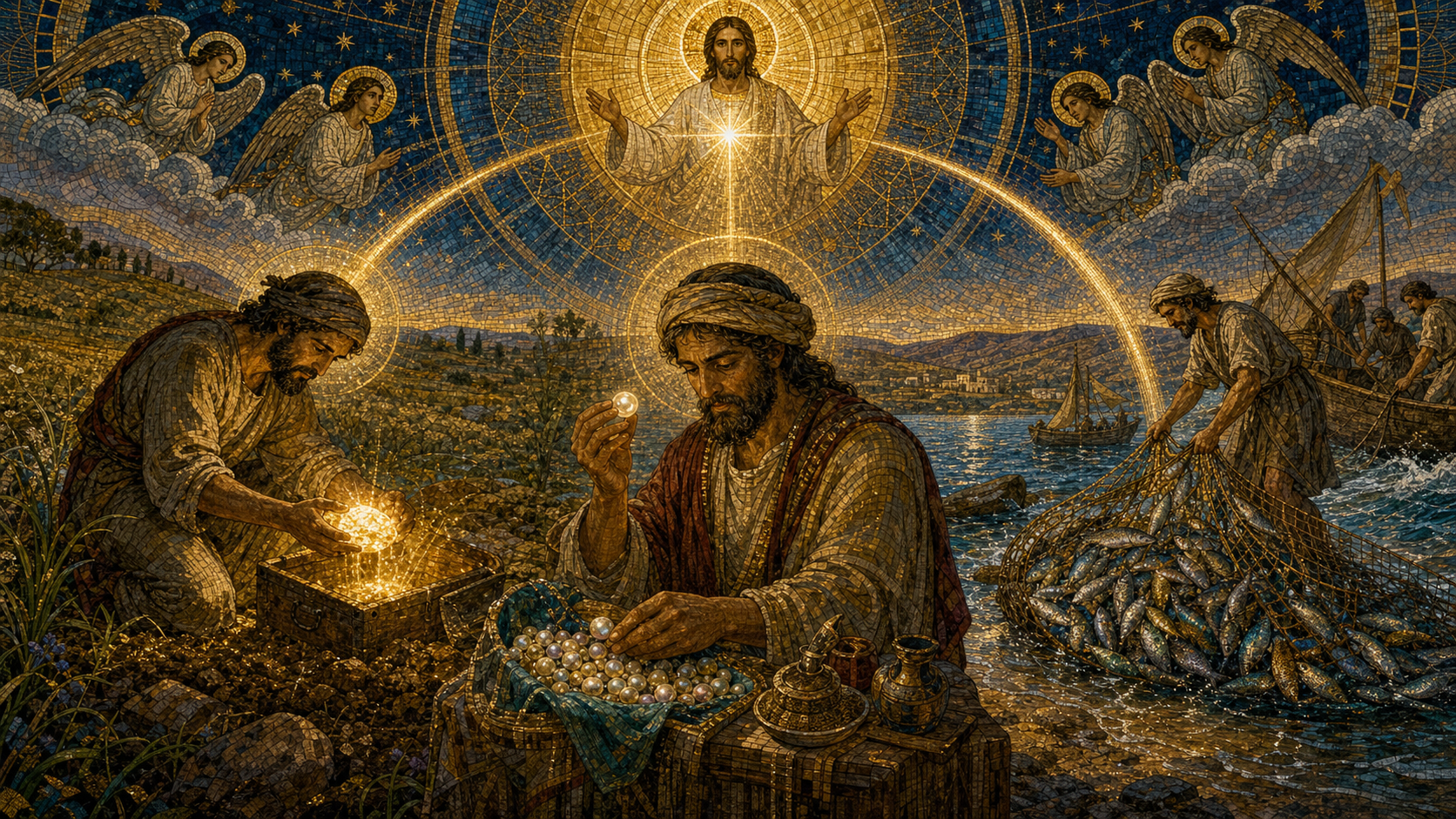
The kingdom of heaven is like a treasure hidden in a field. A man, having found it, hides it; and for joy over it, he goes and sells all that he has and buys that field.
Matthew 13:44–52
Today’s interpretive key
The kingdom is a joy worth every surrender, a pearl beyond comparison, a net that gathers all, and a final judgment that reveals what each life has become.
Jesus closes this sequence of kingdom parables by joining desire, decision, communion, and judgment. The finder and the merchant recognize a value so complete that selling everything becomes an act of joy rather than mere deprivation. The net then widens the horizon: the Gospel gathers people of every kind, while the final separation belongs to God and his angels. Finally, Jesus turns toward disciples who must understand and teach. The scribe formed for the kingdom does not discard what God has already given; from one treasury he brings forth both new and old, showing their unity in Christ.
Douay-AI, modernized from the public-domain Douay-Rheims Bible. View source ↗
The kingdom of heaven is like a treasure hidden in a field. A man, having found it, hides it; and for joy over it, he goes and sells all that he has and buys that field.
Again, the kingdom of heaven is like a merchant seeking good pearls.
Chrysostom sees the merchant as an image of the watchful person who is not swallowed by the business of this life. Such detachment does not mean indifference; it creates the freedom needed to search carefully and recognize what is truly precious. The Gospel is like a pearl whose small outward appearance can conceal immeasurable wealth. Those who possess its truth know themselves enriched, even when unbelievers cannot see what they hold. The merchant's seeking therefore joins discipline to desire. He does not manufacture the pearl's value; he prepares himself to notice the gift when it appears and to respond without delay.
When he had found one pearl of great price, he went away, sold all that he had, and bought it.
Jerome reads the good pearls as the Law and the Prophets, and the one supremely precious pearl as knowledge of Christ, especially the mystery of his Passion and Resurrection. The merchant's decisive sale does not declare the older pearls evil. Rather, everything is reassessed beside the surpassing worth of the Saviour in whom the earlier promises find their meaning. Like Paul, the disciple releases every ground of self-confidence in order to gain Christ. The purchase is therefore not contempt for creation or revelation; it is the wholehearted choice of their fulfilment, the One for whose sake every genuine good receives its proper place.
Again, the kingdom of heaven is like a net cast into the sea and gathering together every kind of fish.
Jerome connects the net with the prophetic promise that God would send many fishers. Peter, Andrew, James, and John become fishers of people, casting a net woven from the Old and New Testaments into the bitter and restless sea of the world. That net remains spread through the Church's proclamation, receiving all who enter its reach. The mixed catch prevents premature triumphalism: being gathered is a real grace, but it does not erase the need for conversion. The Gospel calls every kind of person, while the condition of each life will be disclosed only when the net reaches the shore.
When it was filled, they drew it out; and sitting by the shore, they selected the good into vessels, but the bad they cast away.
Gregory interprets the sea as the present world and the shore as its end. While history continues, the net of faith contains a mixed people: wise and foolish, rich and poor, strong and weak are all summoned from the danger of the waves. The net is filled only when the whole course of humanity is complete. Then the shore reveals what cannot be judged perfectly in the water. The good are received into eternal dwellings, while the bad are cast away from the inward light of the kingdom. This vision calls the Church to patience without confusing inclusion with final holiness.
So shall it be at the end of the world. The angels shall go out and separate the wicked from among the just.
Chrysostom distinguishes this parable from the tares and the sower. Those earlier images expose the danger of corrupt teaching or inattentive hearing; the bad fish represent an evil life that persists even after a person has been gathered by the net and received knowledge of God. Christ therefore refuses a confidence built on religious proximity alone. The angels' separation at the end reveals the moral seriousness of grace: the Gospel is given to transform conduct, not merely to provide membership or information. Judgment belongs to God's appointed servants, while disciples are called now to let faith become obedience and holiness.
And they shall cast them into the furnace of fire; there shall be weeping and gnashing of teeth.
Gregory says that this verse should first awaken holy fear rather than curiosity. The punishment is stated plainly so that no one may excuse a hardened life by claiming ignorance of its end. Christ's severe image is therefore pastoral: it interrupts complacency while repentance is still possible. The same Lord who describes the kingdom's sweetness as treasure and pearl also names the ruin of refusing its conversion. Fear is not the Gospel's final good, but it can shake awake those whom promised joy has not yet moved. The warning protects hope from becoming presumption and calls the gathered person toward persevering holiness.
Have you understood all these things? They say to him, “Yes.”
Jerome emphasizes that Jesus directs this question especially to the apostles. The crowds have heard the parables, but those who will teach others must move from hearing to understanding. Their brief “Yes” is therefore not a boast of exhaustive knowledge; it is an acceptance of formation and responsibility. Christ has drawn them into the inner meaning of treasure, pearl, net, mercy, and judgment so that their future preaching will not remain at the surface. Every Christian teacher stands under the same question. Familiarity with sacred words is insufficient unless their unity has been grasped and their demands have begun to shape the teacher's own life.
He said to them: “Therefore every scribe instructed in the kingdom of heaven is like a man who is a householder, bringing forth from his treasure new things and old.”
Hilary says that Jesus calls the disciples scribes because they have understood what he has set before them. Their treasury holds things new and old: the teaching of the Gospel and the witness of the Law, both belonging to the same divine householder and drawn from the same source. Christ even compares the instructed disciples to himself as householder, because their doctrine comes from the treasury of his Holy Spirit. Christian teaching therefore neither abandons Israel's Scriptures nor treats the Gospel as a mere repetition. It brings promise and fulfilment together, showing the coherent generosity of the one God who speaks through both Testaments.
The hidden treasure and the precious pearl expose the heart's deepest measure: what do we recognize as valuable enough to reorder everything else? The kingdom does not become ours by accident or admiration alone. Grace awakens recognition, and recognition ripens into joyful surrender. Yet the net warns against reducing that joy to private spiritual possession. The Church gathers widely in the sea of this world, and God alone completes the final separation. Disciples are therefore called to wholehearted desire, sober perseverance, and learned stewardship. Formed by Christ, they bring the one divine treasury into the present without severing promise from fulfilment, mercy from conversion, or hope from judgment.
Read the source Catena Aurea ↗
Jerome explains that the man's concealment is not an attempt to deprive others. He hides the treasure within his heart because he prizes it above everything he formerly possessed and refuses to lose it. The kingdom's hiddenness therefore describes inward fidelity, not selfish secrecy. Once the treasure has been truly recognized, every lesser possession is measured anew. Selling all is the outward shape of an inward judgment: nothing can rival the knowledge of Christ and the wisdom stored in the Scriptures. Joy gives this renunciation its character, because the man relinquishes less only after discovering infinitely more.