1
On the first day of the week, Mary Magdalen came early, while it was still dark, to the sepulchre; and she saw the stone taken away from the sepulchre.
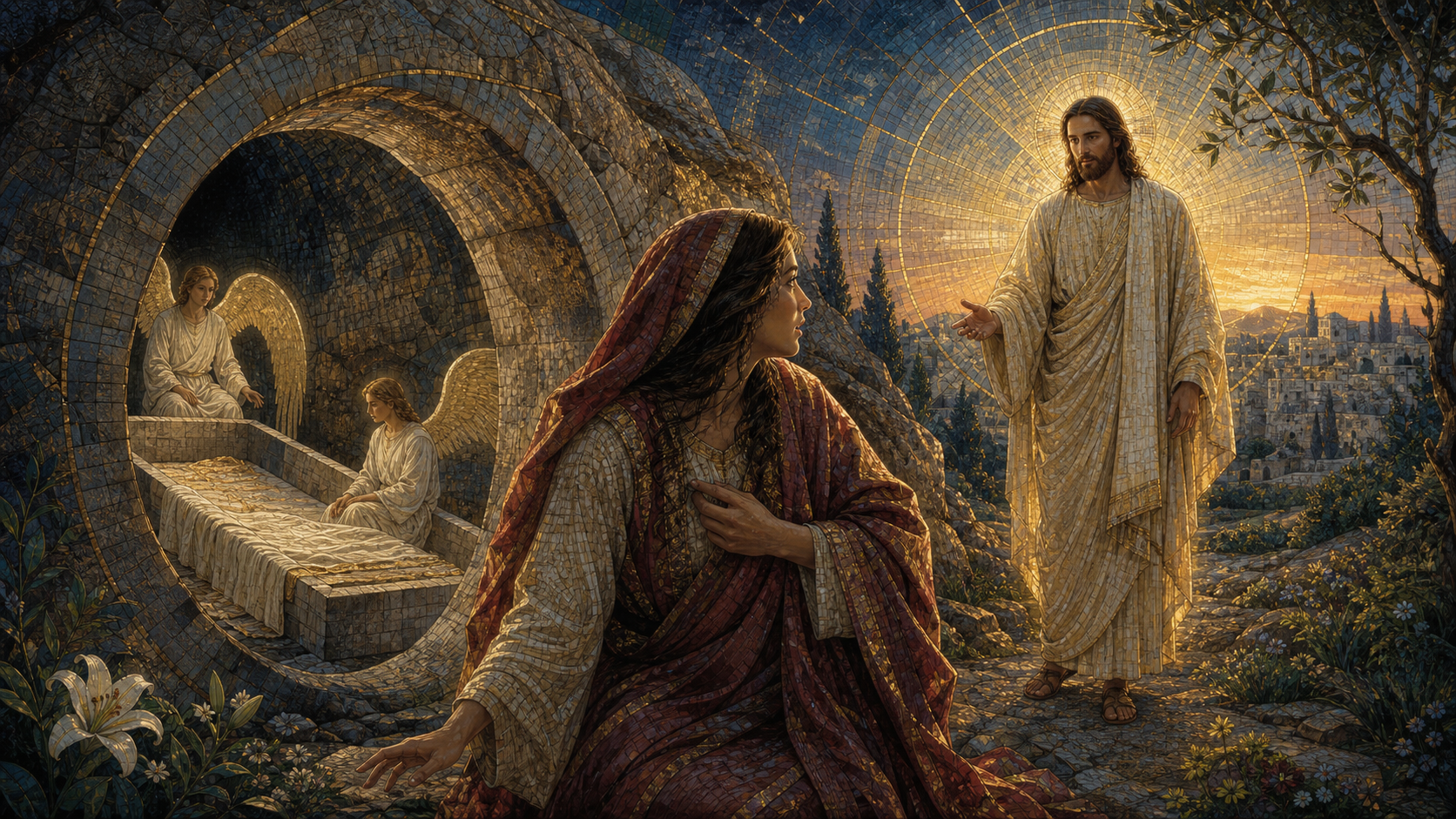
John 20:1–2, 11–18
Today’s interpretive key
Mary's persevering love remains beside the tomb until the risen Christ turns grief into recognition and sends her to announce life to his brethren.
The morning begins in darkness, with an opened tomb that Mary can understand only as another loss. Yet love keeps her near when others depart. Angels question her tears; the Lord himself questions her search. Recognition comes not through sight alone but when Jesus speaks her name. The disciple who came seeking a body is sent away as the first herald of the Resurrection: she has seen the Lord, and death no longer has the final word.
Douay-AI, modernized from the public-domain Douay-Rheims Bible. View source ↗
On the first day of the week, Mary Magdalen came early, while it was still dark, to the sepulchre; and she saw the stone taken away from the sepulchre.
She ran, therefore, and came to Simon Peter and to the other disciple whom Jesus loved, and said to them, “They have taken the Lord out of the sepulchre, and we do not know where they have laid him.”
Chrysostom notes that the displaced stone awakens Mary to urgent action, but not yet to the truth of the Resurrection. She neither settles into speculation nor keeps the discovery to herself; she runs to Peter and the beloved disciple so that they may search with her. Her conclusion is mistaken, yet her love is active and communal. John does not conceal that the disciples first received this news from a woman. By preserving Mary's role without embarrassment, the Evangelist honors her courage and devotion. Grace is already making her a messenger before she understands the full message she will bear.
But Mary stood outside the sepulchre, weeping. Now, as she was weeping, she stooped down and looked into the sepulchre.
Gregory contrasts Mary's constancy with the disciples' departure. She remains because love will not let her abandon the place where she last knew her Lord to be. Her repeated looking is not empty restlessness; holy longing grows stronger when fulfillment is delayed. If desire vanished at the first disappointment, Gregory says, it would scarcely deserve the name. Mary bends toward the tomb once more, and this persevering love prepares the encounter she cannot yet imagine. The verse teaches patience without passivity: faithful desire keeps watch, weeps honestly, and continues seeking until God gives the answer in his own way.
And she saw two angels in white, sitting, one at the head and one at the feet, where the body of Jesus had been laid.
Augustine lingers over the angels seated at the head and feet of the place where Christ's body had lain. Since an angel is a messenger, their position signifies the good news extending through the whole course of Christ's saving work—from its beginning to its completion—and outward through the world. The empty space between them is not a void abandoned by God; it has become a place of proclamation. Mary sees heavenly witnesses before she recognizes the risen Jesus. The image gently redirects her gaze: what she mourns as absence is already being interpreted by heaven as news meant to be announced.
They said to her, “Woman, why are you weeping?” She said to them, “Because they have taken away my Lord, and I do not know where they have laid him.”
Augustine notices Mary's striking language. She says that her Lord has been taken, although she is searching for his body. Christian speech likewise says that the Son of God was buried, even though burial touched his human flesh, because the one Christ is not divided into separate persons. Mary's theology is not yet an understanding of resurrection, but her love holds fast to the identity of her Lord. Her sorrow is sharpened because she does not know where to direct it. The angels' question begins to loosen that grief, preparing her to discover that the Lord she seeks is neither stolen nor dead.
When she had said this, she turned back and saw Jesus standing; and she did not know that it was Jesus.
Chrysostom explains Mary's failure to recognize Jesus as merciful accommodation, not distance on Christ's part. The angels know their Lord, but Mary is not suddenly confronted with glory beyond her capacity. Jesus raises her step by step from sorrow and mistaken expectation toward resurrection faith. He stands near while still appearing ordinary to her eyes. The moment shows that divine revelation is both gift and healing: Christ does not merely supply information but prepares the person who receives it. Mary's sight is real yet incomplete, and the risen Lord patiently leads her until presence becomes recognition.
Jesus said to her, “Woman, why are you weeping? Whom are you seeking?” She, thinking that he was the gardener, said to him, “Sir, if you have taken him from here, tell me where you have laid him, and I will take him away.”
Gregory sees Mary's mistake as carrying a deeper fitness. Jesus truly is the Gardener of souls, the one whose love has planted and cultivated virtue within her. Her words also reveal how completely love fills her imagination: she does not name the person she seeks, assuming that anyone nearby must know who “him” means. Christ's questions are not requests for information. They draw her desire into speech, intensifying the longing that he is about to fulfill. Mary offers to carry what she imagines is a dead body; instead, the living Gardener is preparing her to carry the news of resurrection.
Jesus said to her, “Mary.” Turning, she said to him, “Rabboni,” which is to say, “Master.”
Gregory marks the change between “Woman” and “Mary.” When Jesus addresses her only by the common name of her sex, she does not recognize him. When he calls her personally, recognition breaks through: the One sought outside the tomb is also the One who has been teaching her heart to seek. Christ's knowledge precedes Mary's knowing, and his voice gathers her scattered grief into relationship. Her answer, “Master,” is both remembrance and renewed discipleship. Easter faith is not an anonymous conclusion drawn from evidence alone; it is awakened by the living Lord who knows his disciple and calls her by name.
Jesus said to her, “Do not touch me, for I have not yet ascended to my Father. But go to my brethren and say to them: I ascend to my Father and to your Father, to my God and your God.”
Augustine pays close attention to Christ's wording. Jesus does not say “our Father” as though his sonship and ours were identical. The Father is his by eternal nature and ours through the grace of adoption. Nor does he simply say “our God”: in his true humanity Christ stands under God, while for us he is the Mediator who brings humanity to the Father. Mary's encounter must therefore mature beyond recovering the familiar presence she knew before the Passion. The risen Lord draws her toward the mystery of his divine equality, genuine humanity, and saving mediation, then sends her to call the disciples his brethren.
Mary Magdalen came and told the disciples, “I have seen the Lord,” and that he had said these things to her.
Gregory reads Mary's mission against the story of Eden. Humanity's fall involved a woman carrying the serpent's deadly word to a man; at the tomb, that wound is answered when a woman carries the message of life to Christ's disciples. The parallel does not diminish Mary to a symbol. Her persevering love has brought her into a real encounter, and her testimony is concrete: she has seen the Lord and heard his words. Resurrection faith now becomes proclamation. The garden of burial yields a message that begins to undo the ancient garden's grief, because the risen Christ entrusts life-giving news to a faithful witness.
Mary cannot yet interpret the empty tomb, but she refuses to make absence the end of her search. Her tears, questions, and even mistaken words are gathered into grace when Christ calls her personally. The risen Lord does not keep recognition private: communion becomes mission. He names the disciples his brethren and entrusts Mary with the news of his ascent to the Father. Christian hope begins here—not by denying sorrow, but by discovering that the One we seek has already drawn near and sends us to bear witness: “I have seen the Lord.”
Read the source Catena Aurea ↗
Augustine observes that Mary Magdalene was not necessarily alone; the other Evangelists mention women accompanying her. John names her because her love burns with particular intensity and carries the scene forward. She comes before full daylight, unable to remain away from the place where Jesus was laid. Her understanding is still dark, but her devotion is already moving toward the light. The verse therefore honors a love that acts before it comprehends. Mary does not yet possess Easter faith, yet her faithful return to the tomb places her where the risen Lord will reveal himself.