46
While he was still speaking to the multitudes, behold, his mother and his brethren stood outside, seeking to speak to him.
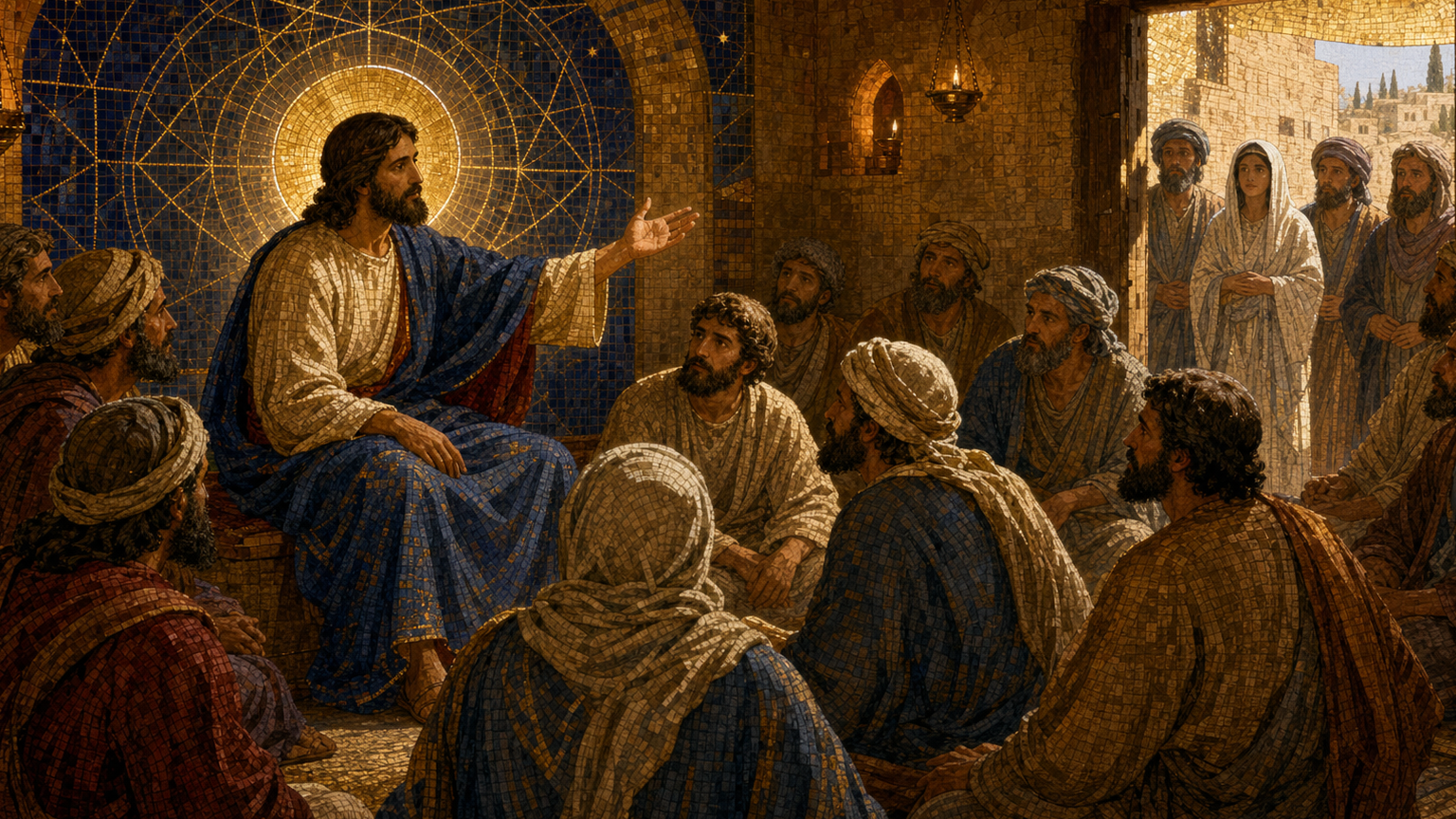
Matthew 12:46–50
Today’s interpretive key
Christ does not diminish natural kinship; he reveals the still deeper communion opened to everyone who does the will of his heavenly Father.
A message from outside becomes an invitation reaching far beyond the room. Jesus honors no merely accidental privilege, yet he does not reject his mother or earthly family. Pointing to his disciples, he declares that obedience to the Father forms a real household around him—a kinship Mary herself embodies perfectly and into which every faithful disciple may enter.
Douay-AI · modernized from the public-domain Douay-Rheims Bible
While he was still speaking to the multitudes, behold, his mother and his brethren stood outside, seeking to speak to him.
And someone said to him, “Behold, your mother and your brethren stand outside, seeking you.”
Jerome reads the announcement as a moment of testing. The messenger draws attention to the natural claim of family while Jesus is teaching, as though asking which bond he will place first. Christ does not respond by despising his mother or relatives. Instead, he refuses to let even genuine human affection displace the work given by the Father. The scene therefore orders love rather than abolishing it. Earthly relationships remain good, but they reach their proper form only beneath obedience to God. No family claim can require Christ—or his disciples—to abandon the spiritual work entrusted to them.
But answering the one who told him, he said, “Who is my mother, and who are my brethren?”
Chrysostom emphasizes what Jesus does not say. He does not send back the cruel message, “She is not my mother,” nor does he deny the reality of his human birth. He continues speaking to the messenger and turns the report into a lesson for everyone present. Elsewhere, and supremely at the Cross, Christ's care for Mary makes contempt impossible. His question instead unsettles the assumption that physical closeness alone grants the deepest access to him. Natural kinship is real, but it must open into the greater bond created by faith, virtue, and obedience to God.
And stretching out his hand toward his disciples, he said, “Behold my mother and my brethren.”
Ambrose guards the verse against a false opposition. Jesus does not overthrow filial duty, for the command to honor father and mother remains God's word. By stretching his hand toward the disciples, however, he shows that his first allegiance is to the Father and to the saving work the Father has given him. Those gathered around his teaching are not merely an audience; grace is forming them into his household. Christian discipleship therefore deepens the meaning of family. It calls natural love into right order and creates a spiritual communion whose source is the Father's will and whose center is Christ himself.
For whoever shall do the will of my Father who is in heaven, he is my brother, and sister, and mother.
Gregory asks how a believer may be called not only Christ's brother or sister but also his mother. Faith joins the disciple to the Lord as a member of his family. Then, when that disciple proclaims Christ so that love of him is born in another person's heart, the disciple becomes like a mother who brings forth the Lord spiritually. The image does not blur the uniqueness of the Incarnation or Mary's motherhood. It shows the fruitfulness of obedience: doing the Father's will makes communion with Christ generative, so that the life received from him may take root in others through truthful and loving witness.
Jesus widens the circle without scorning the bonds of nature. Nearness to him is not secured by ancestry, familiarity, or public standing, but received through the obedient faith that answers the Father. Mary is not displaced by this word; her free assent shows its fullness. The same grace now calls us inward from the threshold: to hear Christ, to do the Father's will, and so to discover that discipleship is not solitary effort but life within the household of God.
Read the source Catena Aurea ↗
Jerome answers the claim that the Lord's “brethren” must be children born to Mary and Joseph. Scripture uses brotherhood in several ways: for children of the same parents, members of one people, members of an extended family, and those united by affection or faith. The immediate context cannot establish that these men were Mary's sons, and elsewhere the same figures are connected with another Mary. Jerome therefore understands them as close relatives—cousins in modern terminology. His careful distinction protects both the plain wording of the Gospel and the Church's confession of Mary's perpetual virginity.