19:1
And entering, he walked through Jericho.
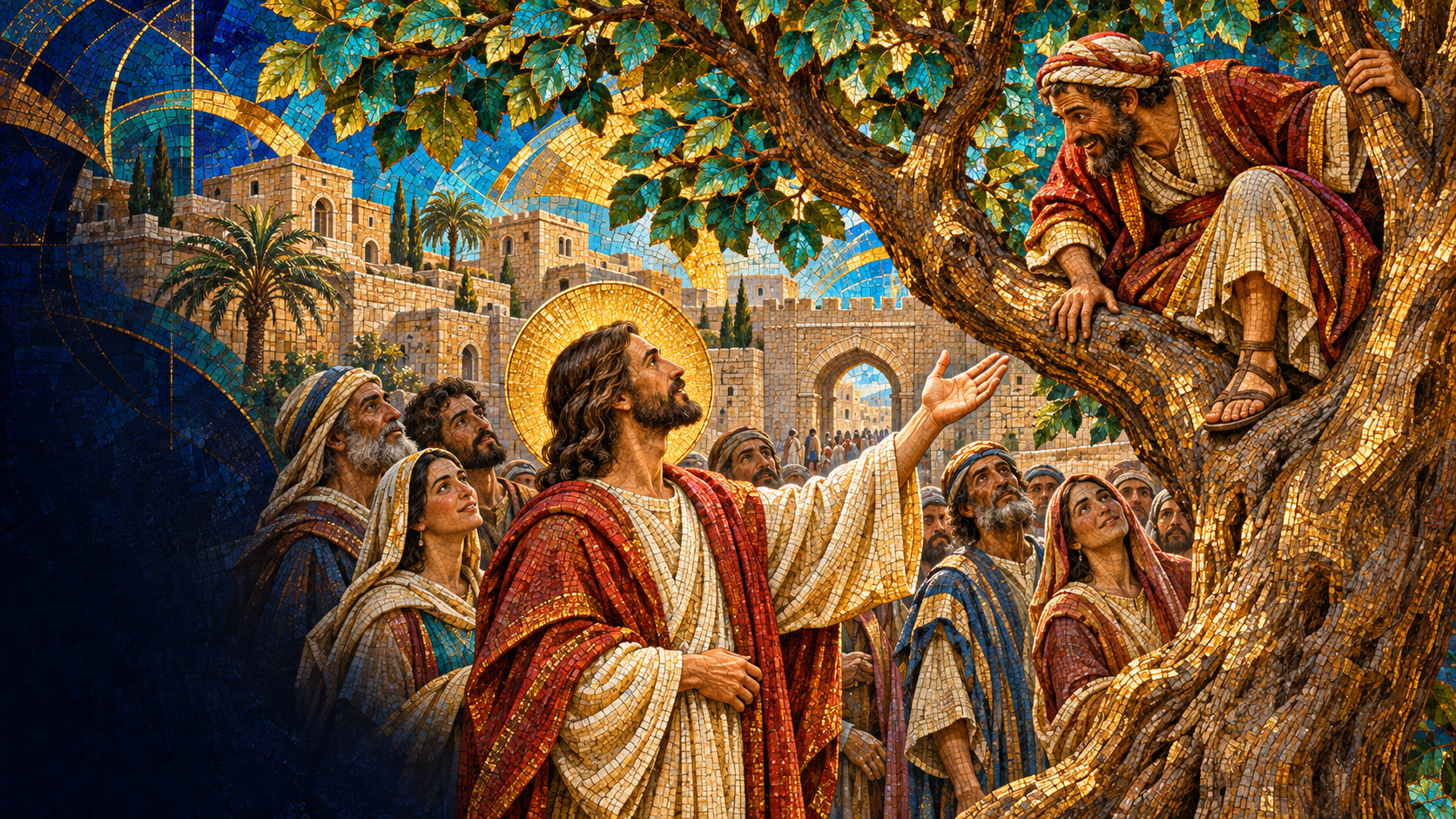
Luke 19:1–10
Today’s interpretive key
Zacheus wants to see Jesus. Jesus comes to stay.
The crowd blocks Zacheus's view, so he runs ahead and climbs a tree. Jesus looks up and calls him by name. Ambrose notices that the invitation comes before Zacheus has spoken: Christ has already seen his willingness. The welcome that follows reaches into his possessions, with gifts to the poor and restitution to anyone he has wronged.
Douay-AI, modernized from the public-domain Douay-Rheims Bible. View source ↗
And entering, he walked through Jericho.
And behold, there was a man named Zacheus, who was the chief of the publicans, and he was rich.
Ambrose notices both descriptions of Zacheus: he is chief among the publicans, and he is rich. His occupation makes the grace he receives a reason for sinners to take courage. His wealth also teaches a distinction that Ambrose wants readers to keep. Not every rich person is covetous. Later in the same passage, Ambrose explains that guilt lies in the misuse of goods rather than in the goods themselves. In good hands, wealth can help virtue; in unworthy hands, it can obstruct it.
And he sought to see who Jesus was, but he could not because of the crowd, for he was short in stature.
Titus describes Zacheus's desire to see Jesus as a seed of salvation already beginning to grow. He has not yet seen the Lord, but he wants to. For Titus, a true encounter with Jesus cannot leave a person settled in wickedness. He then gives the obstacles a spiritual meaning. Alongside the man's small stature and the physical crowd, he sees the multitude of sins that prevents a clear sight of Christ. This is Titus's interpretation of the scene, which begins with a desire still struggling against what obstructs it.
And running ahead, he climbed into a sycamore tree so that he might see him, for he was to pass that way.
Titus follows the practical step Zacheus takes: he runs ahead and climbs the sycamore so that he can see Jesus passing. His desire does not remain idle when the crowd blocks his view. Yet what he seeks is modest beside what Christ will grant. Zacheus wants to see; Jesus will notice him and bring him into a closer encounter. Titus reads this as the generosity of the Lord, who can do more than we ask. He sees the man's earnest movement toward a holy life and turns him toward godliness.
And when Jesus came to the place, he looked up, saw him, and said to him: Zacheus, hurry and come down, for today I must stay in your house.
Ambrose pauses over the unexpected invitation. Zacheus has not asked Jesus to enter his house, yet Jesus tells him that he must stay there. The Lord has seen something before any words of welcome are spoken: the man's willingness to receive him. Ambrose explains that Christ also knows how generously he will reward this hospitality. The initiative therefore belongs to Christ, who recognizes the welcome already forming in Zacheus. His command to come down brings that inward willingness into the open through an actual visit.
And he hurried and came down, and received him with joy.
Bede recalls the image of the camel passing through the eye of a needle. Here, he says, the burden is being removed: a rich man and publican gives up his attachment to wealth and rejects dishonest gains. He can then receive the blessing of the Lord's company. Bede connects the joyful welcome with this change in the man's relation to his possessions. Coming down quickly is part of the encounter, but his reading reaches into the conversion that the whole scene reveals. The guest is welcomed as greed loses its hold.
And when all saw it, they murmured, saying that he had gone to be a guest with a man who was a sinner.
Pseudo-Chrysostom describes Christ's kindness through the contrast between the innocent guest and the guilty host. The Lord enters the publican's house without being stained by his greed; his righteousness drives the darkness away. The crowd's reproaches do not make him abandon the work he has come to do. The commentator compares his approach to a physician's willingness to come close to illness in order to heal it. Zacheus's conversion shows the purpose of the visit. Mercy reaches the sinner and brings a change of life.
But Zacheus stood and said to the Lord: Behold, Lord, I give half of my goods to the poor; and if I have wronged anyone in anything, I restore it to him fourfold.
Theophylact asks readers to look closely at what Zacheus says about his property. Half goes to the poor, and from what remains he makes fourfold restitution to those he has injured. The commentator understands this as leaving none of his possessions for himself. He also insists on the present tense of the words. Zacheus does not merely announce that he will give and restore at some future time. He says that he gives and restores. Theophylact thus reads the confession as repentance already expressed in deeds.
Jesus said to him: Today salvation has come to this house, because he also is a son of Abraham.
Bede explains the name "son of Abraham" through imitation of Abraham's faith, rather than through ancestry alone. Abraham left his country and his father's house; Zacheus now relinquishes his goods in giving to the poor. Bede sees a likeness between these acts of departure. He also attends to the word "also" in Jesus' declaration. The children of promise include those who have lived justly and those who have been raised out of injustice. Zacheus's past does not exclude him from this family when he turns in faith.
For the Son of Man has come to seek and to save what was lost.
Pseudo-Chrysostom reads this saying as Christ's answer to those who criticize his company. Bringing sinners to righteousness is the reason for his coming among them. The commentator returns to the image of healing: Christ stays with the sick so that he can provide the remedy they need. He also distinguishes this encounter from fellowship with someone who stubbornly persists in evil. Here the sinners are being converted. The visit to Zacheus therefore belongs to the saving work Jesus names, the search for those who were lost.
Theophylact asks us to hear the present tense in Zacheus's words: I give, and I restore. His joy at receiving Christ takes the form of help for the poor and restitution for those he has wronged. The welcome has become something he does.
Read the source Catena Aurea ↗
Ambrose reads this encounter alongside the healing of the blind man near Jericho. Christ stops for one man to show him mercy, and gives the other the honor of staying in his house. The two scenes belong together in his reading. The welcome given to the chief publican makes the lesson especially clear: someone whose livelihood has involved fraud can still receive grace. Ambrose asks who could despair after seeing such a man welcomed. The story opens a way back for those ashamed of their sins.