18:35
Now it happened, as he drew near to Jericho, that a certain blind man sat by the roadside, begging.
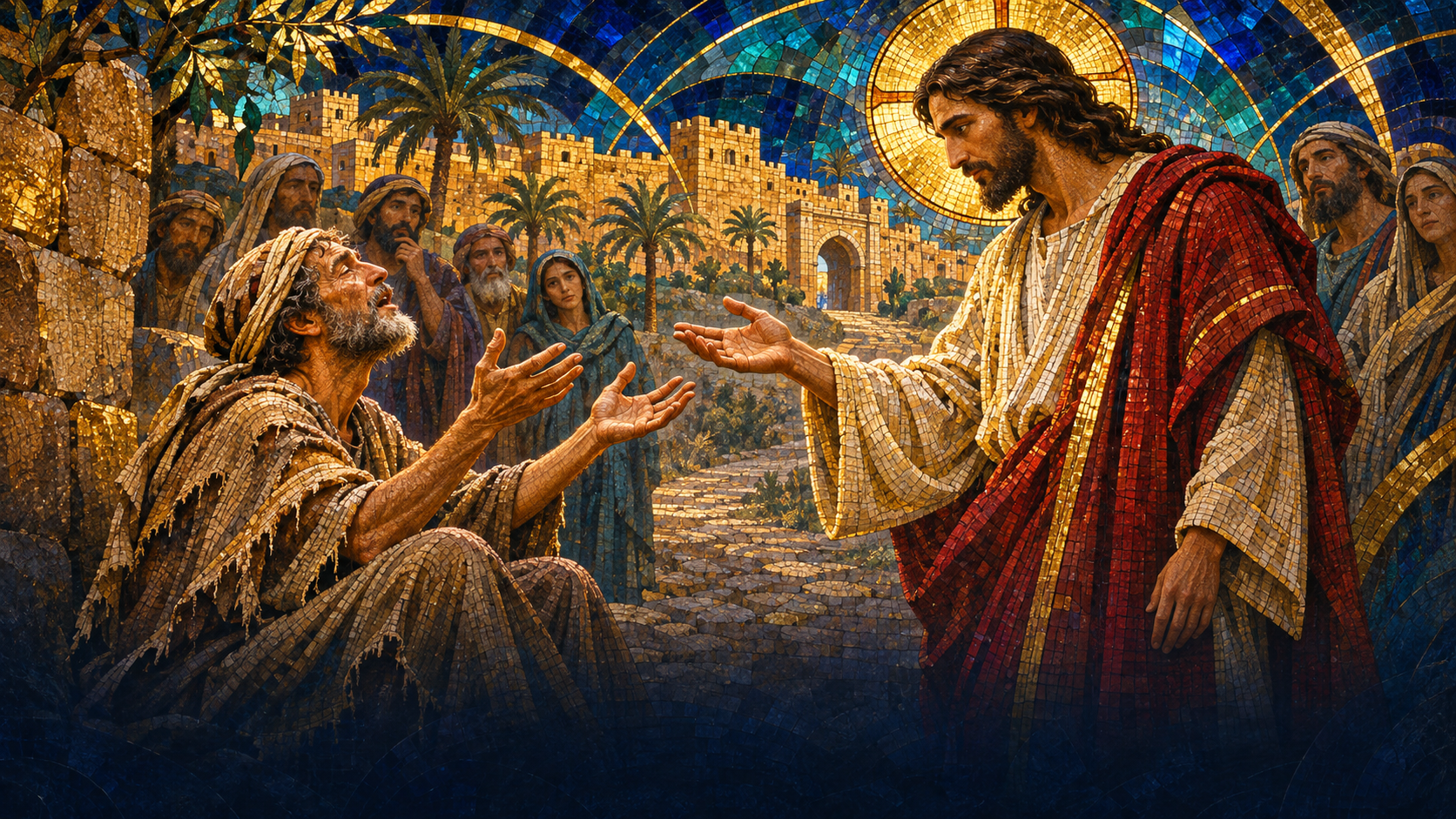
Luke 18:35–43
Today’s interpretive key
The more our thoughts disturb us, the more earnestly we should pray.
A blind man hears that Jesus is passing and calls for mercy. The crowd tries to silence him, but he keeps calling. Gregory reads his persistence as a lesson for distracted prayer: when restless thoughts press in, we should pray more earnestly. The man asks for sight, receives it, and follows Jesus.
Douay-AI, modernized from the public-domain Douay-Rheims Bible. View source ↗
Now it happened, as he drew near to Jericho, that a certain blind man sat by the roadside, begging.
And when he heard the crowd passing by, he asked what this meant.
Pseudo-Chrysostom attends to the contrast between the man's blindness and the movement of his heart. A crowd has gathered around Christ. The man cannot recognize him by sight, yet he feels drawn toward him and asks what is happening. His question begins an encounter in which his inward recognition will go beyond the report he receives. The commentator describes him as grasping with his heart what his eyes cannot embrace. Physical blindness has not prevented this first movement toward the one who can give him light.
And they told him that Jesus of Nazareth was passing by.
The people who can see tell the blind man that Jesus of Nazareth is passing. Pseudo-Chrysostom says that they speak according to their own understanding. The man's reply will go further: he calls Jesus the Son of David and asks for mercy. The commentator sets the report and the response beside each other. The man hears one description and proclaims another. His lack of bodily sight does not keep him from recognizing the Light of the world, whose power gives sight to the blind.
And he cried out, saying: Jesus, Son of David, have mercy on me.
Cyril explains that the man, brought up in the Jewish faith, knows the promise that God would be born according to the flesh from David's line. His words hold together what Cyril refuses to divide. He calls Jesus the Son of David, acknowledging his human descent, and asks him for mercy as God. Cyril directs this confession against those who would separate Christ into two. The man's brief prayer thus expresses a united faith in the one Christ, truly God and truly born in our flesh.
And those who went ahead rebuked him, telling him to be silent; but he cried out all the more: Son of David, have mercy on me.
Gregory gives the crowd a spiritual meaning. Those who walk ahead and try to silence the man resemble the restless desires and faults that scatter our thoughts before Jesus comes into our hearts. Even while we pray, this inward crowd can disturb us. The blind man answers the rebuke by crying out more strongly. Gregory draws the practical lesson from his response: the more violently wandering thoughts trouble us, the more fervently we should give ourselves to prayer. Persistence answers the disturbance that would silence our appeal.
And Jesus stood still and commanded that he be brought to him. And when he had come near, he asked him,
Cyril sees the power of an appeal made in faith. The man's voice stops Christ, who turns toward those who call upon him in faith. Jesus then commands that the man be brought near. Cyril describes this bodily approach as following an approach that has already taken place: the man has first laid hold of Christ through faith. He is now invited to come close in person. The call to draw near answers the same trust that persisted when others tried to prevent his confession.
Saying: What do you want me to do for you? But he said: Lord, that I may see.
Gregory explains that Jesus asks the question to stir the man's heart to prayer. The Lord already knows what the man seeks and what he will grant, yet he wishes it to be asked of him. Gregory also notices the object of the request. The blind man asks for light, not gold. This becomes an instruction for our own petitions: we should seek the light we may share with the angels rather than false riches. Faith is the road by which we come to that light.
And Jesus said to him: Receive your sight; your faith has made you whole.
Pseudo-Chrysostom asks what prophet ever commanded healing in this manner. Christ speaks with authority, and his voice becomes light for the afflicted man. The commentator then considers the man's faith through two comparisons. People draw different amounts from the same fountain according to the vessels they bring; sunlight enters a room according to the windows opened to it. In this way, he explains how grace abounds where faith is willing to receive. The gift comes from Christ, while faith opens the recipient to his mercy.
And immediately he saw and followed him, glorifying God. And all the people, when they saw it, gave praise to God.
Cyril understands the man's response as evidence of release from two kinds of blindness, bodily and intellectual. He now sees with his eyes, and he glorifies Christ as God because he truly recognizes him. The healing therefore bears fruit in the understanding as well as in the body. Cyril also follows the effect beyond the man himself. His restoration gives others an occasion to glorify God. The people who witness what has happened join in praise, so that the gift received by one man becomes a reason for the whole crowd to thank God.
Gregory notices that the man follows Jesus as soon as he can see. Understanding the good calls for putting it into practice. His prayer gives us words to return to: Lord, that I may see.
Read the source Catena Aurea ↗
Gregory begins with the disciples, who have just heard Jesus speak about his approaching suffering and resurrection. They cannot yet grasp what he has told them. Jesus now brings them before a miracle: a blind man receives his sight where they can see it happen. Gregory understands this divine work as a help to their faith. The teaching they struggle to receive is followed by an act that strengthens them. The healing therefore concerns the disciples as witnesses as well as the man who is healed.