17:11
As he was going to Jerusalem, he passed through the midst of Samaria and Galilee.
Luke 17:11–19
Today’s interpretive key
The man who comes back in gratitude draws near to the Lord who healed him.
Ten men call to Jesus from a distance. All ten are cleansed on the way to the priests, but one returns to give thanks. The Catena follows that movement from separation to prayer, and from healing to humble gratitude. Titus notices the courage with which the healed man approaches; Bede sees humility preparing him to rise and walk.
Douay-AI, modernized from the public-domain Douay-Rheims Bible. View source ↗
As he was going to Jerusalem, he passed through the midst of Samaria and Galilee.
As he entered a certain town, ten men who were lepers met him, standing far off.
Titus notices why the ten men have gathered together: each recognises in the others the same calamity he suffers himself. Their shared distress gives rise to sympathy, and together they wait anxiously for Jesus to pass. Their distance also has a reason. Under the Jewish law, leprosy was regarded as unclean. Titus then turns from their bodily condition to the Gospel's concern with inward uncleanness. His reading keeps their actual suffering in view while directing the hearer to the condition of the heart.
They raised their voices, saying: Jesus, Master, have mercy on us.
Theophylact imagines the shame behind the men's distance. Accustomed to being regarded as unclean, they think Christ may shrink from them as others do. Yet distance cannot prevent prayer from bringing them near: the Lord is close to those who call on him in truth. Their appeal is also more than a request addressed to an ordinary man. By calling Jesus Master or Lord, they acknowledge his authority, approaching him, Theophylact says, almost as though they already recognised him as God.
When he saw them, he said: Go, show yourselves to the priests. And as they went, they were made clean.
Theophylact explains the command by recalling the priests' task: they examined people to determine whether they had been cleansed from leprosy. Jesus therefore sends these men to the very people who can recognise their recovery. In telling them to go, he indicates that their healing is about to happen. The narrative then records the fulfilment of that assurance: they are cleansed as they make their way. Theophylact connects the instruction and the event closely, so that the journey to the priests already carries the promise of restoration.
One of them, when he saw that he was made clean, went back, glorifying God with a loud voice.
Theophylact draws attention to the difference in response after the healing. He identifies the nine as Israelites, but the one who returns is the Samaritan stranger. All have received the gift of cleansing; only this man turns back with thanksgiving. His loud voice now gives glory to God for what has happened to him. The contrast concerns gratitude: shared healing has not produced a shared return. Theophylact asks the reader to notice the stranger who remembers to thank the one who has shown him mercy.
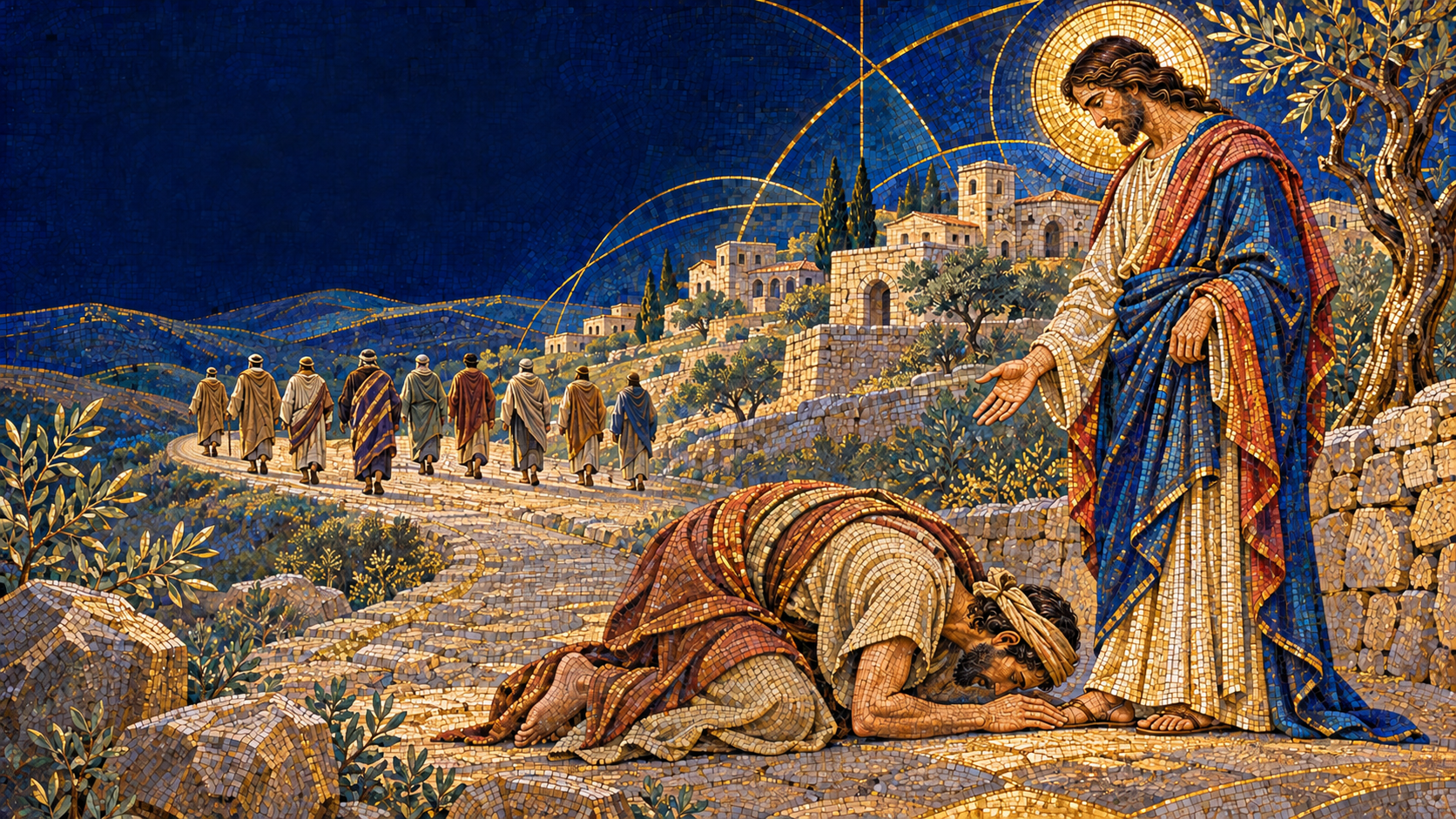
He fell on his face at Jesus' feet, giving thanks; and he was a Samaritan.
Titus follows the change in the man's position. Before the healing, he stood far off with the others; after discovering that he was cleansed, he has the courage to draw near. He comes right to Jesus' feet and falls on his face in thanksgiving. Titus sees both faith and gratitude in this response. The man's posture and prayer belong together: his body bows before the one whom his words thank. The returned Samaritan thus gives a visible expression to the faith with which he approaches his healer.
Jesus answered: Were not ten made clean? Where are the nine?
Theophylact reads Jesus' question as a warning to anyone tempted to boast of religious ancestry. The Samaritan's origin has not prevented him from pleasing God, because he has an honest purpose in his heart. By contrast, the nine whom Theophylact identifies as Israelites have failed to return in gratitude. Descent from holy people is therefore no ground for self-congratulation. His reading directs attention away from inherited standing and toward the person's response to God: the stranger returns, while those with greater grounds for confidence are absent.
No one has been found to return and give glory to God except this stranger.
Augustine gives the whole scene a spiritual reading in which cleansing includes deliverance from confused and false teaching. He then asks what happens when someone follows sound doctrine in the Church but remains ungrateful to the one who cleansed him. Such a person resembles those who knew God yet failed to glorify him or give thanks. For Augustine, the returning man shows the humble devotion that preserves unity. True belief must be accompanied by the willingness to fall before the giver in grateful acknowledgement of what has been received.
He said to him: Rise, go your way; for your faith has made you whole.
Bede reads the man's prostration as an expression of shame at the evils he remembers having committed. The command to rise and walk then shows how divine consolation works: someone who lies low, conscious of his weakness, is led forward by God's word to mighty deeds. Bede also connects faith with the man's haste to return and give thanks. Neglecting to glorify God for received mercy reveals the opposite movement. The humility taught in the preceding parable is now shown in a person's actions, and faith grows through that humility.
Titus sees faith and gratitude together in the Samaritan at Jesus' feet. Bede follows him from that lowly posture into the strength to rise and walk. The gift does not end with recovery: the man returns to the giver, and hears the word that sends him on his way.
Read the source Catena Aurea ↗
Titus places this journey against the hostility between Jews and Samaritans. Jesus passes through the midst of both peoples, and Titus sees a purpose in that route: he comes to allay their enmity and join them together in one new man. The journey therefore prepares us for the meeting that follows, where a Samaritan shares the same need for mercy as the others. Titus reads the movement through these divided regions in light of the reconciliation Christ brings to those who have been enemies.