2:13
The Passover of the Jews was near, and Jesus went up to Jerusalem.
John 2:13–22
Today’s interpretive key
Christ clears the temple and points toward his own body, raised from the dead.
The feast of a church's dedication brings us to the Jerusalem temple. Jesus finds a market where his Father's house should be honoured. The Fathers attend to his authority, the danger of treating sacred gifts as merchandise, and the meaning of the sign he promises. The disciples will understand that sign only after his resurrection: the temple he speaks of is his body.
Douay-AI, modernized from the public-domain Douay-Rheims Bible. View source ↗
The Passover of the Jews was near, and Jesus went up to Jerusalem.
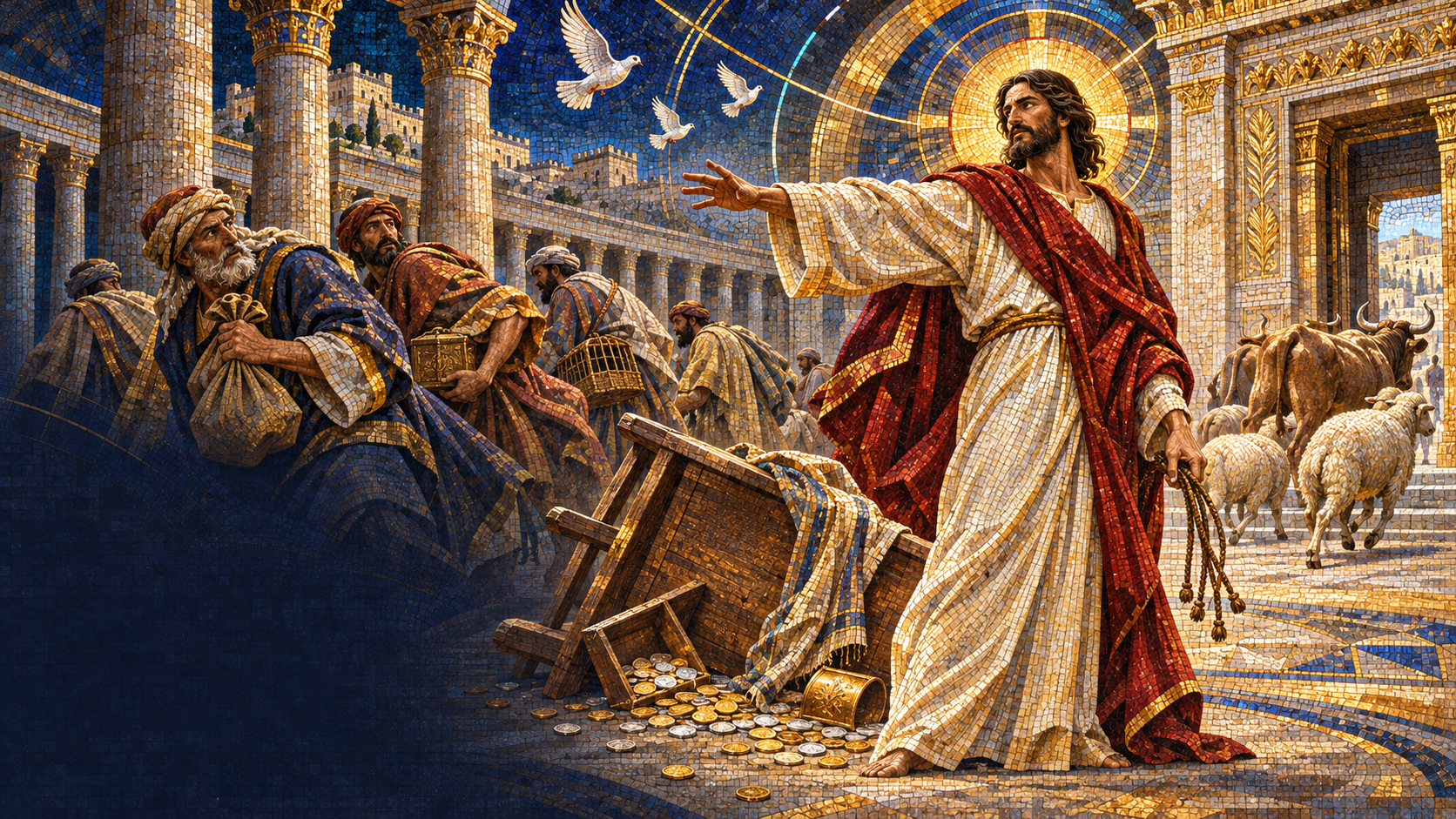
In the temple he found those selling oxen, sheep, and doves, and the money changers seated there.
Bede says that Jesus entered the temple to pray and sees in this an example for those arriving in a new place: their first concern should be to seek God's house in prayer. He explains the animals and money tables through the needs of pilgrims who travelled without their own sacrificial offerings. Yet such arrangements had become an occasion for profit. Bede reads the expulsion as Christ's rejection of worldly business in the house set apart for God, especially business entangled with questionable gain.
Having made what was like a scourge of little cords, he drove them all out of the temple, along with the sheep and the oxen. He poured out the money changers' coins and overturned their tables.
Augustine gives the scourge a spiritual meaning. A person who adds one sin to another is like someone twisting strands together into a cord. The resulting suffering is therefore connected with the wrongs that person has accumulated. Augustine asks the hearer to recognise the Lord's warning in such correction and to change the course of life. His explanation moves from the cords in Christ's hand to the habits a sinner forms, urging repentance before those habits end in the binding sentence of the final judgment.
To those selling doves he said: Take these things away, and do not make my Father's house a house of trade.
Augustine applies the sellers in the temple to people within the Church who seek their own advantage rather than the interests of Jesus Christ. He recalls Simon's wish to purchase the power of giving the Holy Spirit so that it could become something to sell. Because the Spirit appeared as a dove, the dove sellers become an image of that corruption. Augustine insists that the gift remains free. The very name grace directs the mind away from a transaction and toward what God gives without a price.
His disciples remembered that it was written: Zeal for your house has consumed me.
Alcuin pauses over the word zeal, which can be understood in a good sense. Here it means a fervour of the spirit that stirs the mind to defend the truth. In that movement, human fears are forgotten. His explanation helps us read the disciples' recollection of Scripture: the force of Jesus' action belongs to his devotion to the Father's house. Alcuin's brief definition directs attention to the object of that ardour, the truth being defended, rather than treating intensity alone as the measure of zeal.
The Jews therefore answered him: What sign do you show us, since you do these things?
Chrysostom sees evidence of virtue in Christ's zeal for God's house and asks why putting an end to evil practices should need another credential. He reads the challengers' demand as an attempt to stop Jesus from proceeding. Their gains have been threatened, and they hope to force him either to produce a miracle or to abandon his action. Chrysostom distinguishes this calculated request from an honest desire to learn. Jesus, who elsewhere gives signs without being asked, knows the intention behind the demand made here.
Jesus answered them: Destroy this temple, and in three days I will raise it up.
Bede reads the answer in relation to the authority the challengers have questioned. The temple of stone signifies Christ's body, in which there is no stain of sin. Jesus has just shown his power by clearing the material temple of its trade and wrongdoing. He now announces a further exercise of that power: though they destroy the temple of his body, he will raise it on the third day. Bede thus connects the present cleansing and the future resurrection through the figure of the temple.
The Jews then said: This temple took forty-six years to build, and will you raise it up in three days?
Theophylact explains that the speakers take Jesus to mean the material temple. Their reply follows from that assumption: a building associated with forty-six years of work cannot, they think, be raised in three days. The contrast supplies the force of their scoffing question. Theophylact keeps the reader close to the misunderstanding rather than resolving the number through a separate calculation. They hear a claim about construction, while Jesus has spoken about his body. The Evangelist's next sentence will identify the temple his answer actually concerns.
But he was speaking of the temple of his body.
Augustine considers the temple in relation to the body Christ received from Adam's human family. He makes an essential distinction: the Lord took that body without taking its sinful condition. After its destruction, he raised it again on the third day. The listeners had understood the saying materially, but Jesus was speaking spiritually about his own body. Augustine points to the Evangelist's explanation as the guide to reading the saying. The promised rebuilding concerns the incarnate Lord, whose body is the temple being named.
When he had risen again from the dead, his disciples remembered that he had said this, and they believed the Scripture and the word Jesus had spoken.
Chrysostom names two matters that had been far beyond the disciples' understanding. One was the resurrection of the Lord's body; the other, greater mystery was that God dwelt in that body. Jesus' promise to raise the temple himself pointed toward both. After he rose, the disciples remembered the saying and believed the Scripture together with his word. Chrysostom reads their remembering through that change in understanding: the event made clear what the earlier promise had placed before them, though they could not yet grasp it.
Bede connects the cleansing of the temple with Christ's power to raise his own body. Augustine warns against selling what God gives freely. Chrysostom stays with the disciples as the resurrection makes Jesus' words clear. Their readings invite reverence for the house of prayer and trust in the Lord who has overcome death.
Read the source Catena Aurea ↗
Alcuin considers the journey itself before the confrontation in the temple. Jesus goes to Jerusalem for the festival, fulfilling the divine commands whose author he is. Alcuin then turns from the Son to those who serve him: if Christ observed the feasts, his servants should prepare for and celebrate them with holy zeal. The ascent to Jerusalem therefore teaches something before Jesus speaks. His conduct gives weight to the observance of God's commands and asks for a willing, careful response from those who follow him.