25:1
Then the kingdom of heaven will be like ten virgins who took their lamps and went out to meet the bridegroom and the bride.
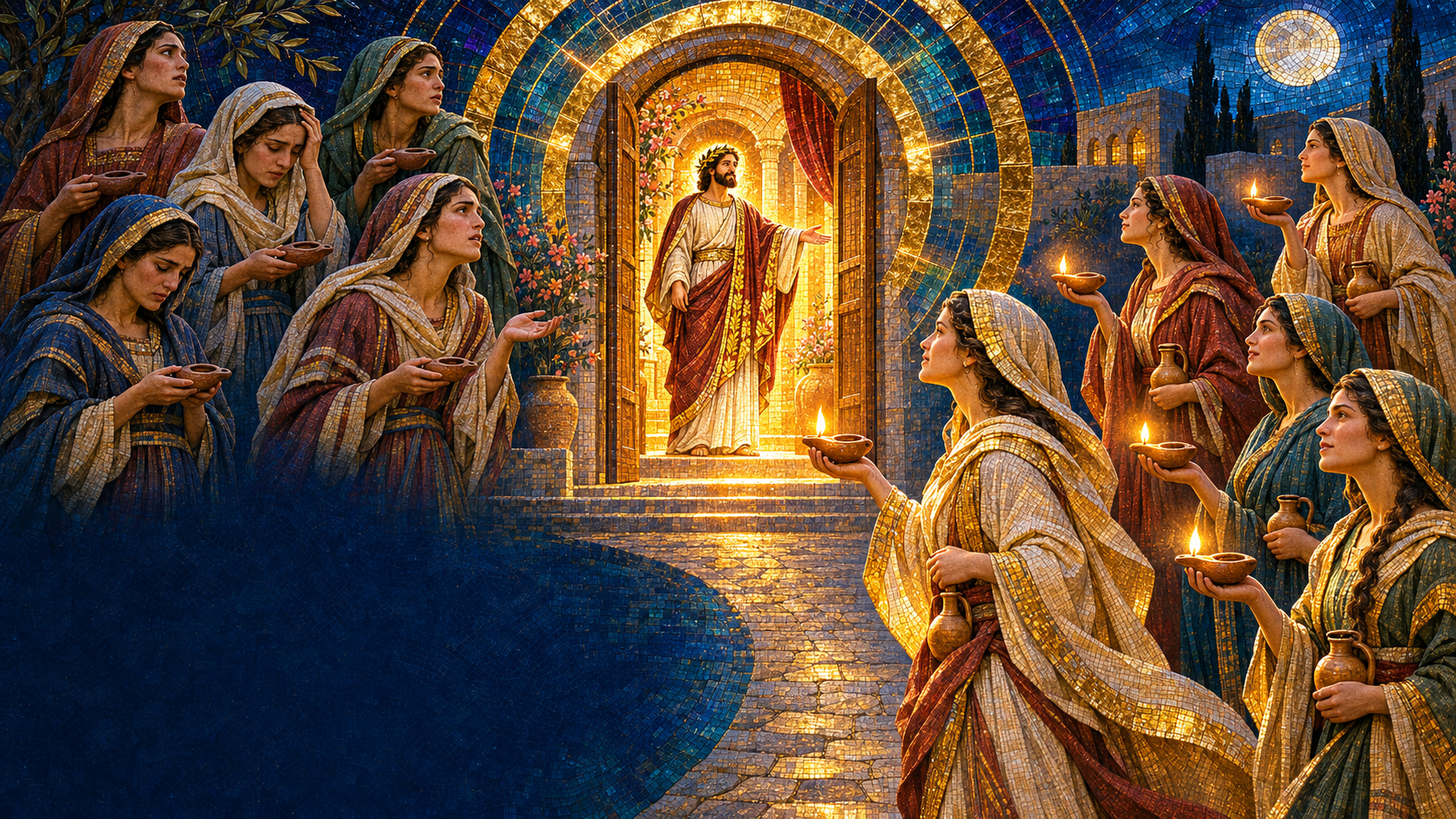
Matthew 25:1–13
Today’s interpretive key
The bridegroom’s delay gives us time to practise the love we cannot borrow at his coming.
Ten virgins wait for a wedding, carrying lamps that look much alike. All grow drowsy; all hear the midnight cry. The difference lies in the oil they have brought. The Fathers read the oil through good works, mercy, and the gladness of a conscience turned toward God. Their interpretations ask what sustains our outward profession of faith when applause falls silent and the waiting ends.
Douay-AI, modernized from the public-domain Douay-Rheims Bible. View source ↗
Then the kingdom of heaven will be like ten virgins who took their lamps and went out to meet the bridegroom and the bride.
Five of them were foolish, and five were wise.
Augustine understands the five virgins through restraint of the five bodily senses. Both groups practise a kind of continence: they hold back from the pleasures that might draw them away. Yet the purpose of that restraint matters. Some seek to please God and find their joy in a conscience turned toward him. Others depend upon the approval of people who see their outward conduct. Augustine therefore locates wisdom and folly within the intention of the person, even where the visible practice looks much the same.
The five foolish ones took their lamps but did not take oil with them.
Jerome distinguishes those who possess oil from those who merely appear to share the same faith. The first join their confession to good works; the others neglect the works of virtue. His explanation follows the contrast within the parable itself: everyone has a lamp, but the provision accompanying it differs. Outward similarity can conceal a serious lack. Jerome does not dismiss the confession of faith. He asks whether that confession has been accompanied by the conduct that belongs to it, so that what is professed is also lived.
But the wise took oil in their vessels along with their lamps.
Augustine connects the oil with the gladness of a life pleasing to God. The wise take this gladness in their vessels because they keep it within the heart and conscience. Their joy does not require another person to applaud their restraint or certify their goodness. Augustine recalls Paul's counsel that each person should examine his own work and then have grounds for rejoicing in himself rather than in another. The vessel thus directs attention inward, toward the place where conduct is weighed before God rather than displayed for praise.
While the bridegroom delayed, they all grew drowsy and slept.
Jerome understands the sleep of the virgins in relation to death and the resurrection. They sleep because they are dead, yet the description also looks ahead to their being awakened. Both groups pass through this sleep; it does not by itself distinguish the wise from the foolish. The bridegroom's delay expresses the long interval between the Saviour's first coming and his second. Jerome's reading keeps the story's expectation alive across that interval: death is described as sleep because the sleepers will not remain beyond the reach of the coming summons.
At midnight a cry rang out: Look, the bridegroom is coming! Go out to meet him.
Augustine reads midnight as the moment when people neither knew nor expected the bridegroom to arrive. He also considers why the summons now speaks of meeting the bridegroom alone. The virgins themselves belong to the bride: the Church is made up of the people gathered into her, just as children run to a mother who is herself their gathered company. The Church is now betrothed. At the marriage, what is mortal will have passed away, and she will be held in an enduring union with her Lord.
Then all those virgins rose and trimmed their lamps.
Gregory sees both the elect and the rejected rising from the sleep of death. The summons reaches everyone; the difference between the two groups emerges in what they have brought to that meeting. To trim their lamps is, in his explanation, to reckon up the works for which they hope to receive eternal blessedness. The scene therefore turns from the long common sleep to a personal accounting. Each must face the truth of the life already lived, rather than rely on the fact that all have heard the same awakening cry.
The foolish said to the wise: Give us some of your oil, for our lamps have gone out.
Gregory explains the failing lamps through the contrast between outward appearance and inward truth. Some works seemed bright to those who watched them, yet lose that brightness when the Judge comes. Those who find themselves empty within then look outside themselves for someone to speak on their behalf. Their neighbours have seen their conduct; perhaps those witnesses can now establish what their own conscience cannot. Gregory presents the request for oil as this appeal for testimony, made by people whose confidence in their visible reputation has failed at the moment of judgment.
The wise answered: There might not be enough for us and for you. Go instead to those who sell it, and buy some for yourselves.
Chrysostom calls the wise virgins merciful and says their mercy is precisely why they are approved. Their refusal therefore cannot be explained by unwillingness to help. At that judgment they cannot supply what the others failed to acquire through their own lives. He connects the oil with charity and aid to the needy, then brings the warning back to the present. The poor are here, where we can help them now. The time for storing this oil is the life in which those needs stand before us.
While they went to buy, the bridegroom came. Those who were ready went in with him to the marriage feast, and the door was shut.
Jerome pauses at the moment when the foolish leave to make the provision they neglected. In his reading, the season for buying has passed: judgment is arriving, and there is no longer room to begin the repentance and works that should have preceded it. What is required now is an account of the life already lived. The shutting of the door gives that warning its final form. After the day of judgment, he says, there is no further opportunity to acquire righteousness through new good works.
At last the other virgins also came, saying: Lord, Lord, open to us.
Jerome notices that the latecomers still address the bridegroom as Lord. He calls this confession worthy and recognises it as a sign of faith. Yet the repeated title does not erase the life that has brought them to the closed door. His question is direct: what does it avail to confess with the mouth the one whom a person denies through works? The problem is not that their words name the wrong Lord. It is the division between those words and the conduct that should have answered to them.
But he answered: Amen I say to you, I do not know you.
Augustine observes that the story never says the foolish virgins succeeded in buying oil. Deprived of the praise on which they depended, they return in distress to ask God for entrance. He describes the severity after judgment in relation to the unspeakable mercy available before it. The answer follows divine wisdom: those who acted under the commandments in order to please people, rather than before God, cannot claim the joy they neglected. Augustine's concern remains the inward direction of their deeds, which the admiration of others could never settle.
Keep watch, therefore, because you know neither the day nor the hour.
Augustine applies the final command to two times hidden from us. We do not know when the bridegroom will come, and each of us is also ignorant of the time of our own falling asleep in death. Preparation for the latter prepares us for the great summons that will awaken everyone. His reading gives the warning a personal urgency without offering a calculation of dates. The unknown hour calls for readiness before death, so that the voice which raises all sleepers will not find us without the provision we needed to make.
Chrysostom places the poor before us here and now, where help can still be given. Augustine asks where our joy rests when no one praises us. Jerome presses the connection between the Lord we confess and the works we do. Their readings leave us with work close at hand: answer a need, examine a motive, and let faith take shape in conduct while the door remains open.
Read the source Catena Aurea ↗
Gregory begins with the Church as we know it before the final judgment. Christ elsewhere speaks of angels gathering offences out of his kingdom; here too, the kingdom includes people whose lives will receive different judgments. Gregory connects the ten virgins with the bodily senses and with a Church gathered from both sexes. The outward company is shared, while inward readiness differs. His reading prevents us from assuming that belonging to the waiting company already settles the question of how we have lived within it.