12:49
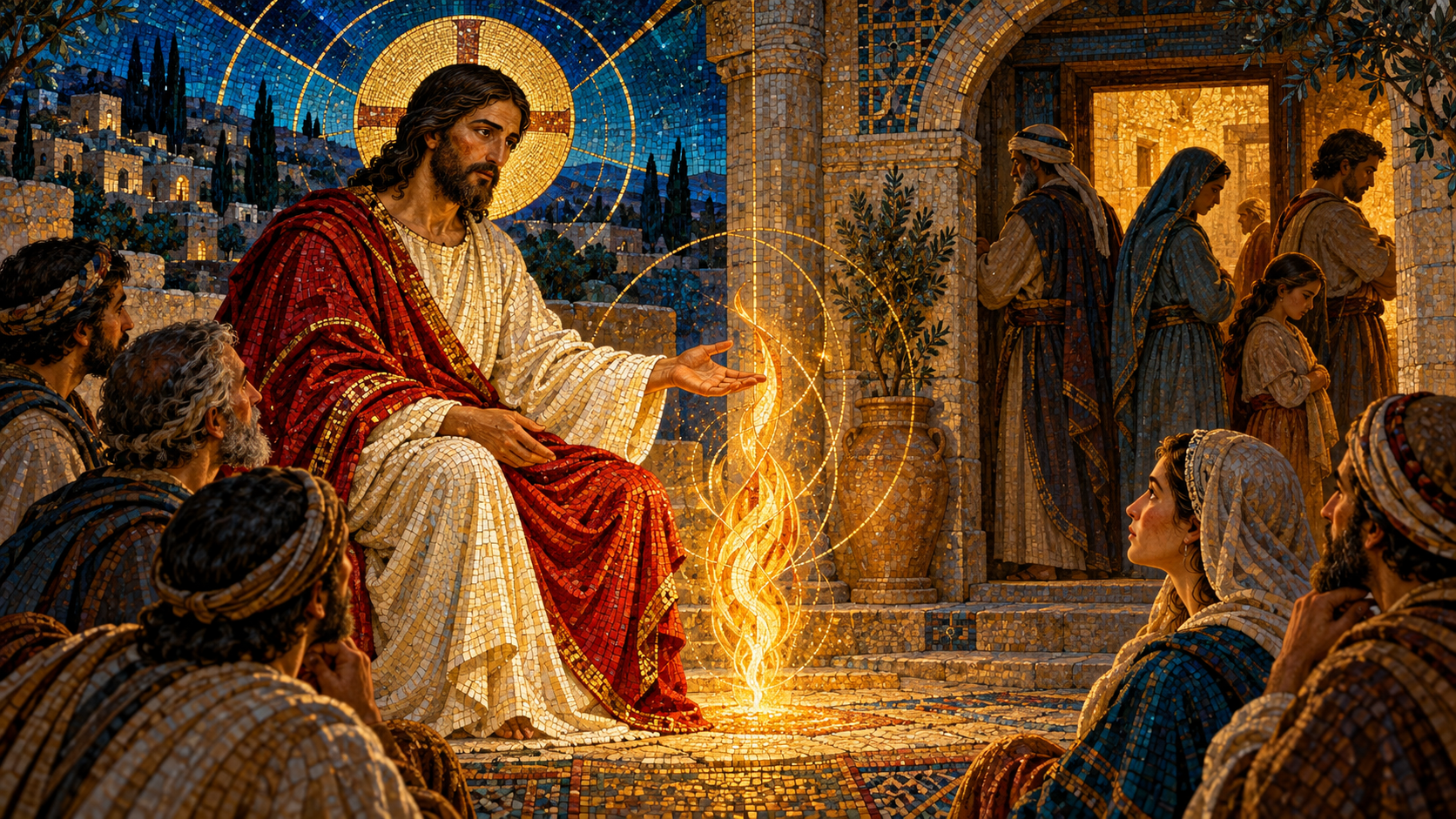
I have come to cast fire on the earth; and what do I desire but that it be kindled?
Luke 12:49–53
Today’s interpretive key
Christ’s fire cleanses the heart; his peace never asks us to make peace with unbelief.
Jesus speaks of fire, a baptism still to be accomplished, and division within a household. The Fathers hear these difficult words in the light of his saving Passion. The fire is not the destruction of those he loves, but the Gospel’s purification of hearts through the Spirit. The baptism points toward his suffering and blood. His warning about division does not make every kind of peace worthless: it exposes the false peace that would require someone to turn away from God. These verses ask what holds our deepest allegiance, even when the answer is costly.
Douay-AI, modernized from the public-domain Douay-Rheims Bible. View source ↗
I have come to cast fire on the earth; and what do I desire but that it be kindled?
And I have a baptism with which I am to be baptized; and how distressed I am until it is accomplished!
Ambrose reads the Lord’s distress as a revelation of his extraordinary condescension toward us. Christ makes known his desire to awaken devotion in human hearts and to bring his work in us to perfection. His eagerness reaches even to the Passion he will undergo for our sake. The baptism of suffering is therefore inseparable from the good he wills for those he saves. In this reading, the urgency of his words discloses the generosity of a Saviour who desires the accomplishment of our salvation, not merely the ending of his own waiting.
Do you think that I have come to give peace on earth? I tell you, no, but separation.
Cyril confronts the apparent contradiction: Christ is our peace, reconciles heaven and earth through the cross, and gives his peace to his disciples. How then can he speak of bringing division? Cyril distinguishes peace as a genuine good from an agreement that becomes spiritually harmful. Peace is harmful when it binds us to those who turn away from God and thereby separates us from his love. The warning concerns such earthly bonds. Christ’s gift of peace cannot require a fellowship that draws the faithful away from God.
For from now on there will be five in one house divided: three against two, and two against three.
Alongside the household itself, Ambrose offers a spiritual reading in which a single house signifies a single person. He considers divisions within our powers and senses, then describes how vices once lived together in apparent agreement. Christ’s fire interrupts that alliance by burning away the heart’s offences. What looked like peace was a common attachment to wrongdoing; renewal brings a separation from it. In this interpretation, the divided house pictures a person being changed, as the soul ceases to share the purposes of its former sinful desires.
The father will be divided against the son, and the son against his father; the mother against the daughter, and the daughter against the mother; the mother-in-law against her daughter-in-law, and the daughter-in-law against her mother-in-law.
Chrysostom understands these words as a prediction fulfilled in households where believers met pressure from their own families to return to unbelief. The teaching of Christ proved stronger than even these intimate ties: the faithful were willing to endure separation and suffering rather than lose the worship belonging to their faith. Chrysostom also sees in this an indication of Christ’s greatness. Across the world, not merely in a handful of houses, love for him could surpass the strongest natural affections. The Lord both foretold this costly allegiance and brought it about.
Christ does not kindle the heart merely to leave its old allegiances untouched. Cyril sees the Gospel purifying what sin has dulled; Ambrose sees charity drawing us beyond fear. Ask today where keeping an easy peace might be keeping you from faithfulness. Let that question begin with your own heart, not an accusation against someone else. The fire to seek is the Spirit’s cleansing love, received through the Saviour who gives himself for us.
Read the source Catena Aurea ↗
Cyril explains that Scripture sometimes calls holy and divine words fire. He compares their work to the refining of gold and silver: fire removes the dross, and the Saviour’s Gospel, acting through the power of the Spirit, cleanses the minds of believers. This is therefore a beneficial fire, not a picture of pointless destruction. Those who have become cold and lifeless through sin are brought back to a life of devotion. Christ desires the kindling of a flame that purifies and gives spiritual life.