8:19
And his mother and brethren came to him, and they could not reach him because of the crowd.
Luke 8:19–21
Today’s interpretive key
Jesus reveals a spiritual kinship created by hearing God's word and carrying it into action, without diminishing the sacred claims of natural family.
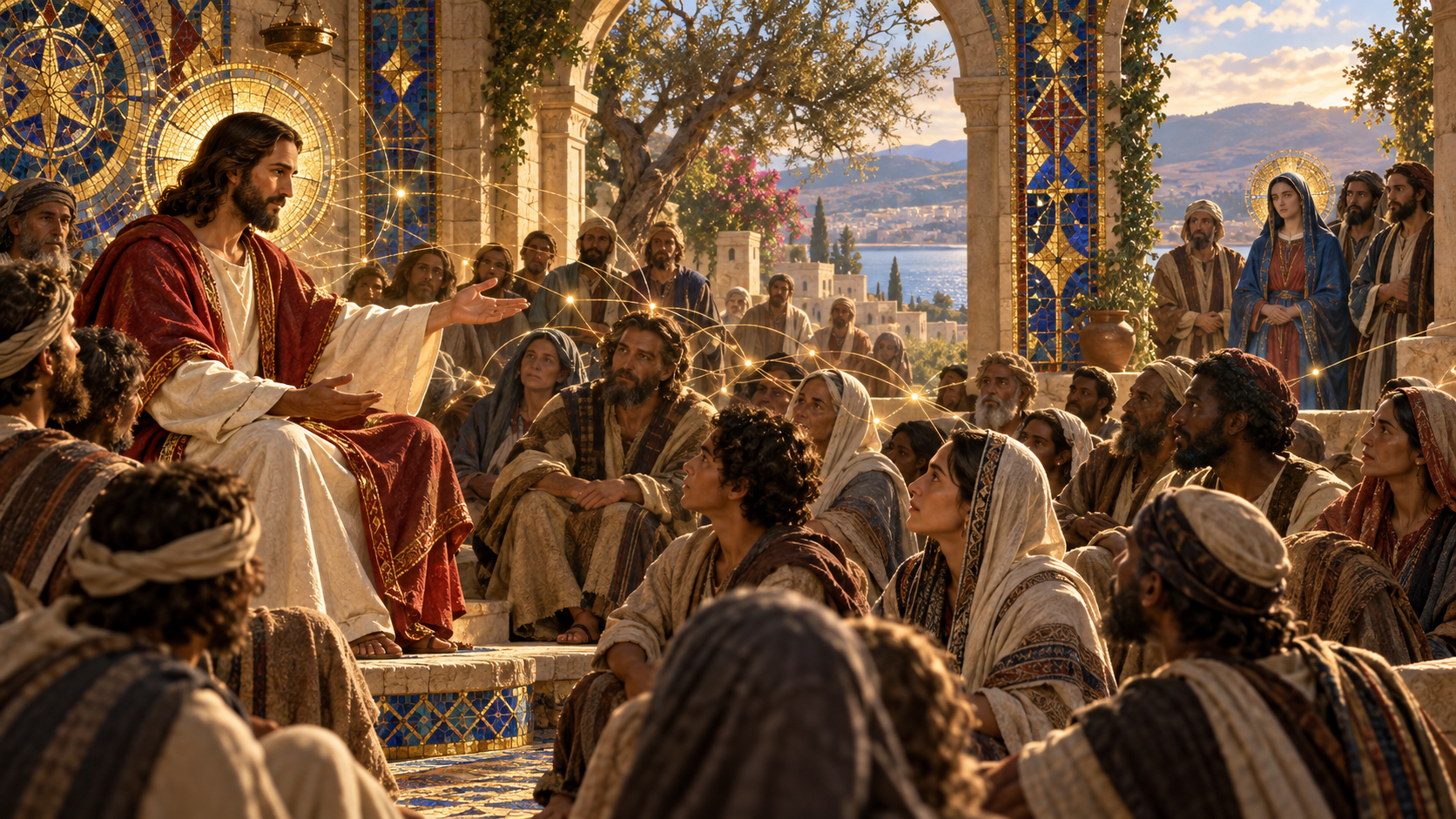
A dense crowd surrounds Jesus while his mother and brethren wait outside, unable to reach him. Their arrival gives the Lord an occasion to reveal how widely divine grace opens his household. He does not deny Mary or treat natural affection as worthless. He identifies the deepest bond with him: receptive obedience to God's word. Hearing and doing belong together. Attention that never becomes action remains incomplete, while outward activity severed from the word loses its source and measure. Mary herself exemplifies this union in her faithful reception of God's message and her consent to it. Christ's answer therefore invites every disciple into genuine intimacy with him. No ancestry, social standing, or physical nearness can manufacture that communion; yet anyone who listens in faith and obeys may be received as mother and brother within the family gathered around the Son.
Douay-AI, modernized from the public-domain Douay-Rheims Bible. View source ↗
And his mother and brethren came to him, and they could not reach him because of the crowd.
And he was told: “Your mother and your brethren stand outside, desiring to see you.”
Chrysostom asks us to picture the whole assembly attentive to Jesus, hanging upon his words after his teaching has begun. Into that moment comes the message that his mother and brethren are outside and wish to see him. The request therefore carries more than private information: it raises the question of whether natural claims should interrupt the work of divine instruction. Christ's answer does not arise from indifference to his family. It preserves the priority of the Father's work and teaches everyone present that access to him cannot rest merely on physical relationship. The listening crowd is being invited toward a bond that obedience can make real.
Answering, he said to them: “My mother and my brethren are those who hear the word of God and do it.”
Theophylact explains that lowly birth can harm no one before Christ, because the person who hears God's word is welcomed as his kinsman. Yet the Lord immediately joins doing to hearing. Mere exposure to sacred teaching is not enough and can even increase responsibility when the word is ignored. True kinship with Christ appears when listening passes into obedience. The “word of God” here includes Christ's own teaching, for what the Son speaks comes from the Father. Jesus thus opens his family to all who receive that divine teaching with a responsive life: attention and action together mark those whom he recognizes as his own.
Christ places no barrier of birth or status around his household. He asks for the openness that hears God's word and the obedience that gives it flesh in ordinary life. Receive today's brief Gospel as a personal summons: listen without defensiveness, then identify the concrete deed the word requires. That deed may be reconciliation, fidelity to prayer, patient service, truth spoken with charity, or a duty quietly completed. Such obedience does not purchase Christ's love. It reveals the family likeness his grace is forming in us. Ask Mary, who received the word and kept it, to teach you this undivided response. Then move from attention to action, trusting that every faithful yes draws you more deeply into the communion Jesus names as his own family.
Read the source Catena Aurea ↗
Bede pauses over the word “brethren” so that it will not be used to diminish the blessed Virgin. These men should not be imagined as children born to Mary, nor need they be treated as sons of Joseph by another wife; they are the Lord's relatives according to ordinary biblical usage. The crowd that prevents their approach establishes the scene without altering Christ's true human bonds. Jesus belongs within a real family network according to the flesh, while remaining the only-begotten Son according to his divine nature. The passage will deepen the meaning of kinship, not erase the dignity of his mother.