16:1
And he also said to his disciples: There was a certain rich man who had a steward, and this steward was accused before him of wasting his goods.
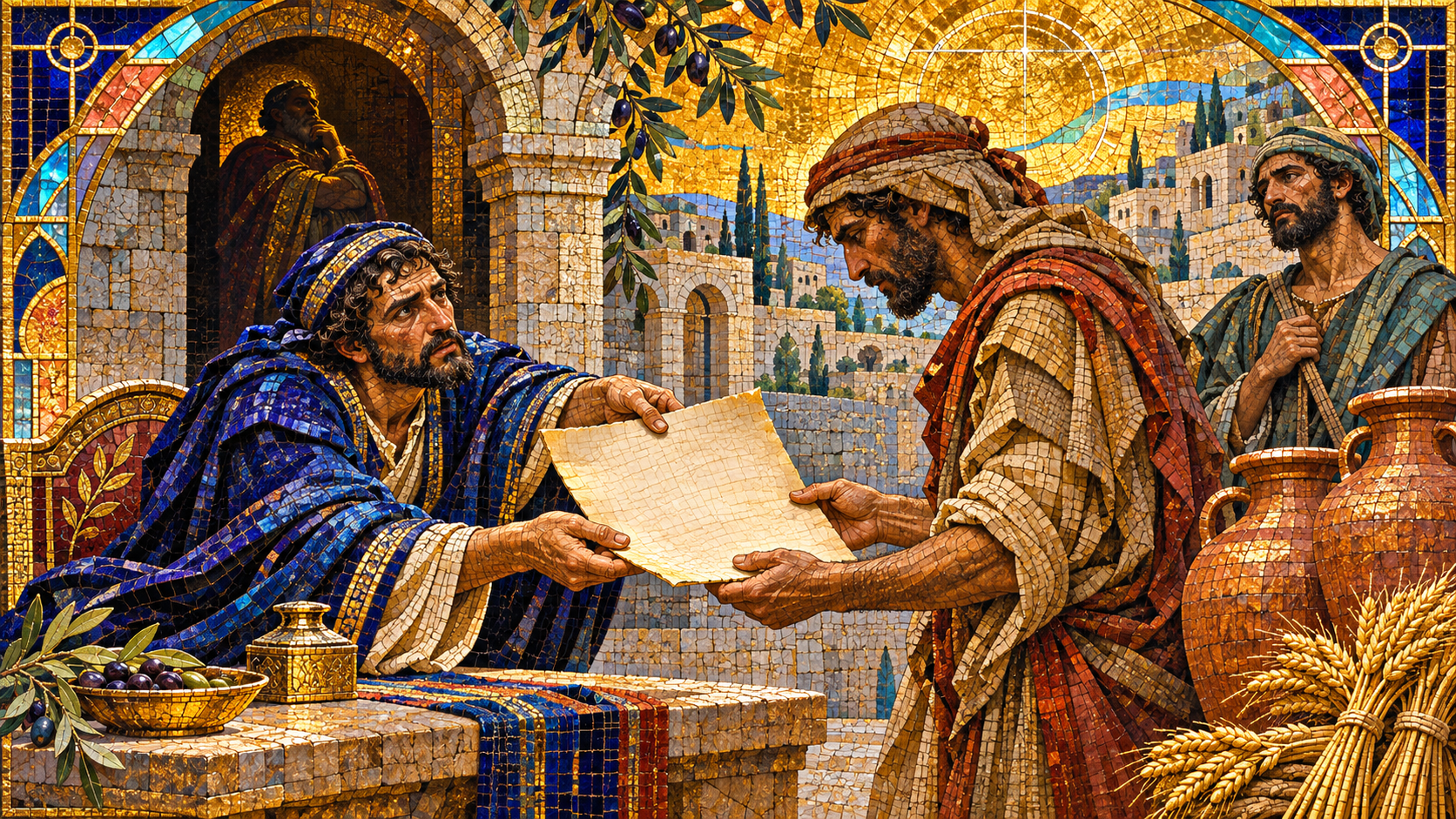
Luke 16:1–8
Today’s interpretive key
What we hold for a time must be used with the life to come in view.
A steward learns that his employment is ending and acts quickly to secure a welcome elsewhere. His methods are dishonest, yet his concern for the future exposes a failure in those who seek eternal life without preparing for it. The Fathers distinguish the foresight worth learning from the fraud we must refuse. They also ask whose possessions we are managing. What looks like our own wealth is entrusted to us by God, and mercy belongs in the account we will give.
Douay-AI, modernized from the public-domain Douay-Rheims Bible. View source ↗
And he also said to his disciples: There was a certain rich man who had a steward, and this steward was accused before him of wasting his goods.
And he called him and said to him: How is it that I hear this about you? Give an account of your stewardship, for now you can no longer be steward.
Pseudo-Chrysostom hears the master's demand in the events that remind us how suddenly life may end. Someone healthy at midday can be dead by evening; another dies during a meal. These changes announce that our stewardship will not last indefinitely. He contrasts two ways of facing that departure. The faithful steward, confident about the management entrusted to him, can share Paul's desire to depart and be with Christ. The person whose wishes remain bound to earthly things is distressed when the time comes to leave them behind.
And the steward said to himself: What shall I do, since my lord is taking the stewardship away from me? I am not able to dig; I am ashamed to beg.
Pseudo-Chrysostom first relates the steward's inability to dig to a life unused to labour. He then gives an allegorical reading: after death, the time for carrying out what God commands is over. The present life is the place of that work; the future brings its consolation. An anxious request made only then cannot supply what was neglected here. He recalls the foolish virgins, who asked the wise for help and returned empty. Each person wears the life he has lived like an inner garment that cannot be exchanged with someone else's.
I know what I will do, so that when I am removed from the stewardship, they may receive me into their houses.
Pseudo-Chrysostom reads the steward's plan as an occasion to consider the good a person can still do when the end of life approaches. Forgiving a debtor or giving generously to the poor uses the Lord's possessions to relieve another's burden. Such kindness gains friends whose testimony before the judge consists in the good works themselves, rather than in a speech. He describes this witness as bringing consolation to the giver. His argument rests on a claim about ownership: nothing is simply ours, for everything remains under God's power.
Therefore he called together every one of his lord’s debtors, and said to the first: How much do you owe my lord?
The question about what is owed follows Pseudo-Chrysostom's insistence that everything belongs to God. The steward deals with his lord's debtors and disposes of his lord's goods; he has no independent store of wealth outside that relationship. In the spiritual reading, a person who forgives a debt or provides for the poor likewise distributes what belongs to the Lord. The help given to fellow servants can become testimony before the judge. This reading directs attention to mercy exercised with entrusted goods, while retaining the distinction between the steward and their owner.
And he said: A hundred barrels of oil. And he said to him: Take your bill, sit down quickly, and write fifty.
Bede explains the measure of oil before attending to the reduction itself. The debtor is told to replace a hundred with fifty, so half the debt is remitted. He then reads this alongside the smaller reduction given to the debtor who owes wheat. His simple moral interpretation concerns relieving a poor person's need: whether someone supplies half or a fifth, the act can receive the reward of mercy. The amounts differ, but both express real help. Bede draws the reader toward the relief provided rather than prescribing one identical amount for every giver.
Then he said to another: And how much do you owe? And he said: A hundred quarters of wheat. He said to him: Take your bill and write eighty.
Bede calculates the second reduction as a fifth of the wheat debt. The steward has eighty entered in place of a hundred, just as he earlier halved the amount of oil. Bede places the two reductions together when explaining the passage's practical meaning. Someone who relieves a poor person's want by supplying either half or a fifth can be blessed with the reward of mercy. The smaller proportion is still included in that judgment. What matters in his interpretation is that the person's need is relieved through an actual gift.
And the lord commended the unjust steward because he had acted wisely. For the children of this world are wiser in their generation than the children of light.
Augustine explains why a dismissed steward can still receive a word of praise: he has taken care to provide for his future. But the whole of his conduct is not offered for imitation. We must never deceive our Lord and then imagine that giving alms from the fraud makes it acceptable. Augustine instead argues from the lesser case to the greater. If even a dishonest steward can receive praise for looking ahead, those who act according to God's commandment have far more reason to hope that their works please him.
Augustine refuses to turn this parable into permission to cheat. Its challenge is the steward's attention to what comes next. Pseudo-Chrysostom brings that challenge into the present: our possessions are God's, and the time to use them mercifully is now. A debt forgiven or a poor neighbour helped can bear witness to how we have managed what was entrusted to us. What would change today if we took that account seriously?
Read the source Catena Aurea ↗
Pseudo-Chrysostom challenges the assumption that whatever we possess belongs to us as absolute masters. That belief encourages us to seize passing goods as though they were ours without qualification. In this life, however, we are guests and strangers, and our circumstances can change without warning. A rich person may suddenly become poor. Whatever authority or advantage we have is granted for a brief use. The right response is therefore the modesty of a steward: we administer another's goods, and the power we exercise over them gives us no grounds for pride.