1:1
The book of the generation of Jesus Christ, the son of David, the son of Abraham.
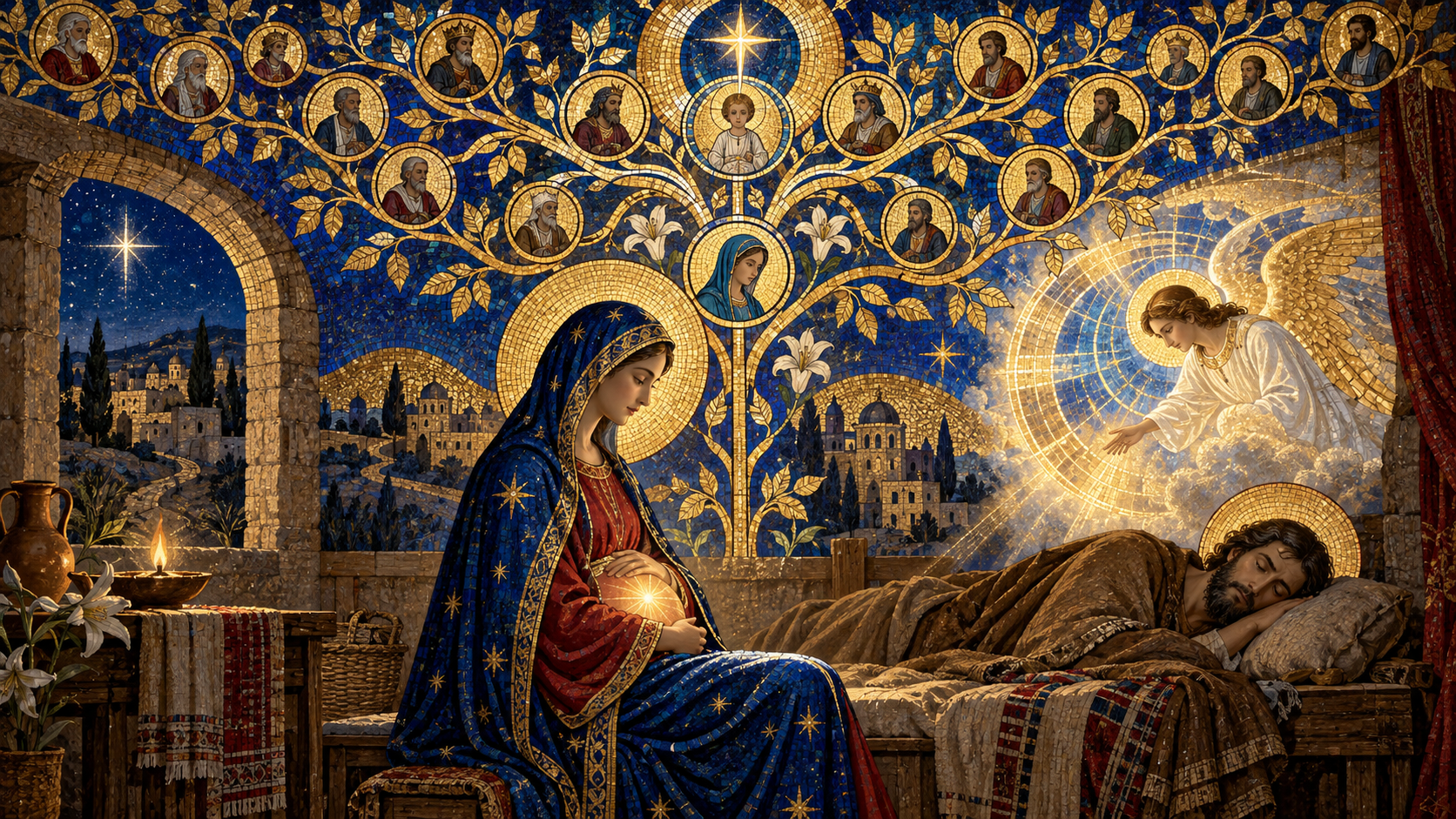
Matthew 1:1–16, 18–23
Today’s interpretive key
The long history of promise reaches fulfillment when the eternal Son takes flesh from the Virgin Mary and comes to save his people from their sins.
Matthew begins the Gospel with names. The succession may appear quiet beside the angelic dream, yet the Fathers hear divine fidelity moving through faith, failure, kingship, exile, and return. Abraham and David stand near the beginning because each received a promise fulfilled in Christ. Women from unexpected histories enter the line, showing that the Savior does not disdain a wounded human inheritance: he comes to redeem sinners and gather the nations. The genealogy is not a display of human purity but a testimony that grace works patiently within real history. Its wording changes decisively at Mary. Joseph is named her husband, but Jesus is born of her; the repeated pattern of human generation yields to a conception from the Holy Spirit. On the feast of Mary's nativity, this Gospel locates her within Israel's hope and reveals the singular vocation toward which her birth was ordered. Joseph, faced with a mystery he cannot explain, joins justice to mercy. He refuses public accusation, reflects in silence, and receives light from God. The angel gives the child two names that interpret the passage. Jesus is the Savior who delivers his people from sin, and Emmanuel is God with us. The promised descendant is not merely another link in the line. In Mary's son, God enters the lineage himself, assumes our humanity without ceasing to be God, and makes the history of promise his dwelling place.
Douay-AI, modernized from the public-domain Douay-Rheims Bible. View source ↗
The book of the generation of Jesus Christ, the son of David, the son of Abraham.
Abraham became the father of Isaac; Isaac became the father of Jacob; and Jacob became the father of Judas and his brothers.
Chrysostom observes that Matthew names Isaac rather than Ismael and Jacob rather than Esau because he is tracing the line through which Christ comes to David. Yet when he reaches Judas, he includes the brothers as well. The twelve patriarchs did not share one outward dignity or one maternal condition, but all became heads of Israel's tribes. Their inclusion checks the vanity that boasts in noble blood. The genealogy honors God's election without turning ancestry into personal merit. It follows a promise whose fulfillment depends on God's fidelity across generations.
Judas became the father of Phares and Zara by Thamar; Phares became the father of Esron; and Esron became the father of Aram.
Jerome draws attention to Thamar's unexpected presence. Matthew does not construct a polished ancestry composed only of figures whose histories appear honorable. He names persons associated with grave disorder so that the genealogy itself begins to proclaim the Incarnation's purpose. The Savior is not contaminated by the wounds he comes to heal; by truly entering human descent he shows that sinners are not beyond his mercy. No inherited shame can prevent virtue or defeat God's promise. The line moves through damaged lives toward Christ, who assumes our nature to put away its sin.
Aram became the father of Aminadab; Aminadab became the father of Naasson; and Naasson became the father of Salmon.
Rabanus receives these names not as empty links but as figures directing attention toward Christ. He associates Aram with being chosen, Aminadab with willingness, and Naasson with knowledge embracing past, present, and future. These qualities find their fullness in the Lord who is chosen for the Father's saving work, offers himself freely, and knows the people he comes to redeem. The historical succession remains real, yet its placement in the Gospel gives it a Christward horizon. Across quiet generations, providence carries forward the line from which the willing Savior will arise.
Salmon became the father of Booz by Rahab; Booz became the father of Obed by Ruth; and Obed became the father of Jesse.
Pseudo-Chrysostom sees Rahab and Ruth entering the genealogy through faith. Rahab sheltered Israel's spies, and Ruth left the gods of her ancestors to choose the living God and Israel's people. Their former distance does not exclude them from the line leading to David and Christ. Grace creates a true belonging deeper than ethnic pride. Their names also anticipate the gathering of the Gentiles into the Church. Matthew's family record bears witness that God's promise moves outward: those who entrust themselves to him are received, and their fidelity becomes fruitful within salvation history.
Jesse became the father of David the king. David the king became the father of Solomon by her who had been the wife of Urias.
Chrysostom notes the deliberate reminder of David's adultery in the phrase concerning the wife of Urias. The evangelist honors David's kingship without hiding his fall. If even Israel's great figures could not fulfill the law by their own strength, their descendants cannot boast as though ancestry made redemption unnecessary. The genealogy exposes universal need while preserving the promise entrusted to David. Christ does not arrive because his forebears achieved unbroken righteousness. He comes because all have sinned, and because God's faithful mercy can bring the promised king through a history requiring forgiveness.
Solomon became the father of Roboam; Roboam became the father of Abia; and Abia became the father of Asa.
Remigius draws spiritual meanings from the names in this royal succession. Solomon signifies the peaceful one, directing the reader to Christ who is our peace. Abia suggests the Lord and Father, while Asa evokes lifting up or taking away, fulfilled by the Lamb who takes away the world's sin. These associations do not erase the ancestors' histories. They show how Matthew's ordered line trains Christian memory to seek its completion in Jesus. Kings pass their inheritance onward, but qualities only signified in their names become saving realities in the everlasting King descended from them.
Asa became the father of Josaphat; Josaphat became the father of Joram; and Joram became the father of Ozias.
Remigius interprets Josaphat as judging, Joram as exalted, and Ozias as the Lord's strength. Together they turn the royal list toward Christ, to whom the Father commits judgment, who descends from heaven and ascends, and whose strength accomplishes salvation. The ancestors remain finite and their reigns pass away; their names become verbal signposts toward the king whose authority does not fail. Reading the genealogy this way keeps it from becoming a bare catalogue. Each generation carries the promise until judgment, exaltation, and divine power are united without defect in Mary's son.
Ozias became the father of Joatham; Joatham became the father of Achaz; and Achaz became the father of Ezechias.
Rabanus associates Joatham with what is completed or perfected and Achaz with embracing. These meanings find their true measure in Christ, the fulfillment of the law, and the Son whose knowledge of the Father is unique. The genealogy's kings often fell short of meanings attached to their names, but God's promise did not fail with their weakness. The line continues toward the one in whom obedience and communion with the Father are complete. Matthew's succession invites hope: human bearers of the promise are partial, but the promised Son perfectly embodies what they could only foreshadow.
Ezechias became the father of Manasses; Manasses became the father of Amon; and Amon became the father of Josias.
Remigius links Ezechias with the Lord's strength and consolation, Manasses with forgetting, Amon with faithfulness, and Josias with the Lord's salvation. He applies the sequence to Christ, who tells his disciples to take courage, promises not to remember forgiven sins, is faithful in every word, and gives lasting salvation. The actual reigns include deep contrasts of fidelity and wickedness, sharpening the point: God's purpose survives unstable human rule. The names can proclaim virtues their bearers possessed imperfectly or betrayed, while directing faith toward the Son in whom every promise is secure.
Josias became the father of Jechonias and his brothers at the time of the transmigration to Babylon.
Ambrose regards the mention of Babylonian captivity as a revelation of abundant mercy. The Lord did not seek the appearance of an unblemished human pedigree; he chose to be born among people who knew sin, defeat, and exile because his mission is liberation and forgiveness. Captivity becomes part of the written road to the Savior. The promise to David is not canceled when the throne collapses or the people are carried away. By entering this lineage, Christ identifies with those needing release and proves that God's kingship can arise after every earthly sign of royal security has failed.
After the transmigration to Babylon, Jechonias became the father of Salathiel; and Salathiel became the father of Zorobabel.
Pseudo-Chrysostom reflects on the generations after deportation by drawing hope from their names. Salathiel is associated with petition to God, fitting a people who must pray while afflicted in captivity. Zorobabel is connected with Babylon and Israel's return to its land, a movement in which truth proves stronger than worldly claims. The genealogy does not leap over exile as wasted time. Prayer, endurance, and restoration belong to the path by which the promise advances. Even when the royal family lives as private persons, providence preserves the line and prepares a greater deliverance in Christ.
Zorobabel became the father of Abiud; Abiud became the father of Eliacim; and Eliacim became the father of Azor.
Remigius interprets Abiud as a confession of the Father, Eliacim as God who raises again, and Azor as one who is aided. The sequence points toward Christ, who is one with the Father, promises resurrection on the last day, and lives his mission in unbroken communion with the one who sent him. These generations are scarcely visible in the larger biblical narrative, yet Matthew preserves their names. Hiddenness does not mean abandonment. Through lives mostly unknown to us, God carries forward the human descent of the one who will reveal the Father and raise the dead.
Azor became the father of Sadoc; Sadoc became the father of Achim; and Achim became the father of Eliud.
Remigius associates Sadoc with the just one, Achim with the words “he is my brother,” and Eliud with the confession “he is my God.” He sees these meanings fulfilled in Jesus: the righteous one suffers for the unrighteous, calls those who do the Father's will his brothers, and receives Thomas's confession of Lord and God. Thus an obscure stretch of ancestry speaks of the communion salvation creates. Christ does not merely conclude a family register. The just Son enters it so sinners may be reconciled, received into his kinship, and brought to faith in his divinity.
Eliud became the father of Eleazar; Eleazar became the father of Mathan; and Mathan became the father of Jacob.
Rabanus reads the genealogy's closing movement as a pattern of spiritual growth. Eleazar signifies recognition that God is our helper; Mathan points to the gift and giver; Jacob recalls the struggle in which vice is overcome. Such a person learns to rely on grace, receives every good from God, and perseveres toward increased virtue. Matthew's historical line approaches Joseph through these names, but Rabanus also makes it a path for the reader. Christ's coming calls forth dependence, gratitude, and combat against sin, because the promised gift is meant to transform those who receive him.
Jacob became the father of Joseph, the husband of Mary, of whom was born Jesus, who is called Christ.
Chrysostom explains that the genealogy reaches Joseph and calls him Mary's husband because the line has been traced for her sake. Matthew does not say Joseph fathered Jesus. The repeated formula changes: Jesus is born of Mary, and Joseph's true place is within their lawful marriage and the Davidic household. This protects both the reality of Christ's human descent and the virginity of his conception. The title Christ gathers the kingly and priestly hope carried through the preceding names. Mary's son belongs truly to Israel's history while entering it through a birth unlike every preceding generation.
Now the generation of Christ was in this way: when his mother Mary was betrothed to Joseph, before they came together, she was found with child by the Holy Spirit.
Cyril safeguards the mystery named in this verse. The Word did not begin to exist in Mary; he is eternally born of the Father. In these last times, however, he truly united human flesh and a rational soul to himself and was born from a woman according to that humanity. Mary did not bear a separate ordinary man later joined to God. She bore the one incarnate Word and is rightly confessed as Mother of God. Conception by the Holy Spirit preserves both truths: Christ's full humanity comes from Mary, and his personal identity is the eternal Son.
Joseph her husband, being a just man and unwilling publicly to expose her, intended to put her away privately.
Chrysostom says “just” means more than strict freedom from wrongdoing; it describes a person broadly formed by virtue. Joseph faces circumstances he cannot reconcile with what he knows, yet his response remains merciful. He will not expose Mary to public disgrace or the law's severest penalty. Before Christ is visibly born, the light of his coming already appears in this union of justice and compassion. Joseph neither calls evil good nor uses uncertainty as permission for cruelty. His intended privacy shows a heart concerned for Mary's protection even while he believes he must withdraw.
But while he considered these things, behold, an angel of the Lord appeared to him in sleep, saying: “Joseph, son of David, do not fear to take Mary your wife, for that which is conceived in her is of the Holy Spirit.
Chrysostom notes that the angel repeats what Joseph kept within himself, giving him a sign that the messenger comes from God, who alone knows the heart's secrets. The revelation does more than calm him. It vindicates Mary, declares the conception supernatural, and entrusts Joseph with remaining beside her. Addressing him as son of David recalls the promise that Christ would come from David's house. Joseph's merciful hesitation becomes the setting for divine instruction: because he has not rushed to condemn, he receives the truth that transforms suspicion into guardianship and fear into joy.
She shall bring forth a son, and you shall call his name JESUS, for he shall save his people from their sins.”
Jerome directs attention to the meaning of the name sent from heaven. Jesus is not an arbitrary designation but the announcement that this child is Savior. His deliverance reaches deeper than release from visible enemies or political danger: he saves his people from their sins. The possessive phrase also reveals his authority. The people belong to him, and the work attributed to him is the divine work of forgiving and rescuing from sin. Joseph is commanded to pronounce the name, accepting his guardian's role, while the name proclaims that Mary's son bears an identity and mission established by God.
Now all this was done so that what the Lord spoke by the prophet might be fulfilled, saying:
Chrysostom hears enormous depth in Matthew's phrase “all this.” Natural expectation is surpassed, reconciliation begins, and the one above all humbles himself to enter human life. Yet Joseph must not imagine that God devised the mystery only in response to present circumstances. The prophetic word shows that it was determined long before. The angel therefore points Joseph, a son of David familiar with the prophets, back to Scripture. Fulfillment joins the new wonder to God's ancient fidelity. What happens in Mary is unprecedented in manner, but it is not disconnected from the promise patiently carried through Israel's history.
“Behold, a virgin shall be with child and bring forth a son, and they shall call his name Emmanuel,” which, being interpreted, is “God with us.”
Remigius finds both of Christ's natures proclaimed in Emmanuel. The one eternally born of the Father enters time through a Virgin Mother and joins our frail human substance to his divine person. “God with us” means more than divine assistance from a distance. The Son becomes like us in a passible and mortal humanity, though without sin, while remaining truly God. The name interprets the whole genealogy and conception. Jesus belongs within our history and can suffer for us because he is man; his saving presence is God's own presence because Mary's son is the eternal Son.
The genealogy refuses despair over a broken past and pride in an honored one. Matthew names saints and sinners, foreigners and kings, fidelity and captivity, because the Son of God comes into history as it exists. Grace neither denies that history nor becomes imprisoned by it. The Fathers turn the names toward Christ, seeing every promise, deliverance, and longing gathered into him. Yet the final movement is new. Joseph belongs within David's house, and Mary truly gives the Savior his humanity, but the child's origin is the Holy Spirit. He is from us without being merely one more product of us. Joseph's justice is merciful before he understands, patient while he considers, and obedient when God speaks. He does not force the mystery into his first interpretation. He makes room for revelation and accepts the guardianship entrusted to him. Mary's hidden vocation is protected within ordinary forms even as God performs within her Isaiah's unique wonder. Jesus comes to save his people from their sins. Emmanuel does not merely send help from afar; he is God with us. Let the genealogy teach patience with providence, Joseph teach merciful discernment, and Mary's feast awaken gratitude for the life prepared to welcome Life himself. No inheritance is beyond redemption, no exile defeats the promise, and no faithful yes is too hidden to become a dwelling place for God's saving presence.
Read the source Catena Aurea ↗
Chrysostom urges the reader not to treat the genealogy as a minor preface. Its wonder is that the eternal Son truly enters human descent, accepting David and Abraham as ancestors according to the flesh. Both men received promises concerning the Messiah: royal fulfillment through David and blessing for all nations through Abraham. Matthew names them together to show that Jesus gathers those promises into one person. The title announces continuity and astonishing newness. The one whose human generation is recorded is Christ, in whom God has become man and from whom every saving blessing proceeds.