19:23
Then Jesus said to his disciples, “Amen, I say to you, a rich man will enter the kingdom of heaven only with difficulty.”
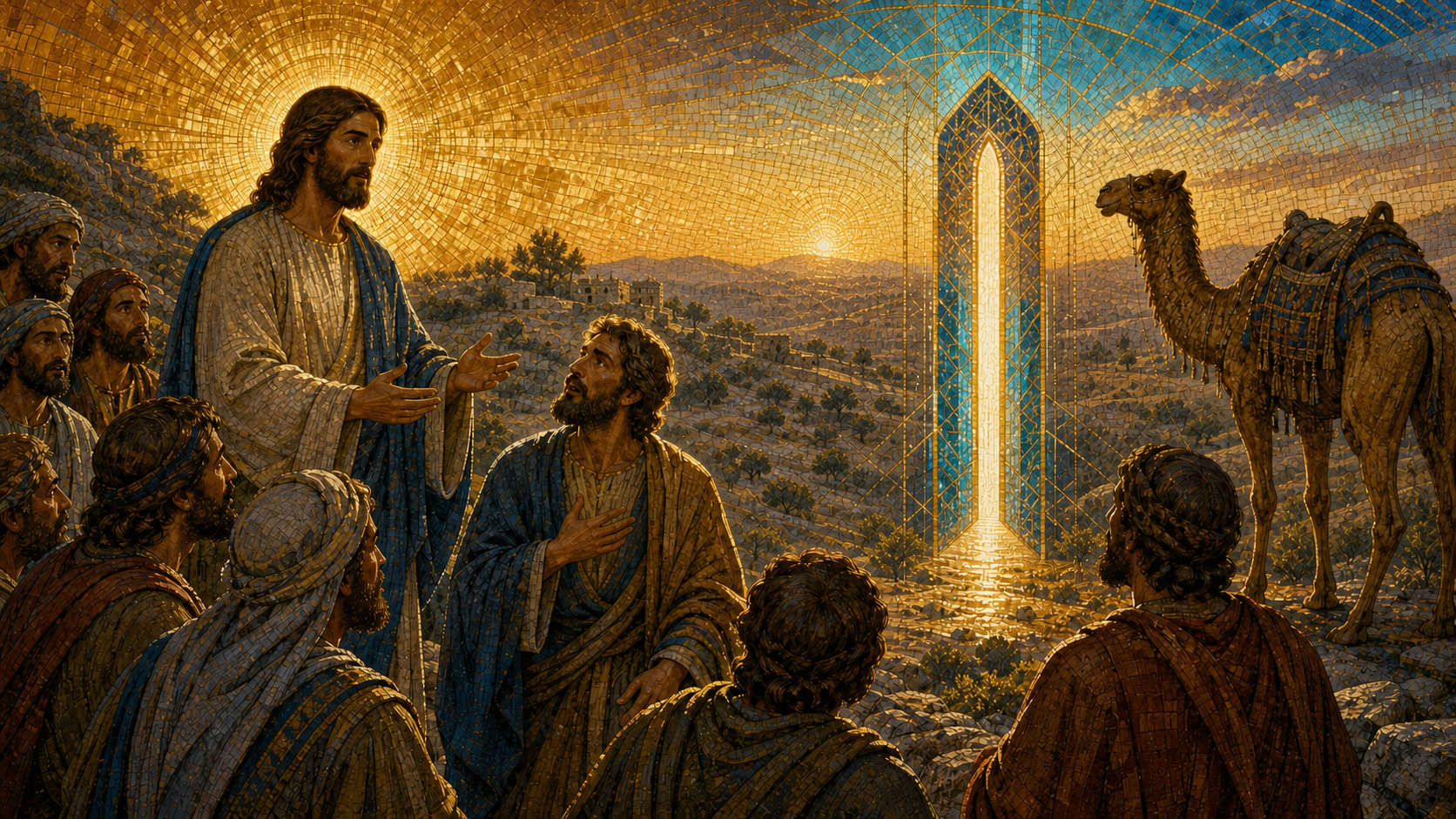
Matthew 19:23–30
Today’s interpretive key
Jesus exposes the grip of riches without declaring anyone beyond grace. What possession cannot release and human effort cannot achieve, God can transform; those who follow Christ receive a kingdom whose order overturns every worldly measure.
A wealthy young man has just walked away sorrowful because his possessions hold him more firmly than he can hold them. Jesus turns to the disciples and names the danger without softening it. Riches can train the heart to trust what it can count, guard, and control, until dependence on God feels like loss. The disciples hear more than a warning aimed at a privileged few. They recognize the universal reach of attachment and ask the question beneath every spiritual struggle: who, then, can be saved? Jesus does not offer a technique for squeezing human achievement through a narrow opening. He looks at them and places hope wholly in God, for whom the impossible is possible. Peter then speaks for those who have left their ordinary securities to follow Christ. The answer does not turn sacrifice into a commercial bargain. It promises communion with the Son of Man, a share in his renewed creation, a new family gathered around his name, and everlasting life. Yet the final reversal keeps discipleship free from entitlement: first may become last, and last first. Grace does not confirm the rankings we bring to it. It frees us to follow the King through the gate we could never open for ourselves.
Douay-AI, modernized from the public-domain Douay-Rheims Bible. View source ↗
Then Jesus said to his disciples, “Amen, I say to you, a rich man will enter the kingdom of heaven only with difficulty.”
And again I say to you: it is easier for a camel to pass through the eye of a needle than for a rich man to enter the kingdom of heaven.
Gregory reads the rich man spiritually as anyone swollen with pride and the burdened camel as an image brought low. Christ himself passes through the narrowness of suffering and death in perfect humility, opening the pattern his disciples must follow. The comparison is intentionally overwhelming: a heart stiffened by self-sufficiency cannot force its own entrance into life. Yet the camel’s burden also suggests what grace can remove. The saying summons the attached person not to despair, but to bend, be unburdened, and receive from the humble Redeemer the form of a new life.
When they heard this, the disciples wondered greatly, saying, “Who then can be saved?”
Chrysostom notices that the disciples are not defending their own wealth; they have little to lose. Their alarm reaches beyond themselves toward everyone endangered by attachment, revealing the beginnings of a teacher’s compassionate heart. Augustine adds that the warning includes not only the few who are rich, but also the many who long to become rich and place their imagination there. The question “Who can be saved?” is therefore honest rather than theatrical. It recognizes that covetousness can inhabit poverty as well as abundance and that no social condition, by itself, makes the heart free.
Jesus looked at them and said, “With men this is impossible, but with God all things are possible.”
Chrysostom lingers over Christ’s look: Jesus first soothes the disciples’ troubled souls with his merciful gaze, then names the source of hope. Much grace is needed to guide a person amid riches, and what unaided effort cannot accomplish God can do. Remigius carefully explains that this does not mean God ushers covetousness and pride unchanged into the kingdom. God makes the impossible possible by converting the person, loosening false trust, and leading the renewed heart into life. Divine possibility awakens prayer and effort; it does not excuse passivity before the very attachments grace intends to heal.
Then Peter answered and said to him, “Behold, we have left all things and followed you. What then shall we have?”
Origen says Peter speaks confidently because, although the apostles left possessions of little market value, they surrendered them with a love that would have relinquished greater things as readily. God considers the will and fullness of the gift, not merely its price. Chrysostom sees Peter asking on behalf of every poor person who might fear that perfection belongs only to those with fortunes to give away. Jerome then supplies the decisive condition: leaving is not enough; Peter also says, “we have followed you.” Christian renunciation receives its meaning from attachment to Christ, not from deprivation treated as an achievement.
Jesus said to them, “Amen, I say to you: you who have followed me, in the regeneration, when the Son of Man shall sit upon the throne of his majesty, you also shall sit upon twelve thrones, judging the twelve tribes of Israel.
Augustine understands the regeneration as the resurrection, when the body is renewed in incorruption as the soul is renewed now by faith. He also cautions against restricting the promise to exactly twelve judges. The number twelve signifies the complete company that will judge with Christ; otherwise Paul, who labored abundantly as an apostle, would be strangely excluded. The apostles’ thrones therefore express participation in the Son of Man’s victorious truth, not independent authority beside him. Those who follow the humbled Christ will share his glory when all disguises fall away and faithful witness exposes unbelief for what it was.
And everyone who has left house, or brothers, or sisters, or father, or mother, or wife, or children, or lands for my name’s sake, shall receive a hundredfold and shall possess everlasting life.
Jerome rejects a carnal accounting in which every relinquished thing is simply returned in bulk. He understands the promise spiritually: what is surrendered for the Savior is answered by gifts whose value exceeds the former goods as a hundred exceeds one. Origen points to the new kinship of faith—brothers and sisters in the Church, spiritual fathers, and children formed in Christ—together with the repose of God’s city. Chrysostom also insists that leaving a wife does not authorize breaking the marriage bond; fidelity to Christ must take precedence when persecution pressures a believer toward apostasy. The promise culminates in everlasting life.
And many who are first shall be last, and the last shall be first.”
Origen hears both warning and encouragement. Those long formed in the faith must not presume that ancestry, education, or office makes them secure, while latecomers should hasten without imagining that time has locked them behind everyone else. He also sees Israel and the Gentiles within the reversal, yet carefully notes that Jesus says “many,” not all: the saying is not a mechanical exchange of entire groups. Remigius applies it directly to the encounter. The rich young man seemed first because of his commandments, but attachment pulled him back; the poor apostles seemed last, yet humility and faithful following brought them forward by grace.
The Fathers refuse two easy distortions of this Gospel. They do not condemn created goods as evil, and they do not reduce Jesus’ warning to a harmless metaphor. Saint John Chrysostom distinguishes possession from enslavement: the danger lies in a heart that builds its hope upon riches. Saint Jerome therefore hears difficulty rather than fatalism, while Saint Gregory sees the proud soul bent beneath a load it cannot carry through the narrow way. The disciples’ alarm is itself charitable, because they are already concerned for the salvation of others. Christ meets that alarm with a look of mercy and a promise of divine action. Conversion is not the rich person’s private feat; God can make the burdened heart free. Peter’s question then reveals that the value of renunciation is measured by love, not by the market price of what was left. Nets can be a total gift when they are a person’s all. Still, leaving something is incomplete unless it becomes following Christ. The hundredfold is not a ledger of replacements but life enlarged within the communion of faith and completed in eternity. Ask today what you are trusting to secure the life only God can give. Then place even your inability to let go within his possibility. The narrow gate is not widened by denial; the heart is made small, humble, and free enough to pass by grace.
Read the source Catena Aurea ↗
Chrysostom explains that Christ is not attacking riches considered in themselves, but those who become their slaves. The warning also strengthens the poor disciples: lack of wealth is no cause for shame when freedom for the kingdom is the greater treasure. Jerome adds that Jesus says entry is difficult, not absolutely impossible. Possessions already acquired can cling more tightly than possessions merely desired, making surrender feel like the loss of part of oneself. The verse therefore examines where hope rests and whether wealth remains a servant or has quietly become a master.