24
He proposed another parable to them, saying: The kingdom of heaven is like a man who sowed good seed in his field.
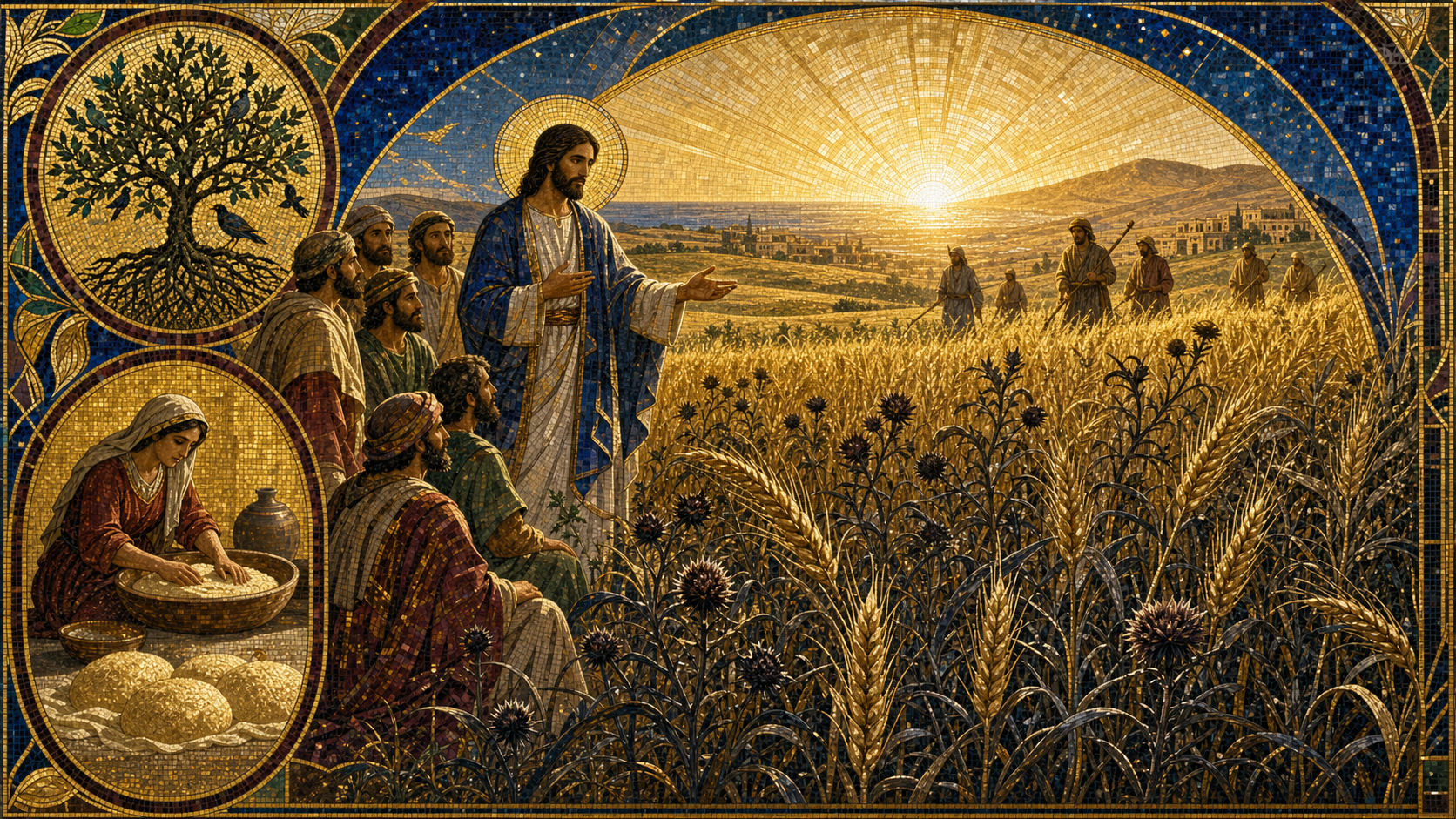
Matthew 13:24–43
Today’s interpretive key
Christ teaches patience amid the mingling of good and evil, confidence in the hidden growth of his kingdom, and hope in God’s final, just harvest.
The kingdom grows in a field where wheat and cockle stand side by side. Christ forbids the servants’ impatient uprooting, not because evil is harmless, but because judgment belongs to the Lord who sees every root. The mustard seed and leaven reveal the same kingdom quietly spreading; the final explanation promises that hidden fidelity will one day shine.
Douay-AI · modernized from the public-domain Douay-Rheims Bible
He proposed another parable to them, saying: The kingdom of heaven is like a man who sowed good seed in his field.
But while men were asleep, his enemy came and oversowed cockle among the wheat, and went away.
Chrysostom sees the enemy’s malice in both his timing and his method. He does not simply destroy the field openly; he sows something that resembles the wheat and hides his work until growth reveals it. Error often follows truth in this parasitic way, borrowing Christian language while bending its meaning. The sleeping servants signify negligence among those charged with watchfulness, not ordinary bodily rest. Christ’s warning is therefore sober: shepherds and disciples must remain attentive, because deception prefers disguise and quietly enters where care for the apostolic seed has grown drowsy.
When the blade had sprung up and brought forth fruit, the cockle also appeared.
Chrysostom notes that the enemy’s counterfeit is not immediately obvious. Only when the wheat begins to bear fruit does the cockle become clearly distinguishable. Christ thereby directs judgment away from hurried impressions and toward what a teaching or life actually produces. The delay is uncomfortable, yet it protects against mistaking the immature for the false. Genuine doctrine ripens into holiness, charity, and confession of Christ; corruption eventually displays another character. Discernment must therefore be patient enough to observe fruit while remaining alert enough to name evil once its nature is truly manifest.
The servants of the master of the house came and said to him: Sir, did you not sow good seed in your field? Where, then, did the cockle come from?
Augustine reads the servants’ question as a confession that the field belongs to a good master. They know what he planted and therefore understand that the corruption cannot have come from him. Their perplexity resembles the believer’s question before evil: if God is good, whence comes this destructive growth? The parable refuses to make God its author. At the same time, the servants do not take independent control of the field; they seek the master’s knowledge. Christian discernment likewise begins in prayerful dependence, bringing scandal before God instead of turning confusion into accusation or reckless action.
He said to them: An enemy has done this. The servants said to him: Do you want us to go and gather it up?
Chrysostom emphasizes that the master immediately identifies the malicious source, yet the servants still await his command. Their eagerness to cleanse the field may appear admirable, but zeal without the Lord’s measure can become destructive. Christ neither excuses the cockle nor leaves his disciples unable to distinguish it; he governs the response. The verse teaches an essential discipline for the Church: truth must name what opposes the Gospel, while charity and obedience determine how persons are treated. A righteous diagnosis is not permission for anger to appoint itself judge, reaper, and final tribunal.
He said: No, lest perhaps while gathering up the cockle, you root up the wheat together with it.
Jerome explains that immediate uprooting is forbidden because judgment in the present age is dangerously entangled with uncertainty. What appears wholly corrupt may later receive the word and become fruitful, while harsh attempts at purification may scandalize or destroy those still growing in faith. The command is not doctrinal indifference: the Church must distinguish wheat from cockle and resist false teaching. Yet coercive finality belongs to God alone. Christ’s patience leaves room for conversion and guards the little ones whose roots may be intertwined with persons we would too readily discard beyond hope.
Let both grow until the harvest; and at harvest time I will say to the reapers: Gather up the cockle first and bind it into bundles to burn, but gather the wheat into my barn.
Rabanus gathers the whole parable into a school of virtue. Good seed calls forth good will; the enemy’s intrusion demands vigilance; the master’s restraint teaches patience and discretion; the long growing season forms endurance; and the harvest reveals justice. Waiting is therefore not surrender to evil but obedience to God’s timing. The same Lord who forbids premature uprooting promises a true separation at the end. Believers can refuse both despair and vengeance because the field is not abandoned. Christ will preserve the wheat, expose every counterfeit, and bring his own safely into the barn.
He proposed another parable to them, saying: The kingdom of heaven is like a mustard seed which a man took and sowed in his field.
Jerome identifies the mustard seed with Gospel preaching and the knowledge of Scripture that leads to life. Its first appearance is humble: Christ crucified, poor disciples, and a proclamation lacking the polish by which worldly systems advertise themselves. Yet the seed carries a strength no surface comparison can measure. Sown by the Saviour in believers, or received by the mind within its own field, it rises through faith. The parable consoles disciples tempted to judge the kingdom by immediate size. God’s smallest gift may hold within it a future far exceeding every impressive human beginning.
It is indeed the least of all seeds; but when it has grown, it is greater than all herbs and becomes a tree, so that the birds of the air come and dwell in its branches.
Chrysostom understands the least seed through the apostles, who appeared weaker and less consequential than the powers surrounding them. Nevertheless, the might within the Gospel carried their preaching throughout the world. What began without armies, wealth, or prestige became greater than competing doctrines and offered a dwelling to peoples from every nation. The birds resting in its branches evoke souls lifted from earth and finding refuge in the Church’s teaching. Christ therefore answers fear with growth: apparent weakness does not set the kingdom’s limit, because its mature breadth comes from God rather than the seed’s outward size.
He spoke another parable to them: The kingdom of heaven is like leaven which a woman took and hid in three measures of meal, until the whole was leavened.
Chrysostom says that leaven changes a large quantity of flour into its own condition while itself disappearing within the mixture. So the disciples, though cast among hostile peoples and often hidden by persecution, would gradually transform the world through their preaching. The image joins humility to confidence: the Gospel does not require constant visibility to be effective, and tribulation cannot dissolve the life placed within it. Christ asks his followers not to fear because the kingdom works deeply before it looks impressive. Grace enters ordinary human life and patiently permeates the whole from inside.
All these things Jesus spoke in parables to the multitudes, and without parables he did not speak to them.
Chrysostom observes that Jesus speaks of the kingdom through seeds, fields, birds, and leaven because the crowds need visible realities to lead them toward invisible truth. The method is merciful accommodation, not theatrical obscurity. Everyday creation becomes a doorway into doctrine, allowing simple hearers to retain an image and return to its meaning. Yet the parable also asks something from its audience: attention, humility, and willingness to seek. Christ does not reduce mystery to a slogan. He places truth near enough to invite everyone while ensuring that understanding grows in those who truly desire to hear.
So that what was spoken by the prophet might be fulfilled: I will open my mouth in parables; I will utter things hidden from the foundation of the world.
Jerome sees the evangelist answering anyone who might regard Christ’s parabolic teaching as novelty without roots. The prophet had already foretold that divine mysteries would be voiced through figures. Jesus now opens what had lain hidden from the world’s foundation, revealing the kingdom’s pattern in created things. Seed, harvest, tree, and leaven were always capable of serving this disclosure because creation itself comes from the Word. The verse therefore strengthens confidence in Christ as fulfiller of Scripture: his teaching is new in manifestation, yet continuous with the single purpose God prepared and announced from ancient days.
Then, having dismissed the multitudes, he went into the house. His disciples came to him, saying: Explain to us the parable of the cockle in the field.
Chrysostom praises the disciples’ manner of learning. Earlier they hesitated, but Christ’s assurance that the mysteries of the kingdom were given to them makes their question confident. They wait until the crowd is dismissed and ask about the difficult parable rather than the mustard seed and leaven, whose meaning seems plainer. Discipleship therefore includes honest incomprehension brought directly to the Teacher. Intimacy with Jesus does not eliminate questions; it gives them their proper home. Those who remain with him after the public word receive deeper explanation and learn to distinguish mystery from mere confusion.
He answered and said to them: He who sows the good seed is the Son of Man.
Remigius notes that Christ calls himself the Son of Man while claiming the divine work of sowing the kingdom. The title protects the truth of his real humanity and offers humility as the pattern for those who teach in his name. Yet the field and seed belong to him with sovereign authority; the lowly sower is also Lord of the harvest. The verse joins Christology to discipleship: we ascend toward knowledge of his divinity through faithful confession of the humanity he assumed. Every child of the kingdom begins in the action of this one Sower.
The field is the world. The good seed are the children of the kingdom; and the cockle are the children of the wicked one.
Chrysostom stresses that the Son of Man sows in his own field; the world is not the devil’s rightful possession. Good seed now signifies persons formed by Christ’s word, while cockle signifies those who have yielded themselves to the enemy’s falsehood. The language describes spiritual parentage by resemblance and obedience, not a denial of human freedom or the possibility of repentance. Each life grows from a received word and eventually bears its character. Because the field remains Christ’s, believers need not surrender it to darkness, even while honestly recognizing the mixed growth present until the harvest.
The enemy who sowed them is the devil. The harvest is the end of the world, and the reapers are the angels.
Chrysostom follows Christ’s own interpretation rather than turning every detail into private invention. The devil is the enemy, not a rival creator; the world moves toward an end, not an endless cycle; and the angels carry out the judgment under divine command. This clarity steadies the Church between superstition and complacency. Evil is purposeful but not sovereign, and history is morally serious without escaping God’s rule. The servants were forbidden to perform the final separation because heaven already has appointed reapers. Judgment will be neither forgotten nor entrusted to our limited sight.
Just as cockle is gathered up and burned with fire, so shall it be at the end of the world.
Chrysostom reads the comparison as Christ’s solemn confirmation that the mixed condition of the present world is temporary. The master’s patience cannot be used to argue that good and evil are ultimately the same or that choices bear no consequence. The end reveals their difference completely. Yet this warning is given now, while repentance remains possible, so that fear may become conversion rather than despair. Christians receive the verse neither as permission to condemn particular souls nor as imagery to relish. It calls each hearer to examine what is growing within before the harvest arrives.
The Son of Man shall send his angels, and they shall gather out of his kingdom all scandals and those who work iniquity.
Chrysostom draws attention again to the authority of the Son of Man. The angels are sent by him, showing that final judgment belongs to Christ and is executed without the ignorance that marks human tribunals. Scandals include what ensnares others and turns them from fidelity; workers of iniquity are those who make evil their practice. Nothing hidden beneath religious appearance will remain concealed. For disciples, the verse is both warning and consolation: avoid becoming an obstacle to another soul, and trust that Christ can cleanse his kingdom without destroying any goodness planted by his hand.
They shall cast them into the furnace of fire; there shall be weeping and gnashing of teeth.
Chrysostom refuses to soften Christ’s conclusion into a consequence without real anguish. Weeping expresses the misery of loss, while gnashing of teeth conveys the bitterness of a will fixed against the good. The image is terrible precisely because the kingdom offered communion and joy. Yet Christ tells it within the season of growth, before the angels reap, making the warning an act of pastoral urgency. The Church does not speculate about named persons or delight in punishment. She hears the verse as a summons to repentance, intercession, and serious care for every soul.
Then the just shall shine like the sun in the kingdom of their Father. Whoever has ears to hear, let him hear.
Chrysostom points to the splendour reserved for the righteous after the field’s long confusion. Wheat that seemed ordinary, threatened, or obscured by cockle will shine with a brightness compared to the sun, not through self-made glory but within the kingdom of their Father. Christ’s final appeal shows that this promise demands more than physical hearing. The listener must receive, ponder, and obey. Hope in future radiance strengthens present patience without making it passive: the children of the kingdom are to bear true fruit now, trusting the Father to reveal its full beauty at the harvest.
The Church does not deny the presence of evil, nor does she confuse patience with indifference. She waits because Christ alone knows every heart and because grace can still turn what appears barren into living grain. Meanwhile the Gospel works like mustard seed and leaven: small, hidden, and stronger than appearances. At the harvest, every falsehood will be uncovered without harming one seed the Father has planted. Until then, disciples are called to vigilance without panic, truth without cruelty, and hope without illusion.
Read the source Catena Aurea ↗
Chrysostom distinguishes this parable from the sower who scattered seed on several kinds of ground. Here the field has received good seed, and the later corruption comes from another hand. The Lord therefore teaches that falsehood is not native to his Gospel and that evil cannot claim equal authorship with good. God plants what gives life; the enemy imitates and corrupts. Christian vigilance begins by trusting the Sower’s intention and recognizing that every genuine growth of faith comes from the seed he has deliberately placed within his field.