01
At that time Jesus passed through the grainfields on the Sabbath. His disciples were hungry and began to pluck heads of grain and eat them.
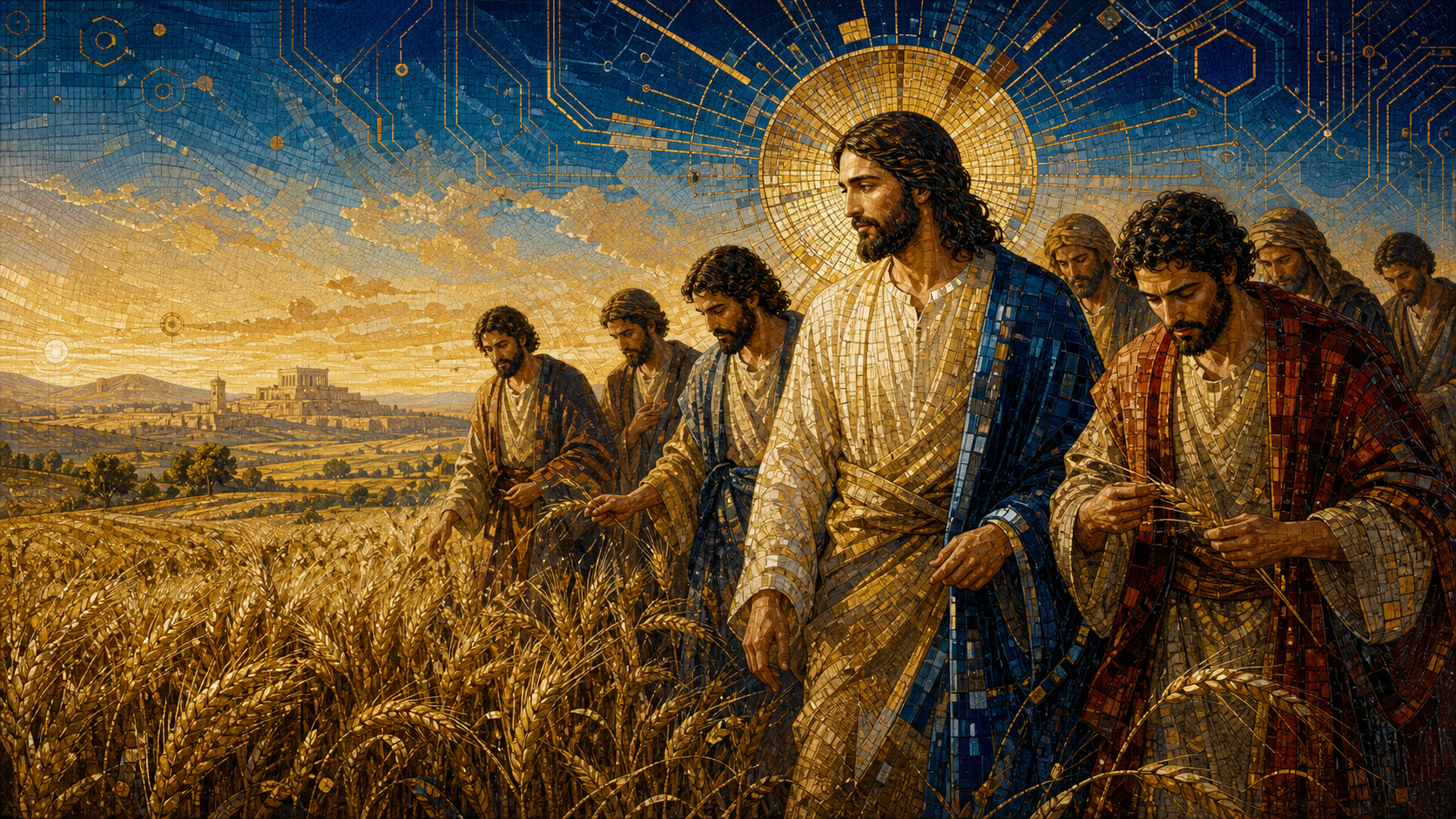
Matthew 12:1–8
Today’s interpretive key
The Sabbath was never meant to make compassion illegal.
Jesus does more than settle a dispute about handfuls of grain. He reveals how every commandment must be read: in the presence of its divine Lawgiver, and toward the life and healing of the human person.
Douay-AI · modernized from the public-domain Douay-Rheims Bible
At that time Jesus passed through the grainfields on the Sabbath. His disciples were hungry and began to pluck heads of grain and eat them.
When the Pharisees saw this, they said to him, ‘Look, your disciples are doing what is unlawful on the Sabbath.’
The Pharisees accuse the disciples of violating Sabbath rest, not of stealing. Deuteronomy permitted a traveller to pluck enough grain by hand to eat, provided nothing was harvested and carried away. The disciples therefore took only what immediate need required. The charge depends on turning a merciful provision of the law into an offence through an excessively narrow account of work. Their critics can see the motion of the disciples’ hands, but not the hunger those hands are answering.
But he said to them, ‘Have you not read what David did when he and those with him were hungry?’
Jesus recalls David fleeing from Saul and arriving hungry at Nob, where the priest Ahimelech gave him food. David was revered by those accusing the disciples, so his story turns their own scriptural judgment back upon them. If hunger could excuse David and his companions, the same human need cannot suddenly become blameworthy in Christ’s disciples. The point is not that admired people may ignore commandments, but that Scripture itself teaches how commandments must be read when life and ritual restriction meet.
‘He entered the house of God and ate the bread of offering, which neither he nor those with him were permitted to eat, but only the priests.’
Christ chooses an example more serious than picking grain. The bread of the Presence was reserved to priests, yet David and the men with him received it in their distress. Their need did not make holiness irrelevant; it showed what holiness is for. Ahimelech judged that preserving people from hunger was itself an offering acceptable to God. If the stricter boundary around consecrated bread yielded to urgent mercy, rubbing a few heads of grain cannot honestly be condemned.
‘Or have you not read in the Law that on the Sabbath the priests in the Temple break the Sabbath and remain blameless?’
The priests slaughtered offerings, prepared fires, and performed other demanding work in the Temple on the Sabbath, yet the law itself declared them innocent. One divine command was not defeating another. Their work served the worship toward which Sabbath rest was ordered. Jesus therefore exposes the Pharisees’ selective literalism: they accept strenuous Sabbath activity when it fits the Temple system, but condemn a tiny act that answers hunger beside the Lord of the Temple.
‘But I tell you, something greater than the Temple is here.’
Jesus has appealed first to David, a royal figure, and then to the priests serving in the Temple. Together they point beyond themselves to Christ, who is both King and Priest. The disciples stand not merely beside another teacher offering a clever legal opinion, but beside the one to whom kingship, priesthood, Temple, and Sabbath all refer. If Temple service rendered its priests blameless, service in the presence of the Temple’s Lord cannot make his disciples guilty.
‘If you understood what this means, “I desire mercy, not sacrifice,” you would never have condemned the innocent.’
Christ does not merely offer a technical defence. He identifies the spiritual failure beneath the accusation: they have not learned God’s desire for mercy. Sacrifice without mercy can become a religious instrument for condemning the innocent. The disciples need no grudging pardon, because they are blameless. A heart formed by God would have recognized their need before searching for an offence. Mercy is therefore not opposed to faithful worship; it is the disposition that makes worship truthful.
‘For the Son of Man is Lord even of the Sabbath.’
By calling himself the Son of Man, Jesus speaks from the humanity his hearers can see. Yet he claims lordship over the Sabbath, something belonging to God, the Creator who established it. The one they take to be merely human is Lord of every creature and of sacred time itself. His authority is not arbitrary. He can disclose the law’s true purpose because it is his law: rest ordered toward God, liberation from what enslaves, and mercy toward those in need.
Across the Fathers’ comments runs one golden thread: the law is not abolished by mercy but brought to its intended fullness. David’s hunger, the priests’ service, and the disciples’ need all point toward Christ, the true King and Priest. He does not merely interpret the Sabbath from outside it. As its Lord, he discloses the rest for which it was made: freedom from sin, communion with God, and active love of one’s neighbour.
Read the source Catena Aurea ↗
Jesus knowingly led the disciples through the fields on the Sabbath, but he did not oppose the law casually or without reason. Their real hunger supplied the reason. The disciples’ conduct also shows their restraint: they did not abandon Christ to seek comfort or prepare an elaborate meal. Only when hunger pressed them did they take the simplest food at hand. Christ allows this moment to expose the difference between genuine obedience and a use of law that has forgotten the human beings for whom it was given.